
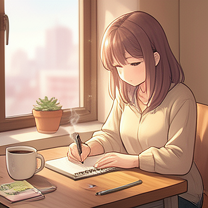
My First Week at “Schmidt & Sohn” – Learning to Describe My Day in German
Okay, deep breath. It’s been a week since I started my job at Schmidt & Sohn, a small printing company in Heidelberg, and honestly, it’s been… a lot. Not just the work itself, but talking about the work. The Germans, you know, they like to be precise. And right now, my German precision is, let’s just say, developing. I’m realizing that just knowing words isn’t enough. I need to actually use them, and more importantly, I need to describe my day in a way that makes sense. This week, I’ve been focusing on the present tense – die Präsens – and how to put things in order, which feels incredibly important.
The Morning Rush – “Guten Morgen” and “Was machen Sie?”
The first few mornings were chaotic. I’d walk in at 8:30, feeling incredibly anxious, and Mr. Schmidt, the owner, would ask, “Guten Morgen, Herr Müller! Was machen Sie?” (Good morning, Mr. Müller! What are you doing?). I’d completely freeze. My brain would short-circuit. I’d blurt out something like, “Ich… ich… arbeite!” (I… I… I work!). It sounded so basic, so… wrong. He’d smile politely and say, “Ja, ja, natürlich. Gut.” (Yes, yes, of course. Good.) but I could tell he was waiting for a little more.
The key, I’m discovering, is to give a bit of context. It’s not enough to just say “I work.” It needs to be, “Ich arbeite am Computer” (I’m working on the computer) or “Ich checke E-Mails” (I’m checking emails). The real problem is, I keep getting the order wrong! I tried to explain yesterday that I was checking emails before printing brochures, and Mr. Schmidt just stared at me. He corrected me patiently – “Nein, Herr Müller, zuerst die E-Mails, dann die Broschüren.” (No, Mr. Müller, first the emails, then the brochures.) It’s a small thing, but it highlights how important sequence is.
Describing My Tasks – Simple Sentences, Simple German
Yesterday was a slightly better day. I had to prepare a file for the new advertising campaign. I started by saying, “Ich lade die Dateien auf den Server hoch” (I upload the files to the server). Then, “Ich erstelle ein neues Dokument” (I create a new document). After that, “Ich füge Bilder hinzu” (I add pictures). I even managed to use “damit” (so that) – “Ich mache das, damit Herr Schmidt die Broschüren drucken kann” (I do that so that Mr. Schmidt can print the brochures).
It felt good to string those sentences together. I repeated them to myself – “lade… erstelle… füge… damit…” – just to get the rhythm down. I noticed that Mr. Schmidt repeated my sentences back to me too, which felt like a tiny bit of encouragement!
Misunderstandings and Corrections – “Ich verstehe nicht”
There have been a few hilarious misunderstandings. I was trying to explain to Frau Schmidt (his wife, who helps with the accounts) that I needed to order more paper and said, “Ich muss Papier bestellen.” (I need to order paper). She looked completely baffled and said, “Aber woher sollen Sie das Papier nehmen?” (But where are you going to get the paper?). It turns out I needed to tell her where I was ordering it from – “Ich muss Papier von Müller Papier bestellen” (I need to order paper from Müller Paper). It’s these little details that throw you! I’ve started carrying a small notebook to jot down phrases I find confusing.
Sequencing – Putting It All in Order
Mr. Schmidt keeps emphasizing the sequence of my tasks, and he’s right. It’s not just about saying what I’m doing; it’s about when I’m doing it. Today, I had to print a large batch of brochures, and I really wanted to avoid the mistake I made yesterday. I carefully said, “Zuerst drucke ich die Broschüren. Dann scanne ich sie ein.” (First, I print the brochures. Then, I scan them). “Danach gebe ich sie Frau Schmidt zur Überprüfung.” (Then, I give them to Mrs. Schmidt for verification.) This methodical approach seems to be appreciated.
Looking Ahead – Building My Vocabulary
I’m starting to build a small vocabulary related to the printing industry – “Layout,” “Raster,” “Farbe” (Layout, grid, color). I’m also learning more about German business etiquette. It seems a lot more formal than what I’m used to. I’m slowly realizing that the more I actively try to describe my day in German, the more comfortable I’m becoming. I still stumble, I still make mistakes, but that’s okay. “Schritt für Schritt” (Step by step), right?
Next week, I’m aiming to actually ask Mr. Schmidt about specific tasks – “Was können Sie mir zeigen?” (What can you show me?). I think that will be a big step forward. Wish me luck!


Leave a Reply