
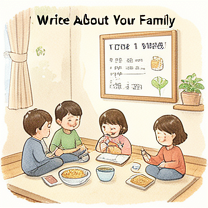
TOPIK 1 Writing: Write About Your Family
So, you’re taking the TOPIK 1 exam and need to write a paragraph about your family? It’s a surprisingly common question. Don’t panic! This guide will break down how to approach it with realistic Korean and give you some practical tips. The goal isn’t perfect grammar, but clear communication.
Understanding the Task
The TOPIK 1 writing task often asks you to describe a familiar situation or topic in simple Korean. “Write About Your Family” is one of these. You’ll typically be given around 30 minutes for this section, and the expected length is roughly 60-80 words.
Key Vocabulary & Phrases
Here’s some useful vocabulary and phrases you’ll need:
- 가족 (gajok): Family
- 부모님 (bumo-nim): Parents
- 형제 (hyeongje): Brothers/Sisters
- 저는 (jeo-neun): I
- ~입니다 (imnida): Formal ending, “is/am/are”
- ~예요 (yeyo): Less formal version of 입니다
- 좋아요 (joayo): Like / It’s good
- 사랑해요 (saranghaeyo): I love you
- 가족사진 (gajok-sinchi): Family photos
- 함께 (hamkke): Together
Example Paragraph – A Realistic Approach
Here’s an example of a TOPIK 1 level response. Notice it’s not perfect, but it’s understandable and conveys the information:
저는 한 가족입니다. 제 부모님은 모두 건강해요. 저에게는 형제가 하나 있어요. 그가 이름은 민수이고, 대학생이에요. 저희 가족은 함께 밥을 먹고 영화를 보는 것을 좋아해요. 사진 찍는 것도 좋아요. 저는 가족을 정말 사랑해요.
(Translation: I am a family of one. My parents are all healthy. I have one brother. His name is Minsoo, and he’s a college student. My family likes to eat together and watch movies. Taking pictures is also good. I really love my family.)
Common Mistakes & Corrections
Let’s look at some common mistakes beginners make and how to fix them:
- Overusing Formal Language (입니다/예요): While correct, using “입니다” every sentence can sound unnatural. Vary your language – sometimes “요” is better for simple statements.
- Incorrect Particle Usage (~는/이/께서): These particles are tricky! Make sure you’re using them correctly to connect nouns. Incorrect usage leads to sentences that don’t quite make sense. For example, instead of “저 는 가족입니다” (I am family), saying “저는 가족입니다” is more natural.
- Missing Connecting Words: Using words like “그리고” (geurigo – and) or “또한” (ttaehan – also/furthermore) to link ideas can improve your writing flow.
Tips for Success
- Keep it Simple: Focus on the essential information. Don’t try to write a novel!
- Start with Basics: Describe your family members, their jobs/studies, and something you do together.
- Practice Regularly: The more you write, the better you’ll get.
- Don’t Worry About Perfection: Remember, this is TOPIK 1! Focus on communicating clearly.
Good luck with your writing portion of the TOPIK exam!


Leave a Reply