
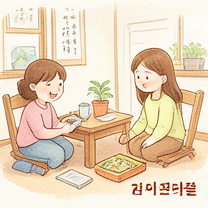
TOPIK 1 Speaking: Talk About What You Did Yesterday
Okay, you’re starting your Korean language journey! The TOPIK (Test of Proficiency in Korean) exam has four levels, and Level 1 focuses on basic conversational skills. One key part is the speaking section, and a fantastic starting point for beginners is practicing “Talk About What You Did Yesterday.” This article will break it down with realistic Korean examples you can actually use.
Understanding the Task
In this TOPIK 1 Speaking task, you’ll be given a prompt – in this case, “Talk about what you did yesterday.” You’re not expected to deliver a perfect, grammatically flawless monologue. The examiners are looking for your ability to express yourself simply and clearly in Korean. Don’t worry too much about complex grammar; focus on getting your message across.
Essential Vocabulary & Phrases
Here’s some useful vocabulary and phrases you’ll need:
- 어제 (eoje) – Yesterday
- 오늘 (oneul) – Today
- 내일 (nae-il) – Tomorrow
- 아침 (achim) – Morning
- 점심 (jeomsim) – Lunch
- 저녁 (jeonyeok) – Dinner
- 먹다 (meokda) – To eat
- 하다 (hada) – To do / to make
- 공부하다 (gongbu-hada) – To study
- 가다 (gada) – To go
- 집에 (jibe) – Home/to home
- 친구와 (chinguwa) – With a friend
Sample Dialogue & Phrases
Let’s look at some example dialogues to illustrate how this might sound:
Example 1: Simple Version
화자 (Speaker): 어제 저는 아침에 일어나서, 점심을 먹었어요. 저녁에는 집에서 영화를 봤어요.
(Hwaja (Speaker): Eoje jeoneun achime urinseo, jeomsimeul meogeosseoyo. Jeonyeoneun giseo yeonghwareul bwasseoyo.)
Translation: “Yesterday, I woke up in the morning and ate lunch. In the evening, I watched a movie at home.”
Example 2: Slightly More Detailed
화자 (Speaker): 어제는 친구와 같이 점심을 먹었어요.  맛있는 치킨을 먹고, 오후에 공부했어요. 저녁에는 집에 가서 가족과 함께 밥을 먹었요.
(Hwaja (Speaker): Eojeuneun chinguwa gati jeomsimeul meogeosseoyo. Masineunteu chingeureul meokgo, ohu-e gongbuhaesseoyo. Jeonyeoneun gije-ga gaseo gamgyakgwa hamkke babeul meogeotyo.)
Translation: “Yesterday, I ate lunch with a friend. We ate delicious fried chicken, and in the afternoon I studied. In the evening, I went home and ate dinner with my family.”
Common Mistakes & Corrections
Here are some common mistakes beginners make and how to correct them:
- Incorrect Verb Conjugation: Saying “먹었어요” instead of “먹었습니다” (meogeosseoyo) vs. “먹었습니다” (meogeotseumnida). “먹었습니다” is the more formal, standard past tense for TOPIK 1.
- Over-Reliance on Perfect Grammar: Don’t try to construct elaborate sentences. Short, clear phrases are fine! Focus on communicating your idea.
- Mispronunciation of “어제” (eoje): Make sure you pronounce it correctly – it sounds similar to “uh-cheh.”
Tips for Success
Here’s how to approach this task:
- Start Simple: Begin with just two or three activities.
- Practice Regularly: The more you say these phrases out loud, the more natural they will become.
- Don’t Be Afraid to Make Mistakes! Everyone makes mistakes when learning a new language. It’s part of the process.
Good luck with your Korean studies!


Leave a Reply