
My Journey to B1.2 German: Volunteering and Words
Okay, so I’ve been living in Munich for six months now, and honestly, the German is still… a challenge. I’m aiming for the TELC B1.2 exam, and it feels completely achievable, but it’s not just about memorizing grammar rules. It’s about using the language, really using it. And recently, I’ve been involved in something that’s helped me massively – volunteering at a local soup kitchen.
The Soup Kitchen and the First Conversations
I signed up through a local youth organization, Jugend ein Herz, and it’s been incredible. The people I work with are amazing, and the work itself is rewarding. But let’s be real, the biggest challenge is communicating. My initial attempts at German were… awkward, to say the least.
The first few days, I tried to be overly formal. I’d say “Guten Tag, ich bin [my name]” constantly, and the kitchen staff would just smile politely. Later, I heard one of the older volunteers, Klaus, explain to a new arrival, “Nicht so steif! (Not so stiff!)” He showed me how to say “Hallo!” or “Hi!” to everyone. That was a huge relief.
I had a particularly embarrassing moment when I tried to order supplies. I wanted to ask, “Haben Sie noch Kartoffeln?” (Do you have any potatoes?) and instead, I blurted out, “Ich will Kartoffeln!” It sounded so demanding! Luckily, Sarah, another volunteer, quickly corrected me: “Entschuldigung, du sagst ‘Haben Sie…’ (Sorry, you say ‘Do you have…’)” I felt my face turn bright red.
Key Vocabulary and Phrases for the Situation
The soup kitchen has provided me with a ridiculously useful vocabulary. Here are some phrases I’ve been using constantly:
- “Was kann ich für Sie tun?” (What can I do for you?) – This is essential when serving food.
- “Hier bitte.” (Here you go) – Saying this as you hand someone a plate is really important!
- “Danke schön!” (Thank you very much!) – Seriously, I’m saying this constantly.
- “Es geht?” (How are you?) – I use this when greeting people and checking in.
- “Die Küche ist voll.” (The kitchen is full) – This has come in handy a few times when I’ve tried to help and realized it was busy!
- “Wie viele Portionen?” (How many portions?) – Learning to count accurately is crucial.
Picture Description Practice – The TELC Focus
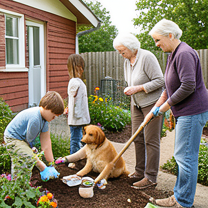
This is where the TELC B1.2 exam comes in. The picture description task is really testing my ability to use this vocabulary. The image is of young people volunteering at a soup kitchen, sorting food and talking to people. I’ve practiced describing it repeatedly.
Here’s how I’d approach it:
“Ich sehe hier eine Gruppe junger Leute, die sich freiwillig engagieren. (I see here a group of young people volunteering.) Einige von ihnen sortieren Lebensmittel – vielleicht Brot und Gemüse. (Some of them are sorting food – maybe bread and vegetables.) Andere sprechen mit den Leuten, die das Essen bekommen. Ich glaube, sie bieten ihnen Hilfe an. (Others are talking to the people receiving the food. I think they are offering them help.) Es sieht aus, als ob es eine sehr freundliche und hilfsbereite Atmosphäre ist. (It looks like a very friendly and helpful atmosphere.) Man kann sehen, dass die Leute sehr engagiert sind. (You can see that the people are very committed.)”
I’m still working on making my descriptions smoother and more detailed, but it’s definitely improving. The TELC examiners will be looking for clarity and the correct use of vocabulary.
Common Mistakes and How I’m Fixing Them
I’ve made plenty of mistakes, and that’s okay! I’m learning from them. One of my biggest problems is using the correct prepositions. I keep saying “Ich bin in der Küche” (I am in the kitchen) when I should say “Ich bin in der Küche”. Small things, but they matter.
Another issue is my pronunciation. The locals are very patient, and they gently correct me. Klaus told me, “Deine ‘r’ klingt sehr weich!” (Your ‘r’ sounds very soft!). It’s a tough sound for me, but I’m trying to imitate how he says it. I even downloaded a pronunciation app to help!
My Next Steps
I’m planning to spend more time observing how the volunteers interact, and I’m going to ask them to correct my mistakes more directly. I want to build my confidence in speaking, and I’m determined to pass the TELC B1.2 exam. This experience at the soup kitchen isn’t just about learning German; it’s about connecting with my new community and contributing in a meaningful way. Ich bin zuversichtlich! (I am confident!)
—


Leave a Reply