
My Journey to B1.2 German: Picture Description Practice
Okay, so I’ve been living in Berlin for about six months now, and honestly, German is…challenging. It’s not just about learning the rules; it’s about understanding people, really understanding what they mean. I’m aiming for the TELC B1.2 certificate, and the picture description task is proving to be a surprisingly helpful way to build my confidence. It’s not glamorous, I know, but it’s incredibly useful.
The Picture: Volunteers and Food
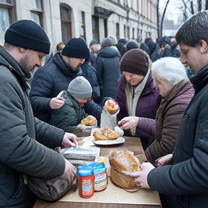
The picture they gave us for the B1.2 exam is pretty straightforward: volunteers handing out food to homeless people. It’s a grey, cold day, and the volunteers are wearing bright orange jackets. There’s a man sitting on a bench looking very tired, and a few other people accepting the food. It’s a stark image, and it’s forcing me to think about how I’d describe it to someone who’s never seen it before.
First Attempts and the “Ich weiß nicht…” Struggle
My first attempt was a disaster. I started with, “Es ist ein Bild von Menschen.” (It’s a picture of people.) Yeah, no one would have understood that! I immediately realized I needed to be more specific. I panicked and blurted out, “Es ist…groß? Und…es ist Essen?” (It is…big? And…it is food?) The tutor, Frau Schmidt, patiently corrected me. “Nein, nein! Don’t just say ‘groß’ – describe what is big! And ‘Essen’ is good, but you need to add more detail.” She explained that picture descriptions aren’t just about identifying objects, they’re about conveying the overall feeling and situation.
Building My Vocabulary: Key Phrases
Frau Schmidt gave me a list of useful phrases. These are the ones I’ve been really focusing on:
- “Im Bild sieht man…” (In the picture, one sees…) – This is my go-to starter.
- “Man sieht…” (One sees…) – A shorter, simpler version.
- “Die Person/Der Mann/Die Frau…” (The person/the man/the woman…) – For describing individual people.
- “Er/Sie trägt…” (He/She is wearing…) – Crucial for describing clothing.
- “Er/Sie scheint… zu sein.” (He/She seems…to be.) – To express impressions about someone’s appearance or mood.
- “Es ist…” (It is…) – To describe the objects.
- “Die Farbe ist…” (The colour is…) – Essential for describing colours.
For example, I practiced saying, “Im Bild sieht man eine Gruppe von freiwilligen Helfern, die Essen in Tüten verteilen.” (In the picture, one sees a group of volunteer helpers distributing food in bags.) I felt so much more confident after that.
Dialogue Practice – A Little Confusion
I started practicing with a language partner, Thomas, who’s also studying for the B1.2. We created a dialogue like this:
Me: “Thomas, beschreibe das Bild!” (Thomas, describe the picture!)
Thomas: “Im Bild sieht man einen Mann, der auf einer Bank sitzt. Er trägt eine orangefarbene Jacke und sieht sehr müde aus.” (In the picture, one sees a man sitting on a bench. He’s wearing an orange jacket and looks very tired.)
Me: “Ja, genau! Und was ist mit dem Essen?” (Yes, exactly! And what about the food?)
Thomas: “Die Freiwilligen verteilen Essen in braunen Tüten. Es sieht kalt aus.” (The volunteers are distributing food in brown bags. It looks cold.)
I messed up slightly when I said “Es sieht kalt aus.” I realised I needed to use a more nuanced phrase – “Es scheint kalt zu sein” (It seems cold). Thomas patiently corrected me, and I quickly understood why. It’s about conveying the impression rather than just stating the obvious.
Misunderstandings and Learning from Mistakes
I completely misinterpreted the word “arm” (poor/homeless) at first! I said, “Die Leute sind arm.” (The people are poor.) Frau Schmidt gently corrected me, explaining that in this context, “arm” refers specifically to the homeless people. It’s amazing how quickly you can slip up with a word that seems simple. It really hammered home the importance of context.
Moving Forward – Focusing on Detail
Now I’m trying to add more detail to my descriptions. I’m consciously trying to focus on the atmosphere, the emotions. I’m working on phrases like, “Die Stimmung ist trist” (The mood is sad) or “Es wirkt sehr bedrückend” (It feels very oppressive).
Why This Matters: Beyond the Exam
Honestly, this exercise is helping me more than I expected. It’s not just about passing the exam. It’s about developing my ability to communicate clearly and accurately in German. It’s building my vocabulary, and, most importantly, it’s giving me the confidence to actually talk about things – to express my thoughts and feelings in a way that feels natural. I still have a long way to go, but this picture description task is definitely a good start. “Viel Glück!” (Good luck!) to me.


Leave a Reply