
My First Time Navigating the German Train Station – And Why B1.2 is a Game Changer
Okay, so, let me be honest. I’ve been living in Berlin for six months now, and I still feel ridiculously overwhelmed when I step foot into a train station – especially Hauptbahnhof. It’s a chaotic beautiful mess! I mean, seriously, the sheer volume of people, the announcements in German that sound like a robot gargling, and the maps… they’re terrifying. Before, I just stood there, feeling utterly lost, desperately trying to figure out if I was going to Munich or just into another suburb. Then I started really focusing on my TELC B1.2 Bildbeschreibung, and it’s completely changed how I approach these situations.
The Scenario: Comparing Travel Options
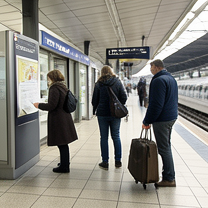
The B1.2 Bildbeschreibung shows this: a group of people huddled around a ticket machine, some looking frustrated, others trying to talk to a station attendant. It’s pretty realistic, right? That’s the point! I’d always avoided talking to anyone – I was so afraid of saying the wrong thing, of making a huge mistake and embarrassing myself. But the B1.2 material really helped me build the confidence to actually try to understand what’s going on.
My First Attempt: A Complete Disaster
Last week, I needed to get to Potsdam for the day. I had a vague idea about taking a regional train (Regionalbahn) – I’d heard “Regionalbahn” mentioned a few times. I approached a man standing near the information board, and in my best (terrible) German, I said, “Entschuldigung, ich möchte… pause, frantic searching …die…die thing nach Potsdam fahren?” He looked completely bewildered. Then he started speaking really fast, using words like “Verbindung,” “Umsteigen,” and “Fahrtzeit.” I just stared at him, completely lost. I mumbled something about “Zug” and “Reise” and he finally pointed me towards a display board. It took me a full ten minutes to decipher it, and I ended up taking a completely different train than I intended!
Useful Phrases From the B1.2 Material
The B1.2 exercises gave me some incredibly useful phrases I actually use now. It’s not just about knowing the words; it’s about knowing what to say in different situations. Here are a few that have saved my sanity:
- “Entschuldigung, können Sie mir helfen?” (Excuse me, can you help me?) – This is my go-to phrase. Seriously, I use it constantly.
- “Ich brauche Informationen über…” (I need information about…) – Perfect for asking about train times or routes.
- “Wie komme ich von hier nach…?” (How do I get from here to…?) – Essential when you’re completely lost.
- “Was bedeutet…? (What does… mean?) – Because let’s be honest, a lot of the terminology is confusing. I’ve asked this about “Gepäckschein” (luggage receipt) – who even knows what that is?!
- “Wie lange dauert die Fahrt?” (How long does the journey take?) – Crucial for planning my day.
Real-Life Dialogues – And My Mistakes!
Here’s a slightly more successful interaction I had this week:
Me: “Entschuldigung, ich möchte nach Köln fahren. Kann ich die Fahrkarten hier kaufen?” (Excuse me, I want to go to Cologne. Can I buy the tickets here?)
Attendant: “Ja, natürlich. Wie viele Personen?” (Yes, of course. How many people?)
Me: “Zwei.” (Two.) – Immediately regretted saying ‘Zwei’ instead of ‘Personen’ – completely butchered it!
Attendant: (Smiling) “Alles klar. Wie viele Kilometer möchten Sie fahren?” (Everything is clear. How many kilometers do you want to travel?)
Me: “Ich weiß nicht… ungefähr 400 Kilometer?” (I don’t know… approximately 400 kilometers?) – Ugh, I felt so stupid!
He patiently helped me explain that I was looking for a “Kurzstreckenfahrt” (short-distance journey) and eventually we figured it out.
Beyond the Phrases – Understanding the System
The B1.2 material also helped me understand why things are the way they are. For example, I now know that the different colored lines on the train maps represent different train types (ICE, IC, RE). I learned about “FlexTarif” (flexible ticket options) and “Sparpreis” (saver fares). It’s not just about asking questions; it’s about understanding the system so you can make informed decisions.
The Takeaway: Don’t Be Afraid to Try
Honestly, before the B1.2 training, I felt completely paralyzed by the German train system. Now, I still get overwhelmed, but I can at least start a conversation, ask for help, and hopefully, eventually, get to where I need to go! The most important thing is to just try. Don’t worry about making mistakes – everyone makes them! The more you practice, the more confident you’ll become. And who knows, maybe one day I’ll even navigate the Hauptbahnhof without a complete panic attack!
Wo kann ich mehr Informationen über die TELC B1.2 Bildbeschreibung finden? (Where can I find more information about the TELC B1.2 Bildbeschreibung?)


Leave a Reply