
Decoding the Festival: My B1.2 German Journey
Okay, so here I am, six months in Berlin, and honestly, learning German is proving to be… intense. It’s not just textbooks and grammar drills anymore; it’s about actually using the language, and sometimes, spectacularly failing. But that’s what’s making it worthwhile, right? The TELC B1.2 exam is looming, and they’ve given us a picture to work with – a massive cultural festival in Berlin. It’s a great focus, and it’s forcing me to really think about how I communicate.
The Picture: A Whirlwind of Colour
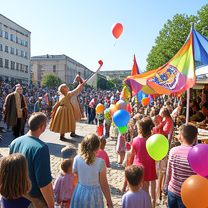
The image is pretty amazing. It’s a huge square, filled with people of all sorts of ages. There are stages with music, food stalls overflowing with delicious-looking things, and flags from all over the world. There’s a guy in a traditional Scottish kilt dancing – seriously! – and a group of women in brightly coloured Indian saris. It’s chaotic, vibrant, and perfect for practicing describing scenes.
First Impressions & The Language Barrier
My first attempt to describe the picture to my colleague, Thomas, was a disaster. I started excitedly, “Schauen Sie! Hier sind viele Menschen! Es ist eine Festival! Die Musik ist laut!” He just stared at me, blinked, and said, “Okay… sehr gut. Aber, vielleicht etwas weniger… enthusiastisch?” (Okay… very good. But, maybe a little less… enthusiastic?).
It highlighted something really important: I was relying too much on basic phrases and not really focusing on details. I needed to build my vocabulary. I realized I was using “Festival” – it’s fine, but a more specific term felt better.
Vocabulary Boost: Describing the Scene
Okay, let’s break down the useful words I’ve picked up. “Menschen” is obviously people. But then I need to be more specific. “Familien” – families, “Jugendliche” – teenagers, “ältere Menschen” – older people. Looking at the image, I noted “Kleidung” – clothing (obviously!), “Farben” – colours (brightly coloured saris!), and “Musikinstrumente” – musical instruments.
I also learned phrases like: “Es gibt…” (There is/are…) – “Es gibt viele Menschen, die tanzen” (There are many people dancing). “Die Musik ist…” (The music is…) – “Die Musik ist sehr laut” (The music is very loud). And crucially, “Die Leute essen und trinken” (People are eating and drinking).
I’ve even started trying to use German for simple requests at the food stalls. Yesterday, I wanted a Currywurst (a Berlin staple!), and I managed to say, “Ich hätte bitte eine Currywurst, bitte!” (I would like a Currywurst, please!). The vendor just smiled and said “Na klar!” (Of course!). Small victories!
Dialogue Practice: A Slightly Less Complicated Conversation
Let’s try a little dialogue. Imagine I’m talking to Lena, who’s also studying for the exam:
Me: “Lena, schaust du dir das Bild an? Es ist sehr lebendig, nicht wahr? Viele Leute feiern, und es gibt verschiedene Kulturen.” (Lena, are you looking at the picture? It’s very lively, isn’t it? Many people are celebrating, and there are different cultures.)
Lena: “Ja, stimmt! Ich sehe Musik, Essen und… eine Parade? Was ist das?” (Yes, that’s right! I see music, food, and… a parade? What is that?)
Me: “Das ist wahrscheinlich eine Teil der Parade! Die Leute freuen sich!” (That’s probably part of the parade! The people are happy!)
Common Mistakes & How I’m Correcting Them
I’ve definitely made some mistakes. Using the wrong gender for nouns – it’s so frustrating! “Das Festival” instead of “Die Festival.” I keep catching myself, and Thomas patiently corrects me. He says, “Es ist ‘Die Festival’. ‘Festival’ ist ein Eigennamen.” (It’s ‘The Festival’. ‘Festival’ is a proper noun).
Also, my pronunciation! I need to work on rolling my ‘r’s – it’s a constant struggle. I’m trying to listen carefully to native speakers and mimic them.
Looking Ahead – My B1.2 Strategy
This picture is a great starting point. I’m going to spend the next few days focusing on describing it in detail, building my vocabulary related to festivals, cultural events, and food. I’m going to try and record myself speaking and listen back to identify my mistakes. And, most importantly, I’m going to keep practicing – even if it means getting a few confused looks from my colleagues!
Ich glaube, ich kann das schaffen! (I believe I can do it!)
—
Would you like me to generate a specific kind of example dialogue or a new section focusing on a particular aspect of the B1.2 picture?


Leave a Reply