
My Train Nightmare and Why I’m Focusing on TELC B1.2
Okay, so I’ve been living in Munich for six months now, and honestly, the initial excitement has started to wear off a little. It’s a fantastic city, don’t get me wrong, but the public transport… well, let’s just say it’s an experience. And that’s exactly why I’ve started really focusing on my German, specifically targeting the TELC B1.2 exams. I realized I needed to be able to navigate these frustrating situations with a little more confidence, and knowing what to say before I’m crammed onto a train like a sardine is a huge win.
The Bildbeschreibung Scenario: Packed Like Sardines
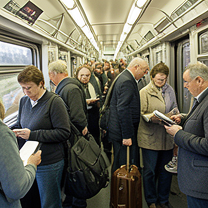
The TELC B1.2 Bildbeschreibung task showed me a picture of a packed commuter train. People were standing, shoulder-to-shoulder, looking miserable. It was… intense. And it really made me think about how I’d reacted in the past. My first instinct was to just get angry, which, you know, isn’t helpful. The aim of the exercise is to describe the picture accurately and speak fluently, so let’s break down how I can use this to improve.
Key Vocabulary and Phrases
First things first, I needed to build my vocabulary around the scene. I started with the obvious:
- Überfüllt: Overcrowded – This was the core of the whole thing! I’d heard it a million times, but I wanted to be able to use it.
- Menschenmassen: Crowds of people. I realized I’d often just muttered “viele Leute” (many people) and it didn’t really convey the sheer chaos.
- Stehen: To stand. Naturally.
- Komfortabel: Comfortable – I’d been trying to say “es ist nicht komfortabel” (it isn’t comfortable) and it sounded so clumsy. Now I’m aiming for “Die Verhältnisse sind nicht gerade komfortabel.” (The conditions are not particularly comfortable).
- Müde: Tired – Everyone looked exhausted!
- Geduldig sein: To be patient – This is a tough one for me, I admit!
A Realistic Dialogue (My Attempt!)
I practiced saying things out loud. Here’s a (slightly awkward) dialogue I created:
- Me: “Schauen Sie! Der Zug ist überfüllt. Die Leute stehen dicht an dicht. Einige sind sehr müde.” (Look! The train is overcrowded. People are standing shoulder to shoulder. Some are very tired.)
- Friend (in German): “Ja, das stimmt. Sieht nicht gut aus. Was sagen Sie, wenn jemand Platz braucht?” (Yes, that’s right. Doesn’t look good. What do you say if someone needs space?)
- Me: “Ich würde sagen: ‘Entschuldigen Sie, ist hier noch Platz?’ (Excuse me, is there still space here?)”
- Friend: “Gut! Oder: ‘Kann ich hier bitte stehen?’ (Can I please stand here?)”
I stumbled over “Kann ich hier bitte stehen?” a lot at first, but repetition is key, right?
Common Misunderstandings & How to Handle Them
One thing I discovered is that Germans can be very direct. I tried to be polite and say “Es wäre schön, wenn…” (It would be nice if…) before asking for space, and it just didn’t land well. They just looked at me like I was being ridiculously fussy! I quickly learned that a straightforward “Entschuldigen Sie, ich brauche Platz” (Excuse me, I need space) is much more effective.
Another time, I tried to explain why I needed space – “Ich bin sehr müde und brauche etwas Platz zum Ausruhen” (I’m very tired and need some space to rest). It seemed to confuse them. Turns out, they just wanted to know what I needed! It’s about clarity, not elaborate explanations.
Practical Scenarios – Beyond the Picture
This exercise isn’t just about the picture. I’m using it to build my confidence in real-life situations. Last week, the train was delayed, and a guy was frantically trying to explain to the conductor why he was late. I overheard him complaining about the “überfüllten Zug” (overcrowded train) and realized I could actually chime in! I said, “Ich verstehe! Es ist wirklich sehr voll heute.” (I understand! It’s really very crowded today). It felt… good.
My Goals and the TELC B1.2 Exam
I’m not aiming for a perfect score on the TELC B1.2 exam. Honestly, that’s a bonus. My main goal is to be able to communicate effectively, especially in stressful situations like this. I want to be able to ask for help, explain my needs, and maybe even crack a smile while enduring another packed train journey! Focusing on this specific scenario is a brilliant way to build that confidence. Next, I’m going to tackle the listening comprehension section – wish me luck!
“Auf Wiedersehen!” (Goodbye!)


Leave a Reply