
My German Journey: Tackling the B1.2 with Bikes and Banter
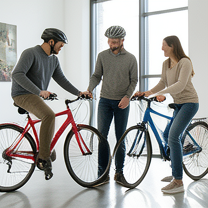
Okay, so, let me tell you, moving to Berlin was… a lot. The sheer size of everything, the efficiency, the language… it’s a beautiful chaos. I’d been studying German for a few months before I landed, mostly just the basics, but I realized fast that “knowing” a language and using it in real situations are two completely different things. That’s where the TELC B1.2 exams started to feel less like a chore and more like a necessary step. And honestly, this particular picture – friends comparing electric bikes in a showroom – helped me focus my learning in a really practical way.
The Showroom Scenario: A Crash Course in ‘Vergleichen’
I’d been trying to sound cool, you know? Like I could just wander into a bike shop and casually discuss electric motors and battery ranges. It didn’t quite work. The first time I went to a Fahrradgeschäft (bike shop) with my friend, Luke, it was… awkward.
“Also, die E-Bikes sind wirklich interessant, oder?” I said, trying to sound knowledgeable. Luke just stared at me.
He then asked, “Was genau meinst du mit ‘interessant’?” (What exactly do you mean by ‘interesting’?)
I realized, immediately, I needed to be more specific. “Ich meine, sie sind umweltfreundlicher und sie brauchen weniger Kraft.” (I mean, they are more environmentally friendly and they need less effort.)
Luke laughed. “Ja, aber die Preise sind teuer! (Yes, but the prices are expensive!)” And there I was, struggling to even ask about the battery life! This wasn’t a theoretical exercise anymore. This was real German conversation.
Key Vocabulary I’ve Been Grinding On
This whole bike thing forced me to really nail down some essential vocabulary. It’s not just “Bike” – it’s Fahrrad, E-Bike, Pedal, Motor. Then there’s the technical stuff. I’ve been learning words like: Reichweite (range), Ladegeschwindigkeit (charging speed), Bremsen (brakes), Rahmen (frame), Tretunterstützung (pedal assist).
I keep a little notebook and write down phrases I hear. For example, the salesperson at the shop said, “Die Reichweite beträgt 80 Kilometer mit einer vollen Batterie.” (The range is 80 kilometers with a full battery.) I added that to my notes immediately. And, crucially, I’m learning how to ask questions: “Wie hoch ist die Ladegeschwindigkeit?” (How fast is the charging speed?) or “Wie viele Kilometer kann ich mit einer einzigen Ladung fahren?” (How many kilometers can I drive on a single charge?)
Misunderstandings and Corrections: Learning from My Mistakes
The biggest mistake I made early on was trying to translate everything directly from English. It sounded so forced! I tried to say something like “Ich möchte die maximale Leistung des Motors wissen” (I want to know the maximum power of the motor) and the shop assistant looked completely lost.
Luke gently corrected me. “Sag einfach: ‘Wie viel Leistung hat der Motor?’ (Just say: ‘How much power does the motor have?’) It’s much simpler!”
It’s amazing how many basic phrases we use every day and don’t even think about in German. I’m also slowly getting better at understanding the nuances. Someone mentioned “die Unterhaltung” (the conversation) about the bikes, and I realized it’s not just a chat, it’s the exchange of information.
Practicing Descriptions: Bildbeschreibung in Action
The TELC B1.2 exam asks you to describe pictures. This bike showroom scenario has been incredibly helpful. I’ve started trying to describe what I see in German, even when I’m just looking at pictures online.
For example, I’d think: “Zwei Männer vergleichen E-Bikes. Einer sitzt auf dem Bike, der andere betrachtet die Anzeige. Der Rahmen ist schwarz und der Himmel ist blau.” (Two men are comparing electric bikes. One is sitting on the bike, the other is looking at the display. The frame is black and the sky is blue.)
It’s about getting used to using descriptive words – groß, klein, schwarz, blau, modern, alt – and building simple sentences.
Moving Forward: More Real-World Practice
I’m planning to go back to the bike shop with Luke again. This time, I’m going to actually ask questions and try to negotiate a price (even if it’s just pretending!). I’m also going to try to summarise what I’ve learned in a short paragraph in German.
This picture isn’t just a test; it’s a practical tool for learning. And honestly, feeling like I can actually talk about electric bikes in German is a pretty good feeling! Super! Now, if you’ll excuse me, I need to go find a good Fahrradgeschäft near me.


Leave a Reply