
Mastering Bildbeschreibung: My Journey to TELC B1.2
Okay, so here I am, a few months into my job at a logistics company in Munich, and I’m finally tackling this TELC B1.2 Bildbeschreibung exam. Honestly, the thought of describing pictures initially terrified me. It felt… weird. But it’s starting to feel less daunting, and I’m actually learning a lot about how people talk about what they see in a practical way. This exam is focused on workplace training scenarios – a perfect fit for my situation, right? Let’s talk about how I’m approaching it.
The First Time: Pure Panic
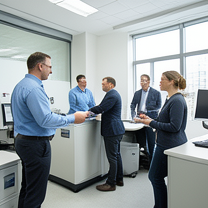
The first practice test I did was a disaster. I had a picture of a team meeting, and I just… froze. I started rambling about the room, the chairs, the light, everything! My German was there, but it was completely unstructured. My examiner, a nice woman called Frau Schmidt, kept gently interrupting with “Bitte konzentrieren Sie sich! Beschreiben Sie die Personen!” (Please focus! Describe the people!). I realized I needed a system. It wasn’t enough to know the words; I needed to use them in a sensible way.
Starting with the Basics: People First
I started focusing on the most important thing – the people. I made a little mental checklist: “First, I need to describe their age, gender, what they are wearing. Then, what are they doing?” I practiced saying things like: “Hier sind zwei Männer. Sie sind etwa 30 Jahre alt. Einer trägt eine graue Hose und eine blaue Jacke. Der andere hat eine schwarze Stoffhose und eine weiße Hemd.” (Here are two men. They are about 30 years old. One is wearing grey trousers and a blue jacket. The other has black trousers and a white shirt.) It felt much more natural than just throwing words around.
Common Phrases and Vocabulary
I’ve picked up some really useful phrases, and I’m writing them down in a little notebook. “Es sieht so aus, als ob…” (It looks like…) is a lifesaver. “Der Mann/Die Frau scheint…” (The man/woman seems…) is great for making observations. I’ve also been learning a lot of descriptive words. Things like “professionell” (professional), “freundlich” (friendly), “nervös” (nervous), “aufmerksam” (attentive) – these are crucial for describing the people in the training scenes. I also realised “die Präsentation ist sehr interessant” (the presentation is very interesting) is a phrase I’ve heard a lot during the training itself.
Misunderstandings and Corrections
Last week, I got a particularly tricky image – a supervisor giving feedback to an employee. I started describing the room in detail, and I said something completely wrong! I said, “Es ist ein sehr gemütliches Büro.” (It’s a very cozy office.) Frau Schmidt gently corrected me. “Nein, nein. Wir sprechen über die Situation. Beschreiben Sie, was der Chef sagt.” (No, no. We are talking about the situation. Describe what the boss is saying.) That was a really important lesson: focus on the action and the dialogue.
Role-Playing – The Best Practice
I’ve started practicing with a colleague, Steven, who is also studying for the exam. We take turns describing images, and he corrects my mistakes. It’s surprisingly helpful! We even started a little game. We’ll give each other a scenario and we have to describe it in one minute. It’s definitely helped me to get faster and more confident. I asked him once, “Haben Sie das Gefühl, dass der Kurs nützlich ist?” (Do you feel that the course is useful?) – it feels a little silly, but it’s a good way to practice asking questions related to the training.
Beyond the Picture – Context is Key
It’s not just about the picture itself; it’s about the context. I’ve realized that hearing snippets of the dialogue alongside the images is incredibly important. This exam is testing my ability to understand and respond to a workplace situation. I’m actively listening to how my colleagues discuss training materials and procedures. For example, I heard my supervisor say, “Wir müssen sicherstellen, dass alle die neuen Richtlinien verstehen” (We need to make sure everyone understands the new guidelines) – that gives me a huge clue about the kind of things I might be asked to describe.
My Goal: Fluency, Not Perfection
Honestly, I’m not aiming for perfect, grammatically correct descriptions. I’m aiming for fluency – being able to talk about what I see in a clear and understandable way. The TELC B1.2 Bildbeschreibung exam is just a stepping stone. It’s forcing me to practice my German in a way that’s directly relevant to my life and work here in Munich. I’m still nervous, but I’m also feeling much more prepared. “Ich bin zuversichtlich!” (I am confident!) I hope.

Leave a Reply