
My Struggle with ‘Hochwasser’ and the B1.2 – It’s Actually Getting Better!
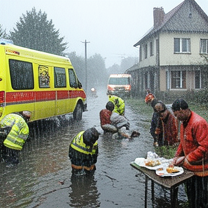
Okay, so this is embarrassing, but I’m really struggling with my German, and it’s all because of this picture. The TELC B1.2 Bildbeschreibung (picture description) test – it’s a scene of emergency workers helping people after a flood. Seriously, it seems so simple, but I’m getting completely tripped up. I moved to Munich six months ago, and while I can order a Bier and ask for directions, anything more complex feels… overwhelming. Let me tell you how it’s been.
The First Time I Saw the Picture
The examiner asked me to describe the image. I started, really enthusiastically, “Okay, so… there is a man… and… water! Lots of water!” He cut me off gently, “Bitte, versuchen Sie, mehr Details zu nennen. Was machen die Einsatzkräfte?” (Please, try to name more details. What are the emergency services doing?). I just panicked. My mind went blank. I mumbled something about “boats” and “sad people” and then just gave up. It was mortifying. I scored terribly.
Key Vocabulary – It’s Not Just “Wasser”
The problem isn’t that I don’t know the basics. I do know Wasser (water), but the picture was full of specific words that kept slipping my mind. I realized I needed to build my vocabulary around this scenario. Here’s what I’ve learned:
- Hochwasser: This is the key, obviously. It means “flood”. I keep hearing people say, “Das Hochwasser ist sehr schlimm!” (The flood is very bad!).
- Einsatzkräfte: This means “emergency services.” I saw a group of them in the picture – die Feuerwehr (the fire department) and die Rettungskräfte (the rescue teams).
- Menschen in Not: People in need. I heard a volunteer say, “Wir helfen den Menschen in Not.” (We are helping the people in need.)
- Boot: Boat. Crucially, I need to be able to say “Sie bringen die Menschen aus dem Wasser.” (They are bringing people out of the water.)
- Deich: A dike, for protection against flooding. I noticed one in the background.
A Realistic Conversation (That Didn’t Quite Happen)
I was practicing with my neighbour, Herr Schmidt, who’s fluent in German. I wanted to feel confident. He asked me, “Wenn Sie die Einsatzkräfte beschreiben würden, was würden Sie sagen?” (If you were to describe the emergency services, what would you say?).
I said, “Ich würde sagen, sie benutzen Boote, um die Menschen aus den Häusern zu retten. Und sie tragen Ärmel!” (I would say they’re using boats to rescue people from the houses. And they’re carrying buckets!).
Herr Schmidt smiled and corrected me. “Nein, nein! Sie tragen Pumpen! Pumpen, um das Wasser wegzubringen!” (No, no! They’re carrying pumps! Pumps to remove the water!). I felt my face burn. It’s so easy to make these little mistakes.
Misunderstandings and Funny Moments
Yesterday, I was talking to a colleague at work about the flood. I tried to use the word überflutet (flooded) and completely butchered the pronunciation. He just stared at me and said, “Ja, das ist richtig! Aber es klingt komisch.” (Yes, that’s correct! But it sounds strange.) It’s embarrassing, but it’s also helpful. I’m learning what I’m getting wrong, and that’s a huge step.
My Progress – It’s Slowly Building Up
I’m starting to recognize more of the vocabulary. I’ve been using flashcards – pictures of boats, pumps, and emergency vehicles – to help me. I’m even starting to build short sentences. The other day, I managed to say, “Die Einsatzkräfte sind sehr professionell” (The emergency services are very professional!) without completely freezing up. It felt like a massive victory!
Next Steps for the B1.2
I need to focus on describing the details in the picture. I need to practice talking about colors, sizes, numbers – everything. I’m planning to spend more time with Herr Schmidt, and maybe even find a language partner who’s also studying for the TELC exam. And most importantly, I’m reminding myself that it’s okay to make mistakes. It’s part of the learning process. Ich kann das schaffen! (I can do this!)
Do you have any tips for tackling picture description tests? Let me know in the comments!

Leave a Reply