
My Struggle (and Small Victories) with German – Targeting TELC B1.2
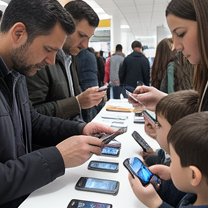
Okay, so here I am, a few months into living in Berlin, and let’s just say my German is… patchy. I’m aiming for the TELC B1.2 exam, specifically the Bildbeschreibung section – describing images – because, honestly, it feels like the most immediately useful thing I can be doing to actually understand German. The image they gave us for practice? A bunch of people in MediaMarkt, looking at smartphones. Seems mundane, but it’s a brilliant way to work on describing what I see.
The First Trip to MediaMarkt – Utter Chaos
My first solo trip to MediaMarkt was… intense. I’d practiced saying “Ich möchte einen iPhone 14 Pro Max, bitte” (I would like an iPhone 14 Pro Max, please) about a hundred times. I felt incredibly confident. Until I actually got to the phone section. It was packed! People were everywhere, touching phones, arguing about prices… it was a complete sensory overload.
A young man, probably about my age, was struggling with a salesperson. He was pointing frantically at a Samsung Galaxy, saying “Wie viel kostet das?” (How much does this cost?). The salesperson, a very patient woman, was replying in rapid-fire German, “Das ist ein Galaxy S23. Der Preis ist 899 Euro. Mit Vertrag ist er teurer.” (That’s a Galaxy S23. The price is 899 Euros. It’s more expensive with a contract). The young man just looked bewildered.
I realised then that just saying the words wasn’t enough. I needed to understand what was being said. I wanted to ask about the camera – “Haben Sie eine gute Kamera?” (Do you have a good camera?). But I just froze. I mumbled something like “Oh… äh… das ist gut?” (Oh… um… that’s good?) and quickly moved on. Mortifying!
Building My Vocabulary – “Display,” “Kamera,” and “Akku”
After that embarrassing encounter, I focused on building my vocabulary related to electronics. I started writing down words I heard constantly: Display (display), Kamera (camera), Akku (battery), Speicher (memory), Preis (price). I even made little flashcards. It’s surprisingly effective.
I started practicing simple sentences: “Der Bildschirm ist groß” (The screen is big), “Die Kamera ist sehr gut” (The camera is very good), “Der Akku hält lange” (The battery lasts long). I’d point to things in shops and repeat them. People, thankfully, were mostly amused and patient.
A Small Success – Describing the Image
The TELC B1.2 Bildbeschreibung task asked us to describe a picture of people in MediaMarkt comparing smartphones. I actually managed to do it! It wasn’t perfect, but I got the key elements across. I said, “Ich sehe einen Mann und eine Frau. Sie schauen auf ein Smartphone. Der Mann hat ein iPhone, und die Frau hat ein Samsung. Sie vergleichen die Bildschirme. Es sieht aus, als ob sie ein Angebot vergleichen.” (I see a man and a woman. They are looking at a smartphone. The man has an iPhone, and the woman has a Samsung. They are comparing the screens. It looks like they are comparing an offer).
I stumbled over some pronunciation – the “Sch” sounds are so tricky! – but I managed to use my vocabulary and describe the scene. I felt a tiny surge of pride. It wasn’t just about ticking a box on an exam; it was about actually communicating something in German.
Common Mistakes and How to Fix Them
I’ve made so many mistakes, and I’m still making them. The biggest one is over-using “ich” (I) when I could just say “das” (that/it). I caught myself saying “Ich sehe das Handy” (I see the phone) when I should have just said “Das Handy ist da” (The phone is there). It’s a simple correction, but it’s made a huge difference in sounding more natural.
Another thing is not asking for clarification. I was so worried about making mistakes that I avoided asking questions. But, honestly, most Germans are incredibly understanding and willing to repeat themselves or explain things slowly. I’ve learned to say “Entschuldigung, könnten Sie das bitte wiederholen?” (Excuse me, could you please repeat that?) – it’s a lifesaver!
Next Steps – More Practice, More Confidence
I’m planning to spend more time practicing Bildbeschreibung. I’m going to look for more images online and describe them out loud. I’m also going to try to have short conversations with people in German – even if they’re just asking for directions!
The TELC B1.2 exam feels less daunting now. It’s not just about passing a test; it’s about building my ability to communicate in this new language. And, slowly but surely, I’m starting to feel a little less like a complete beginner and a little more like… well, like someone who can maybe, just maybe, navigate a trip to MediaMarkt without complete panic. Wer weiß? (Who knows?)


Leave a Reply