
My Struggle (and Small Victories) with German – Targeting TELC B1.2
Okay, so I’ve been living in Heidelberg for almost six months now. Six months of trying to figure out this whole “German life” thing. It’s…challenging. But I’m determined, and honestly, I think focusing on TELC B1.2, specifically the Bildbeschreibung (picture description) tests, is actually a really smart way to build my confidence. It forces me to really look at things and find the right words, which is something I desperately need.
The Town Meeting Picture: My First Big Headache
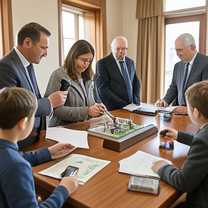
The B1.2 Bildbeschreibung tests often use images like this one: Citizens attending a local town meeting. It’s deceptively simple, right? I spent a whole hour staring at it, trying to write a decent description. I kept getting lost in details, trying to be too precise, and just ended up with a rambling mess.
The picture shows a small room. There are about fifteen people sitting around a table. Most of them are older men and women, maybe in their sixties and seventies. One younger man, probably in his late thirties, is standing at the table, pointing. He’s wearing a dark suit. A woman in the foreground is taking notes in a small notebook. A few people are looking at the table, and one is looking bored. The walls are painted a pale blue. It’s a bit drab, actually.
Common German Phrases & Initial Mistakes
I started with the basics, of course. “Es ist…”, “Dabei sind…” – you know, the usual. But the first time I actually spoke my description aloud, I completely butchered it. I kept using the formal “Sie” instead of “du,” which is such a constant source of embarrassment. Someone gently corrected me: “Ach, aber das ist eine Stadtteilversammlung, da sagt man ‘Sie’ natürlich!” (Oh, but that’s a local town meeting, you use ‘Sie’ here, of course!).
I was mortified. I wanted to disappear. But the good thing is, they were patient. I’m learning to recognize when I’m slipping – that little knot in my stomach is becoming a signal.
Here are some phrases I’ve actually started using naturally:
- “Ich sehe… ” (I see…) – “Ich sehe einen Mann, der einen dunkelblauen Anzug trägt.” (I see a man wearing a dark blue suit.)
- “Vor ihm sitzt…” (In front of him sits…) – “Vor ihm sitzt eine Frau, die ein Notizbuch hält.” (In front of him sits a woman holding a notebook.)
- “Die Leute schauen…” (The people are looking…) – “Die Leute schauen auf den Tisch.” (The people are looking at the table.)
Real-World Scenarios & Practical Vocabulary
The most useful thing has been practicing with real situations. Last week, I was in a café, and I overheard a group of older men discussing something. I wanted to ask if they were talking about the town meeting picture. I hesitated, panicked, and blurted out, “Was reden Sie über die Versammlung?” (What are you talking about the meeting?). They looked at me strangely, and one of them said, “Die Versammlung? Nein, wir reden über das Wetter!” (The meeting? No, we’re talking about the weather!).
It was a massive, embarrassing mistake, but it highlighted the need to listen carefully and understand the context. I realised I need to be more observant.
Here’s some vocabulary that’s really helping:
- Versammlung – meeting (this is key!)
- die Gemeinde – the municipality/town
- ein Protokoll – a record/minutes
- eine Bürgerversammlung – a citizens’ meeting
- der Bürgermeister – the mayor
Small Steps & Celebrating the Wins
It’s not about being perfect; it’s about consistent practice. I’ve started a little notebook where I jot down new words and phrases I learn. Even just describing everyday things – the fruit at the market (“Ich sehe Äpfel und Bananen”), the people on the street – feels like a small victory.
I’m also working on my pronunciation. The locals are incredibly helpful, and they’ve started correcting my “R” sound, which, let’s be honest, is a nightmare for me! (“Der ‘R’ muss härter!” – The ‘R’ needs to be harder!).
Looking Ahead – B1.2 & Beyond
I know the TELC B1.2 tests are just one step, but I’m convinced they’ll give me the confidence to actually use German in everyday situations. My goal is to be able to confidently describe what’s happening around me and to communicate my thoughts and needs. I’m slowly building a foundation, one picture description, one awkward conversation, one slightly-too-formal “Sie” at a time. And honestly, that’s enough for now. Ich glaube, es wird gut gehen! (I believe it will be okay!).


Leave a Reply