
Mastering German: My Journey to TELC B1.2 Through a Family Video Call
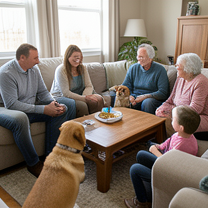
Okay, so I’ve been living in Berlin for six months now, and honestly, learning German has been…a rollercoaster. There were days I felt like I was getting somewhere, then days I’d feel like I was back to square one. But the biggest push I needed came from a very specific situation: my Oma (grandma) wanting to video call her sister, Hanni, who lives in Munich. It felt like a really practical, real-world goal, and suddenly, the textbooks felt a lot less intimidating. This TELC B1.2 Bildbeschreibung scenario has become my training ground.
The Initial Panic (and Misunderstandings!)
The first time we tried to set it up, it was…chaotic. I was trying to explain to Oma that we needed the right app – WhatsApp, not Skype – and she kept saying, “Aber WhatsApp ist doch nur für Nachrichten! Das ist doch nicht richtig zum Sprechen!” (But WhatsApp is only for messages! That’s not right for speaking!). It was frustrating for both of us. I realized I was using too much technical jargon. I quickly switched to, “Oma, es ist einfacher, wenn wir WhatsApp benutzen. Wir können uns dann direkt sehen und hören.” (Oma, it’s easier if we use WhatsApp. Then we can see and hear each other directly.) Small corrections like that, focusing on clarity over perfect grammar, made a huge difference.
Vocabulary Bootcamp: Essential Phrases
The conversation itself was a fantastic way to learn incredibly useful phrases. Hanni kept saying, “Wie geht es dir?” (How are you?) and I realized I always defaulted to “Wie geht’s?” which is perfectly fine, but a little too informal for my Oma. I started using “Wie geht es Ihnen?” (How are you? – formal) when speaking to Hanni, and she genuinely appreciated the effort.
I also picked up a lot of words related to seeing and hearing. “Ich sehe dich!” (I see you!) became a constant, happy exclamation. “Kannst du das bitte vergrößern?” (Can you please enlarge that?) was vital when they were adjusting the video resolution! And of course, “Es ist ein bisschen schwer zu verstehen” (It’s a little hard to understand) – I used that a lot when the connection wasn’t great.
Real-Life Scenarios: A Typical Call
The calls themselves were pretty normal, really. They were chatting about the weather – “Es ist so kalt hier heute!” (It’s so cold here today!) – and complaining about their neighbors. “Der Nachbar hat wieder Musik laut auf!” (The neighbor is playing music loudly again!) It was amazing to hear how people actually talk in German, not just textbook sentences.
I learned that pauses are normal. There wasn’t a constant rush to fill every silence. Oma often said things like, “Ja, ja…” (Yes, yes…) while thinking, and that’s totally acceptable. It’s not about constant, rapid-fire speech.
Troubleshooting and Correction – The Best Part!
There were definitely moments where I completely messed up. I tried to describe a picture on Oma’s laptop – a beautiful sunset – and I used the wrong words for “rot” and “orange.” Hanni patiently corrected me, “Nein, Oma, das ist nicht rot. Das ist orange!” (No, Oma, that’s not red. That’s orange!). I felt a little embarrassed, but she just laughed and said, “Das ist okay, Schatz! Jeder macht Fehler!” (That’s okay, darling! Everyone makes mistakes!). That’s when it clicked – making mistakes is part of the learning process.
TELC B1.2 Relevance: It’s About More Than Just Grammar
This whole experience has really reinforced why I’m working towards the TELC B1.2. It’s not just about passing a test; it’s about developing the skills I need to actually use German in a practical situation. Understanding the nuances of conversation, recognizing common phrases, and knowing how to politely ask for clarification – those are the things that are truly important.
My Next Steps (and Your Tips!)
I’m planning on continuing these video calls with Oma and Hanni. I’m going to focus on expanding my vocabulary around family and everyday life. I’d also love to hear from other expats in Berlin – what are your biggest challenges with German conversations? Any tips for avoiding those embarrassing moments where you completely misunderstand something? Let me know in the comments! Vielen Dank! (Thank you very much!)

Leave a Reply