
My Marathon Marathon: Leveling Up My German with a Picture
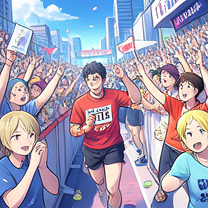
Okay, so here I am, living in Berlin for almost a year now, and honestly, sometimes I feel like I’m just existing rather than truly communicating. I can order a Bier and ask for directions, sure, but conversations really start to fall apart. I was reviewing my TELC B1.1 materials, and the image – a crowd of people cheering at a marathon – suddenly hit me. It’s a really common scene, and it’s a perfect opportunity to practice describing something vividly, which is a key part of the exam.
The Picture and My Initial Struggle
The image itself is pretty straightforward. Loads of people, bright colours, everyone’s smiling and waving. But when I tried to describe it to my colleague, Thomas, in German, it was a disaster. I started rambling, using too many adjectives, and completely lost my train of thought.
“Es ist viele Leute… sie sind… sehr, sehr happy! Die Farben sind… rot, blau, grün! Die Leute schreien… ‘Gut gemacht!’” (There are many people… they are… very, very happy! The colors are… red, blue, green! The people are shouting… ‘Gut gemacht!’)
Thomas just stared at me, politely nodding. “Ja, ja, das ist gut. Aber… du musst es strukturierter sagen.” (Yes, yes, that’s good. But… you need to say it more structured.)
He was right. It was a chaotic mess! I realized I needed to focus on the specific vocabulary and sentence structures that the B1.1 exam tests.
Key Vocabulary for the Scene
Let’s break down the words I need to use when talking about this marathon image. It’s not just about “happy.”
- Die Zuschauer: (The spectators) – This is the core – the people watching.
- Anfeuern: (To cheer on, to encourage) – They aren’t just happy; they’re actively cheering.
- Ein Marathon: (A marathon) – Obviously!
- Läufer: (Runners) – The people doing the marathon.
- Geschwindigkeit: (Speed) – Useful for describing how fast they’re running.
- Die Menge: (The crowd) – A good, broader term for the spectators.
- Applaus: (Applause) – What they’re giving the runners.
- Erfolge: (Achievements) – What they’re celebrating.
- Rotarmband: (Yellow armband) – I noticed a few people wearing these, a common sight at races.
I started writing down all these words and phrases in my little notebook. It felt surprisingly helpful.
Practicing the Description – A Little Dialogue
Okay, let’s try again. This time, I’m speaking to Sarah, another expat who’s also studying for the TELC exam.
Me: “Sarah, schau mal diese Bildbeschreibung. Da sind viele Zuschauer, die einen Marathon anfeuern. Die Menge jubelt den Läufern zu, besonders wenn sie schnell sind. Einige der Zuschauer tragen Rotarmbänder.” (Sarah, look at this picture description. There are many spectators cheering at a marathon. The crowd is cheering to the runners, especially when they’re fast. Some of the spectators are wearing yellow armbands.)
Sarah: “Das klingt gut! Du benutzt die richtigen Wörter. Aber du könntest noch sagen, dass die Zuschauer stolz sind. ‘Sie sind stolz auf die Läufer!’” (That sounds good! You’re using the right words. But you could say that the spectators are proud of the runners!)
I made a mental note: “Stolz” – proud. It’s a really important word to use.
Common Mistakes and How I Fixed Them
I totally messed up describing the runners’ effort. I initially said “Die Läufer rennen sehr schnell.” (The runners run very fast.) But that’s too basic. Thomas corrected me – “Du könntest sagen: ‘Die Läufer kämpfen hart und erreichen ihre Geschwindigkeit.’” (You could say: ‘The runners are fighting hard and reaching their speed.’) It’s more evocative and shows their effort!
Another time, I said “Die Leute sind sehr, sehr fröhlich.” (The people are very, very happy.) While technically correct, it felt a little clunky. Sarah suggested, “‘Die Leute sind begeistert!’” (The people are enthusiastic!). It sounded much more natural.
Beyond the Description – Using the Picture for Other Conversations
This image isn’t just about describing the picture. I can use it to practice other scenarios too. For example, I could imagine I’m talking to someone at the marathon itself.
“Entschuldigung, könnten Sie mir sagen, wie schnell die Läufer gerade sind?” (Excuse me, could you tell me how fast the runners are going right now?)
Or, I could ask about the atmosphere: “Ist die Stimmung hier gut?” (Is the atmosphere here good?)
My Next Steps
I’m going to keep practicing describing this image, and I’m going to focus on building more complex sentences. I’m also going to look for more real-world examples of how people talk about sports and events in German. Maybe I’ll even find a real marathon and use my new skills! Viel Erfolg! (Good luck!) I’m slowly but surely building my German, one marathon picture at a time.


Leave a Reply