
My First Emergency: Learning German with a Firetruck
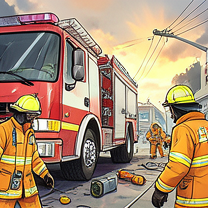
Okay, so here I am, six months in Berlin, and honestly, sometimes I feel like I’m drowning in “Wortschatz” (vocabulary). I’m trying to get to B1.1 level for the TELC exam – you know, the one that proves I can actually communicate – and it’s… challenging. They gave us this picture for practice: firefighters responding to an emergency. Seriously, it’s been stuck in my head ever since. It forced me to think about how I’d react and, more importantly, how to talk about it in German.
The Picture: It’s More Than Just a Firetruck
The image was intense. A big red firetruck, sirens blaring, surrounded by people. A firefighter was shouting something, and a woman looked incredibly worried. It wasn’t just about the fire; it was about the situation. That’s what I realized I needed to focus on. I couldn’t just memorize words; I needed to understand the context and how to use them.
My First Attempt: “Feuer!” (Fire!)
I started with the obvious, right? I practiced saying “Feuer!” repeatedly. It sounded so dramatic, and I felt a little silly. My German friend, Luke, heard me and said, “Ja, aber das ist nicht alles! ‘Feuer’ ist nur der Anfang.” (Yes, but that’s not everything! ‘Fire’ is just the beginning.) He was right. It wasn’t enough to just shout “Fire!”
A Real Conversation – Almost.
The next day, I was walking to the Supermarkt (supermarket) when I heard sirens. My heart jumped into my throat. Instinctively, I started yelling, “Feuer! Feuer!” A couple of people turned to look at me. One man, a very friendly older gentleman, approached me and said, “Entschuldigen Sie, junger Mann? Was ist los?” (Excuse me, young man? What’s wrong?)
I panicked. I mumbled something about the picture, about the firefighters, and completely butchered the grammar. “Ich… ich sehe… die… die Feuerwehr… und… es ist… ein Notfall!” (I… I see… the fire department… and… it is… an emergency!) He patiently corrected me. “Nein, nein! Nicht ‘es ist’. Sagen Sie: ‘Es gibt einen Notfall’ (There’s an emergency) or ‘Die Feuerwehr ist vor Ort’ (The fire department is on the scene). It’s much more natural.”
Useful Phrases and Vocabulary
Here are some phrases I’ve found incredibly helpful related to this scenario:
- “Die Feuerwehr ist vor Ort.” (The fire department is on the scene.) – I’ve started using this whenever I hear sirens.
- “Es gibt einen Notfall.” (There’s an emergency.) – Luke taught me this.
- “Bitte helfen Sie!” (Please help!) – I realized I needed this for a realistic scenario.
- “Was ist passiert?” (What happened?) – This is crucial for asking for information.
- “Wie schlimm ist es?” (How bad is it?) – Trying to gauge the situation.
Misunderstandings and Laughs
Let me tell you, communication is not always smooth. I was trying to explain the picture to my flatmate, Alice, and I said, “Die Männer sind sehr stark und schnell!” (The men are very strong and fast!). Alice burst out laughing. Apparently, I was describing the firefighters, not the situation. She explained gently that I needed to focus on what was happening, not just the people involved. It’s humbling, and honestly, hilarious.
Practicing with Scenarios
I’ve started creating mini-scenarios to practice. I pretend I’m a passerby and someone asks me, “Haben Sie etwas gesehen?” (Did you see anything?) I’m slowly building up my confidence and my vocabulary.
Beyond the Picture: Real-World Relevance
This exercise isn’t just about remembering words for a TELC test. It’s about learning how to react in a real emergency. I feel slightly more prepared now – less likely to panic and more able to communicate, even if I make mistakes. And who knows, maybe one day I’ll actually need to say “Die Feuerwehr ist vor Ort!” – hopefully, it won’t be in a situation as dramatic as a firetruck responding to an emergency. But at least I’ll be ready to say it correctly! “Viel Glück!” (Good luck!) to me.

Leave a Reply