
My First Big Hurdle: Mastering Bildbeschreibung at B1.1
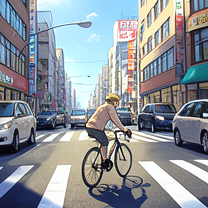
Okay, so this is officially my fourth month in Berlin, and honestly, sometimes I feel like I’m wading through a sea of Wortschatz. Learning German is amazing, but it’s also… exhausting. I’m aiming for the TELC B1.1 certification, and they’ve given me these picture descriptions – Bildbeschreibungen – to practice. It’s supposed to help me with describing what I see, which is vital, especially when I’m trying to navigate this crazy city. Today, I want to talk about one in particular: a cyclist crossing a busy intersection. It felt really relevant to my life, and it threw up some challenges I really wanted to share.
The Picture and My Initial Panic
The image was pretty standard – a cyclist, wearing a bright orange jacket, was carefully stepping into the intersection. There were cars, of course, and a couple of pedestrians, looking a bit impatient. I stared at it for ages, trying to find the words. My immediate reaction was to just try and translate everything perfectly, which, let’s be honest, is a disaster. My German wasn’t up to it. I started mumbling, “Ein Fahrrad… ein Radfahrer… er überquert die Straße… sehr vorsichtig…” It sounded completely unnatural. I felt this little stab of frustration – Ich bin so dumm! (I’m so stupid!).
Practicing the Phrases – “Ich sehe…”
They told me to practice using “Ich sehe…” (I see…). I tried, “Ich sehe ein Fahrrad…” but it felt incredibly stiff. A helpful colleague, Steven, overheard me and said, “Nein, nein! Too formal! Say, ‘Ich sehe einen Radfahrer.’” He explained that Radfahrer is much more common and sounds more natural. He even added, “Also, try, ‘Ich sehe, wie er über die Kreuzung geht.’” (I see, how he is crossing the intersection.) That made a huge difference. It’s all about sounding less like a textbook and more like you’re genuinely observing something.
A Small Conversation – With a Taxi Driver!
This is where things got really interesting. I was trying to explain to a taxi driver – a very serious man named Herr Schmidt – where I was going. I’d just finished practicing the Bildbeschreibung, and I wanted to use it as a reference. I said, “Der Radfahrer… er überquert die Kreuzung. Es ist sehr gefährlich!” (The cyclist… he is crossing the intersection. It’s very dangerous!).
Herr Schmidt stared at me, completely bewildered. He said, in a very gruff voice, “Was? Warum sagen Sie das? Es ist nur ein Fahrrad!” (What? Why are you saying that? It’s just a bicycle!). I realized I’d been too dramatic. He wasn’t trying to criticize my German; he was just genuinely confused by my overly cautious description. I quickly corrected myself: “Entschuldigung, ich meine, es ist gefährlich für den Radfahrer.” (Sorry, I meant, it’s dangerous for the cyclist.) It was a good reminder that even simple phrases can lead to misunderstandings if you don’t adapt your language.
Useful Vocabulary – Let’s Get Specific
Okay, let’s look at some specific words and phrases I found really useful:
- die Kreuzung: (the intersection) – This is a key word!
- der Radfahrer: (the cyclist) – Much more natural than Fahrradfahrer.
- vorbildlich: (exemplary, careful) – I used this to describe the cyclist’s behavior: “Er überquert die Kreuzung vorbildlich.” (He crosses the intersection in an exemplary way.)
- die Ampel: (the traffic light) – Crucial for understanding the situation.
- die Autos: (the cars) – Always a good addition.
- aufpassen: (to be careful) – I instinctively used this: “Man muss aufpassen!” (One must be careful!)
My Biggest Mistake (and How to Avoid It)
My biggest mistake was trying to use overly complex sentences. My brain just froze! It’s so easy to fall into the trap of trying to sound intelligent, but it just makes you sound unnatural. I’ve learned to focus on short, clear sentences. For example, instead of saying something convoluted like, “Der Radfahrer, mit seinem orangefarbenen Anzug, hat auf eine sehr vorsichtige Weise die Kreuzung überquert, um potenziellen Gefahren auszuweichen,” I just said, “Der Radfahrer überquert die Kreuzung vorsichtig.” (The cyclist crosses the intersection carefully.) See the difference?
Final Thoughts (and a Little Motivation!)
This Bildbeschreibung exercise has been really helpful. It’s forcing me to think about how I describe things in German, and it’s showing me how important it is to use natural language. I still make mistakes, and I still get frustrated, but I’m slowly getting better. And who knows, maybe one day I’ll be confidently describing a busy Berlin intersection to a complete stranger – und sie werden es verstehen! (and they will understand!). Now, I need to go practice with another picture… Wish me luck!


Leave a Reply