
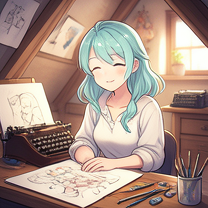
Finding My Voice: Talking About Creative Work in Germany
Okay, so here I am, six months in Berlin, and let’s be honest, my German is…patchy. I can order a Bier and a Kuchen, and generally navigate the U-Bahn, but actually talking about my work feels like wading through treacle. I’m a freelance illustrator back home in London, and the thought of explaining that in German, let alone pitching new ideas, was terrifying. I was worried about jargon, about sounding completely ridiculous, about just…not getting it across. Turns out, it’s not as bad as I thought, but it’s definitely a different beast.
The First Conversation – And the Awkwardness
The first time I really tried to explain what I did, I nearly choked. I met a colleague, Mark, from the marketing agency I’m consulting with – he’s incredibly friendly and helpful. I started with what I thought was a good explanation: “Ich bin freiberuflicher Illustrator. Ich mache Bilder für verschiedene Kunden. Manchmal für Werbung, manchmal für Bücher.” (I’m a freelance illustrator. I make pictures for different clients. Sometimes for advertising, sometimes for books.)
He looked at me blankly. Then he said, “Ah, Grafikdesigner? You’re a graphic designer?” I stammered, “Nein, nein! Illustrator! Ich zeichne, ich male! Es ist…kreativ!” (No, no! Illustrator! I draw, I paint! It’s…creative!) I felt my face turn red. I’d used the wrong word entirely! It was so embarrassing. Mark just laughed and said, “Kreativ is a good word! But ‘Illustrator’ is fine, we get it.” That moment really hammered home how important it is to use the right terminology.
Key Vocabulary for Creative Professionals
Let’s talk about some words that came in handy. Beyond Illustrator (which, thankfully, people seem to understand), here are a few others I’ve been using regularly:
- Design: Design is a super common one. I’ve used it when talking about designing posters or layouts. “Ich helfe bei der Gestaltung von Flyern.” (I help with the design of flyers.)
- Layout: Layout is useful when discussing magazine or book illustrations. “Ich mache die Layouts für die Zeitschriften.” (I do the layouts for the magazines.)
- Bildbearbeitung: (Image Editing) – I do some digital illustration, so this has been really important. “Ich arbeite mit Bildbearbeitungsprogrammen.” (I work with image editing programs.)
- Farben: (Colors) – Always useful, especially when discussing palettes. “Ich arbeite oft mit vielen Farben.” (I often work with many colors.)
- Komposition: (Composition) – A tricky one, but if you explain it’s about arranging elements, people get it. “Die Komposition des Bildes ist sehr wichtig.” (The composition of the image is very important.)
Common Phrases and How to Use Them
Here are some phrases that have saved me from a complete linguistic disaster:
- “Ich arbeite mit verschiedenen Medien.” (I work with various media.) – This is a good general phrase to use when you don’t want to get into specifics.
- “Meine Arbeit ist sehr kreativ.” (My work is very creative.) – Simple, effective, and reassuring.
- “Ich habe eine spezielle Art zu arbeiten.” (I have a special way of working.) – This is good when you’re explaining your creative process.
- “Ich mache Illustrationen für…” (I make illustrations for…) – Follow this with the client or the project type. “Ich mache Illustrationen für Kinderbücher.” (I make illustrations for children’s books.)
A Small Success – Pitching an Idea
Last week, I had a meeting with the team to discuss a new campaign for a local brewery. I wanted to suggest an illustration style – something slightly vintage, a bit quirky. I was nervous, but I took a deep breath. I started: “Ich habe eine Idee für die Werbung. Ich stelle mir Illustrationen vor, die einen alten Stil haben – fast wie aus den 1920ern.” (I have an idea for the advertising. I imagine illustrations that have an old style – almost like from the 1920s.) They actually loved it! They asked me to sketch some ideas, and that’s a huge step. It felt amazing to see my vision come to life, even if it was just on a napkin.
Don’t Be Afraid to Ask for Help
Honestly, the biggest thing has been not being afraid to ask. If I don’t understand a word, I ask! Most people are incredibly patient and happy to explain. I’ve found that simply saying, “Könnten Sie das bitte erklären?” (Could you please explain that?) goes a long way. And, of course, I’m still making mistakes, but that’s okay. It’s part of the process. “Es ist noch schwer, aber ich lerne!” (It’s still hard, but I’m learning!)
Further Learning Resources
- German-English Dictionaries: Linguee and dict.cc are lifesavers.
- Online Courses: Babbel and Duolingo are good for building basic vocabulary.
- Local Meetups: Search for creative networking groups in Berlin – a great way to practice your German and meet other artists.
Would love to hear your experiences too – especially if you’re an illustrator – let me know your best tips!

Leave a Reply