
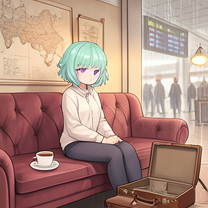
My First Time Navigating the German System: Airport and Train Station Stories
Okay, deep breath. Moving to Berlin was… intense. I’m still getting used to everything, honestly. But one thing I’ve realized is that learning German isn’t just about memorizing verbs; it’s about living it. And a huge part of that is understanding how people actually communicate in everyday situations, like, you know, going to the airport or a train station. It’s terrifying at first, but also surprisingly useful. I wanted to share some of my mishaps and, hopefully, some useful phrases I’ve picked up.
The Airport Chaos – Arrival in Frankfurt
My first trip back home to England after arriving in Germany was a complete disaster. I’d been so excited, and I’d practiced saying “Ich komme aus England” (I come from England) a million times. But when I got to the baggage claim, everything went sideways.
I was frantically looking for my suitcase, and a very kind German man, probably mid-50s, came up to me. “Entschuldigung, können Sie mir helfen?” (Excuse me, can you help me?). I panicked and blurted out, “Ich suche mein Gepäck!” (I’m looking for my luggage!). He looked confused. “Ihr Gepäck? Wo ist Ihr Gepäck?” (Your luggage? Where is your luggage?) I realized, incredibly, that I hadn’t actually said where I was looking.
He pointed to the screens showing flight numbers and baggage carousels. It took me a while to understand that saying “Ich suche mein Gepäck” wasn’t enough. I needed to be more specific. Eventually, I managed to explain, “Ich suche den Koffer mit dem roten Stern” (I’m looking for the suitcase with the red star – it was my carry-on!). He finally pointed me in the right direction, and I found my bag, completely red-faced and relieved.
Key Phrases:
- “Entschuldigung, können Sie mir helfen?” – Excuse me, can you help me?
- “Ich suche mein Gepäck!” – I’m looking for my luggage!
- “Wo ist…? ” – Where is…?
- “Ich brauche Hilfe!” – I need help!
Train Station Blues – A Lost Ticket and a Confused Officer
A few weeks later, I decided to visit my friend in Munich. I was determined to do this independently. I bought a ticket from the Automaten – a complicated machine, let me tell you – and, naturally, I misread the departure time.
When I got to the Hauptbahnhof (main train station), I approached a uniformed officer, a Zugbegleiter (train conductor), trying to explain my mistake. I started saying, “Ich habe den falschen Zug verpasst!” (I missed the wrong train!). The officer just stared at me blankly. I realized I wasn’t being polite enough.
A local woman overheard me and stepped in. She patiently explained to the officer in German that I’d simply made a mistake. “Es passiert,” she said (It happens). The officer, looking a little embarrassed, helped me sort out the situation, and eventually, I was on my way.
Important Vocabulary:
- Zugbegleiter – Train conductor
- Hauptbahnhof – Main Train Station
- “Es passiert” – It happens
- “Ich habe einen Fehler gemacht” – I made a mistake.
Small Talk and Practical Phrases
Beyond the big moments of panic, I’ve found that simple conversations are incredibly helpful. Here are some phrases I use regularly:
- “Wo fährt der Zug nach…? ” (Where does the train go to…?) – This is essential. I use it constantly!
- “Wie lange dauert die Fahrt?” (How long does the journey take?) – Useful for planning.
- “Ich habe kein Geld für den Fahrkartenschalter” (I don’t have money for the ticket counter). – Useful in a pinch! (though I try to avoid it!)
- “Die Bahn ist sehr teuer!” (The train is very expensive!) – A common sentiment, I’ve noticed!
Learning From My Mistakes
Honestly, I’ve made so many mistakes. I’ve asked the wrong questions, said the wrong things, and completely gotten lost. But that’s okay! Everyone does when they’re learning a new language, especially one as complex as German. The most important thing is to keep trying, to not be afraid to make mistakes, and to be patient with myself. I’m slowly getting better, and with each trip to the airport or train station, I feel a little more confident and a little more comfortable navigating the German system. It’s a work in progress, definitely, but I’m enjoying the challenge – and the occasional, chaotic adventure!


Leave a Reply