Learning Spanish: Signs and Simple City Information – A1 Level
Introduction
Welcome to your first step in learning Spanish! This guide focuses on a really practical skill: understanding information you’ll encounter every day – signs, menus, and simple directions. We’ll be working at the A1 level (Nuevo Español en Marcha), which means we’re concentrating on basic communication and getting you able to respond to everyday situations.
Key Vocabulary – The Basics
- Hola (Hello)
- Buenos días (Good morning)
- Buenas tardes (Good afternoon/evening)
- Buenas noches (Good night)
- ¿Cómo está? (How are you? – formal) / ¿Cómo estás? (How are you? – informal)
- Bien, gracias (Fine, thank you)
- Por favor (Please)
- Gracias (Thank you)
- De nada (You’re welcome)
- Sí (Yes)
- No (No)
- ¿Cuánto cuesta? (How much does it cost?)
- Aquí (Here)
- Allí (There)
Understanding Signs: A Real-World Example
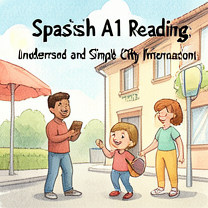
Let’s say you’re in a city and see a sign that says:

Translation: Estación de Metro (Metro Station)
You might hear someone say: “Mira, la estación de metro está allí.” (Look, the metro station is there.)
Common Phrases for Asking Directions
- ¿Dónde está…? (Where is…?) Example: “¿Dónde está el baño?” (Where is the bathroom?)
- A la derecha (To the right)
- A la izquierda (To the left)
- Derecho (Straight ahead)
- Cerca (Near)
- Lejos (Far)
Example Dialogue:
Person A: “Perdón, ¿dónde está la biblioteca?” (Excuse me, where is the library?)
Person B: “Está a la derecha, cerca del parque.” (It’s on the right, near the park.)”
Simple City Information
Here are some other common signs and phrases you might see:
- Hotel (Hotel)
- Restaurante (Restaurant)
- Tienda (Shop)
- Supermercado (Supermarket)
- Baño (Bathroom/Toilet)
Example: Ordering in a Restaurant
Waiter: “Buenas tardes. ¿Qué desea?” (Good afternoon. What would you like?)
You: “Quiero un café, por favor.” (I want a coffee, please.) – Note: Responding with just ‘Quiero’ is fine at this level. It means “I want.”
Common Mistakes and Corrections
- Mistake: “Yo quiero una agua?” (Incorrect word order)
- Correction: “Quiero un agua, por favor.” (I want a water, please.) – Remember the correct placement of pronouns.
- Mistake: Using overly complex sentences.
- Correction: Keep it simple! Focus on clear and concise communication.
Practice
Try to find some basic Spanish phrases online or in a beginner’s textbook. Even just repeating them out loud will help you build confidence!
Leave a Reply