
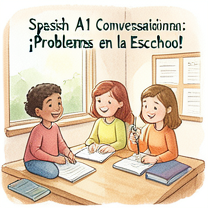
Learning Spanish: ¡Problemas en la Escuela!
Understanding Common School Problems in Spanish
Starting to learn Spanish can feel overwhelming, but a great way to begin is focusing on everyday situations. A common theme within beginner Spanish learning materials is school – specifically, problems students experience. This article looks at some typical issues and provides practical phrases a learner can use.
A Student’s First Day: Introducing the Problem
Maria just started her first year of high school in Madrid. She’s excited but also nervous. Her friend, Juan, noticed she looked worried. Here’s how they initially talked:
Juan: ¡Hola Maria! ¿Cómo estás? (Hello Maria! How are you?)
Maria: Hola Juan. Estoy bien, pero tengo un problema. (Hello Juan. I’m fine, but I have a problem.)
Juan: ¿Qué pasa? (What’s wrong?)
This conversation introduces basic greetings and phrases like “tengo un problema” – “I have a problem”. It demonstrates how quickly people can start talking about difficulties.
Common Problems & Useful Phrases
Let’s look at some specific problems and how to express them. A learner might encounter these:
- Lost Homework: “No tengo mi tarea.” (I don’t have my homework.) A good correction would be: “Perdón, no tengo mi tarea.” (Excuse me, I don’t have my homework).
- Difficulty Understanding the Teacher: “No entiendo al profesor.” (I don’t understand the teacher.) – It’s crucial to be polite and ask for clarification. A learner might say: “¿Puede repetir, por favor?” (Can you repeat, please?).
- Problems with a Classmate: “Mi compañero es muy malo.” (My classmate is very bad). This needs careful phrasing. A better approach might be: “Mi compañero no estudia mucho.” (My classmate doesn’t study much.) – Focusing on the behavior rather than a personal judgment.
- Missing Materials: “No tengo un lápiz.” (I don’t have a pencil.) – Immediately follow up with, “¿Me puede prestar uno?” (Can you lend me one?).
Role-Playing Scenarios – Practicing Solutions
A visitor to the school office might hear Maria explaining her issue. Here’s how that conversation could unfold:
Maria: Señorita Rodriguez, necesito ayuda. (Miss Rodriguez, I need help.)
Señorita Rodriguez: ¿Qué ocurre, Maria? (What’s happening, Maria?)
Maria: No entiendo las matemáticas. Es muy difícil. (I don’t understand math. It’s very difficult.)
Señorita Rodriguez: Vamos a hablar con el profesor. (Let’s talk to the teacher.)
Notice how Maria uses “es muy difícil” – “it is very difficult”. This demonstrates understanding of expressing challenges.
Important Vocabulary
Here’s a list of useful vocabulary for this theme:
- Problema: Problem
- Entender: To understand
- Ayuda: Help
- Profesor/a: Teacher (male/female)
- Compañero/a: Classmate (male/female)
- Perdón: Excuse me/Sorry
Conclusion
Learning Spanish through relatable scenarios like school problems provides a solid foundation. A learner focusing on these basic dialogues and vocabulary will quickly begin to understand common conversations and build confidence in speaking. Remember, making mistakes is part of the learning process – don’t be afraid to try!


Leave a Reply