
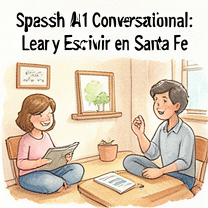
Aprendiendo Español: Leer y Escribir en Santa Fe
Learning a new language can feel overwhelming, but starting with small, achievable goals makes the process much more manageable. A particularly effective approach for beginners is to focus on conversational skills within a specific context – in this case, exploring the city of Santa Fe, New Mexico. This article outlines a practical strategy: “Spanish A1 Conversational: Leer y Escribir en Santa Fe,” designed to help learners build confidence through reading and writing simple Spanish.
Understanding the A1 Level
The A1 level in the Common European Framework of Reference for Languages (CEFR) focuses on basic communication. A learner at this stage can understand and use familiar phrases and expressions related to everyday situations – greetings, introductions, asking for directions, ordering food, and expressing simple needs. The goal isn’t fluency; it’s the ability to participate in very basic interactions.
Setting Up Your Santa Fe Immersion
Santa Fe offers a fantastic setting for this type of learning. The city’s rich culture and historical buildings provide ample opportunities for practicing Spanish with locals. A shopper, for example, might use simple phrases while browsing an artisan shop. A visitor asking for directions to the Plaza can immediately put their new skills into practice.
Key Vocabulary & Phrases
Here are some essential words and phrases a learner should focus on:
- Hola – Hello
- Buenos días – Good morning
- Buenas tardes – Good afternoon/evening
- ¿Cómo está? – How are you? (formal)
- ¿Qué tal? – What’s up? (informal)
- Por favor – Please
- Gracias – Thank you
- De nada – You’re welcome
- Sí – Yes
- No – No
- ¿Cuánto cuesta? – How much does it cost?
- Necesito… – I need…
- No entiendo – I don’t understand
Practical Dialogue Examples
Let’s look at some examples of conversations a learner might have:
Example 1: Ordering Coffee
Barista: “Buenos días. ¿Qué desea?” (Good morning. What do you want?)
Learner: “Quiero un café, por favor.” (I want a coffee, please.)
Barista: “¿Con leche y azúcar?” (With milk and sugar?)
Learner: “Sí, con leche y sin azúcar, gracias.” (Yes, with milk and no sugar, thank you.)
Example 2: Asking for Directions
Visitor: “Perdón, ¿cómo llego a la Plaza Mayor?” (Excuse me, how do I get to the Plaza Mayor?)
Local: “Siga recto por esta calle. Está a la derecha.” (Go straight on this street. It’s on the right.)
Visitor: “Gracias.”
Common Mistakes and Corrections
Many learners make similar errors when starting out. For instance, they might incorrectly say “Yo quiero un café” instead of the more natural “Quiero un café.” Another common mistake is overusing formal greetings (“¿Cómo está?”) in informal situations. Using ” ¿Qué tal?” or ” ¿Cómo estás?” is generally better with shopkeepers and less formally known acquaintances.
It’s crucial to embrace making mistakes! A local might correct a learner gently, saying something like “No, no diga ‘Yo quiero’ – simplemente diga ‘Quiero’.” (No, don’t say ‘I want’ – just say ‘I want’).
Resources for Continued Learning
Several resources can support this learning journey:
- Duolingo: A free app offering introductory Spanish lessons.
- Memrise: Another app focusing on vocabulary building through flashcards and games.
- Local Language Exchange Groups in Santa Fe: Opportunities to practice speaking with native speakers.
By focusing on practical communication within the context of Santa Fe, a learner can build confidence and develop essential Spanish skills at the A1 level. The key is consistent practice and embracing opportunities to use the language – even if it’s just ordering a simple coffee!


Leave a Reply