
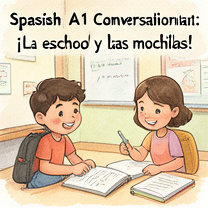
Learning Spanish: ¡La escuela y las mochilas!
Starting a new language can seem daunting, but it doesn’t have to be. A fantastic approach for beginners is focusing on practical conversations and immediate situations. This article explores learning Spanish through everyday scenarios centered around school and shopping – specifically, backpacks.
The School Situation: ¡Hola! ¿Cómo estás?
A learner beginning their Spanish journey will quickly discover that greetings are fundamental. Knowing how to introduce yourself and ask how someone is doing opens the door to all sorts of interactions.
Basic Greetings & Introductions
Here are some useful phrases:
- Hola – Hello
- Buenos días – Good morning
- Buenas tardes – Good afternoon/evening
- Buenas noches – Good night
- ¿Cómo estás? / ¿Cómo está? – How are you? (informal/formal)
- Bien, gracias. Y tú? / Bien, gracias. Y usted? – I’m fine, thank you. And you? (informal/formal)
A visitor at the school entrance might say: “Hola, ¿cómo estás?” Another student responding could reply, “Bien, gracias. Y tú?”
Asking for Information
Let’s say a learner needs to ask where the library is. It’s important to use polite phrases.
- ¿Dónde está…? – Where is…?
A student could approach another student: “Perdón, ¿Dónde está la biblioteca?” (Excuse me, where is the library?). The other student might respond: “Está a la derecha. Sigues recto y la verás.” (It’s to the right. Go straight and you’ll see it.)
Shopping for Backpacks: ¡Compras!
Learning about shopping in Spanish is incredibly useful. A shopper can confidently navigate a store and make purchases.
Asking About Prices
Here are essential phrases:
- ¿Cuánto cuesta…? – How much does…?
- Es caro / Es barato – It’s expensive/cheap
A customer examining a backpack might ask the shop assistant: “¿Cuánto cuesta esta mochila?” (How much does this backpack cost?). The shop assistant could reply, “Cuesta veinte euros.” (It costs twenty euros.)
Describing Backpacks
Learners can describe backpacks using basic adjectives.
- Grande – Big
- Pequeño – Small
- Nuevo – New
- Colorido – Colorful
A shopper might say, “Me gusta esta mochila colorida.” (I like this colorful backpack).
Common Mistakes & Corrections
It’s normal for a learner to make mistakes. One frequent error is using the formal “usted” when speaking with someone they don’t know well.
- Incorrect: “¿Cómo está usted?” (Formal – use with elders or strangers)
- Correct: “¿Cómo estás?” (Informal – use with friends and people your age)
Another common mistake is forgetting the “–r” at the end of verbs in the present tense. Remember to conjugate!
Resources for Further Learning
Several excellent resources are available for learning Spanish online or through language apps:
- Duolingo
- Memrise
- Babbel
¡Buena suerte con tus estudios de español!


Leave a Reply