
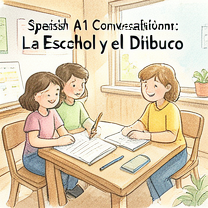
Learning Spanish Through School and Drawing
Starting to learn a new language can seem daunting, but with a focused approach, anyone can make progress. This article outlines a practical method for beginner learners – “Spanish A1 Conversational: La Escuela y el Dibujo” – which centers around common situations like school life and artistic activities. The goal is not perfection, but confident communication.
Understanding the Core Themes
This approach utilizes scenarios frequently encountered by a student in an elementary Spanish class or someone taking art lessons. The vocabulary and phrases used directly relate to these experiences, offering immediate relevance and making learning more engaging.
Key Vocabulary & Phrases (Spanish & English)
- Hola – Hello
- Buenos días – Good morning
- Buenas tardes – Good afternoon / Good evening
- Buenas noches – Good night
- ¿Cómo estás? – How are you? (informal)
- Bien, gracias. ¿Y tú? – Fine, thank you. And you?
- Me llamo… – My name is…
- Soy estudiante – I am a student
- El profesor/la profesora – The teacher (male/female)
- La clase – The class
- Un lápiz – A pencil
- Un papel – Paper
- Dibujar – To draw
- ¡Qué bonito! – How beautiful!
- Por favor – Please
- Gracias – Thank you
A Typical School Scene: Dialogue Practice
Let’s look at a simple dialogue between a student, Mateo, and his teacher, Señora Rodriguez. This demonstrates introducing oneself and asking how someone is.
Señora Rodriguez: “Buenos días, Mateo! ¿Cómo estás?”
Mateo: “Bien, gracias. ¿Y tú?” (A learner might incorrectly say “y usted?” – correction: use ‘tú’ for someone you’ve just met.)
Señora Rodriguez: “Muy bien, gracias.”
Mateo: “¡Qué bonito! El lápiz es muy útil.” (A shopper might say this if given a pencil as a gift.)
Learning About Art – Vocabulary and Simple Instructions
The “Dibujo” theme introduces vocabulary related to art materials and simple instructions. Here’s an example:
A visitor asks: “¿Cómo dibujo un círculo?” (How do I draw a circle?)
Señora Rodriguez responds: “Primero, sostén el lápiz. Segundo, dibuja un punto. Tercero, traza un círculo alrededor del punto.” (First, hold the pencil. Second, draw a point. Third, trace a circle around the point.)
A common mistake a learner might make is using overly complex verbs like “dibujar” repeatedly. Practicing with simpler expressions – “¿Cómo hago esto?” (How do I do this?) – can be beneficial.
Practical Exercises & Common Mistakes
- Role-Playing: Practice the dialogues above with a friend or language partner.
- Picture Cards: Use flashcards featuring school supplies and art materials to reinforce vocabulary.
- Common Mistake: Incorrect Pronoun Usage – Remember to use “tú” for informal situations with people you are getting to know, not “usted”.
- Expanding Phrases: Once comfortable with basic greetings, try adding more information, such as “Me llamo Mateo y soy estudiante”.
Learning Spanish through relatable scenarios like school and art provides a solid foundation for beginners. Focus on building confidence in simple conversations, and don’t be afraid to make mistakes – that’s part of the learning process!


Leave a Reply