
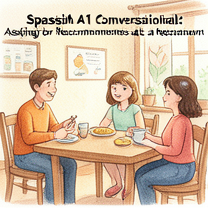
Learning Spanish: Asking for Recommendations at a Restaurant (A1)
Starting to learn a new language can feel overwhelming, but focusing on practical conversations is a fantastic way to build confidence. This article explores how a learner can practice basic Spanish while navigating the experience of ordering food in a restaurant – specifically, requesting recommendations.
The Scenario: A Tourist in Spain
Imagine a visitor, let’s call him David, recently arrived in Seville, Spain. He’s excited to explore the local cuisine and wants to find a good tapas place. However, his Spanish is very limited – ideally at an A1 level. He knows basic greetings and numbers but struggles with more complex phrases. This scenario provides a perfect opportunity for practicing essential conversational skills.
Key Phrases & Vocabulary
Before going to the restaurant, a learner should familiarize themselves with some fundamental Spanish phrases:
- Hola – Hello
- Buenos días/tardes/noches – Good morning/afternoon/evening
- ¿Cómo está? – How are you? (formal) / ¿Cómo estás? – How are you? (informal)
- Me llamo… – My name is…
- Por favor – Please
- Gracias – Thank you
- De nada – You’re welcome
- ¿Qué me recomienda? – What do you recommend?
- Para mi, – For me,
- Con hambre – I’m hungry
- Con sed – I’m thirsty
The Dialogue: Ordering and Asking for a Recommendation
Let’s look at a possible dialogue between David and the waiter, Miguel:
David: Hola. Buenos días. (He smiles nervously)
Miguel: Buenos días. ¿Qué desea? (What would you like?)
David: Para mi, tengo hambre. ¿Qué me recomienda?
Miguel: Pues, tenemos unas tapas muy buenas. El jamón serrano y las croquetas son muy populares. O también, la tortilla española es excelente.
David: La tortilla española suena bien. ¿Es caro?
Miguel: No, no es caro. Unos cinco euros.
David: Perfecto. Para mí, la tortilla española y una cerveza, por favor.
Miguel: Muy bien. Vuelvo enseguida.
Common Mistakes and Corrections
A learner might make a few common errors at this stage. For example:
- Incorrect: “¿Qué me recomendarías?” – While grammatically correct, “me recomienda” is more natural in this context.
- Correction: “¿Qué me recomienda?”
- Incorrect: Saying “por favor” after every sentence (although perfectly polite, native speakers use it less frequently).
Tips for Success
Here are some helpful tips for a learner approaching this situation:
- Start Simple: Focus on using the phrases outlined above. Don’t worry about perfect grammar initially.
- Listen Carefully: Pay close attention to how Miguel responds and try to pick up new words or phrases.
- Don’t Be Afraid to Ask: It’s perfectly acceptable to ask someone to repeat themselves, especially if they speak quickly. Try saying: “¿Puede repetirlo, por favor?” (Can you repeat that, please?)
- Body Language Matters: A smile and friendly demeanor go a long way in building rapport.
Practicing conversations like this is an excellent way for a learner to build fluency and confidence in their Spanish abilities. Remember, the goal is communication – not perfection!


Leave a Reply