
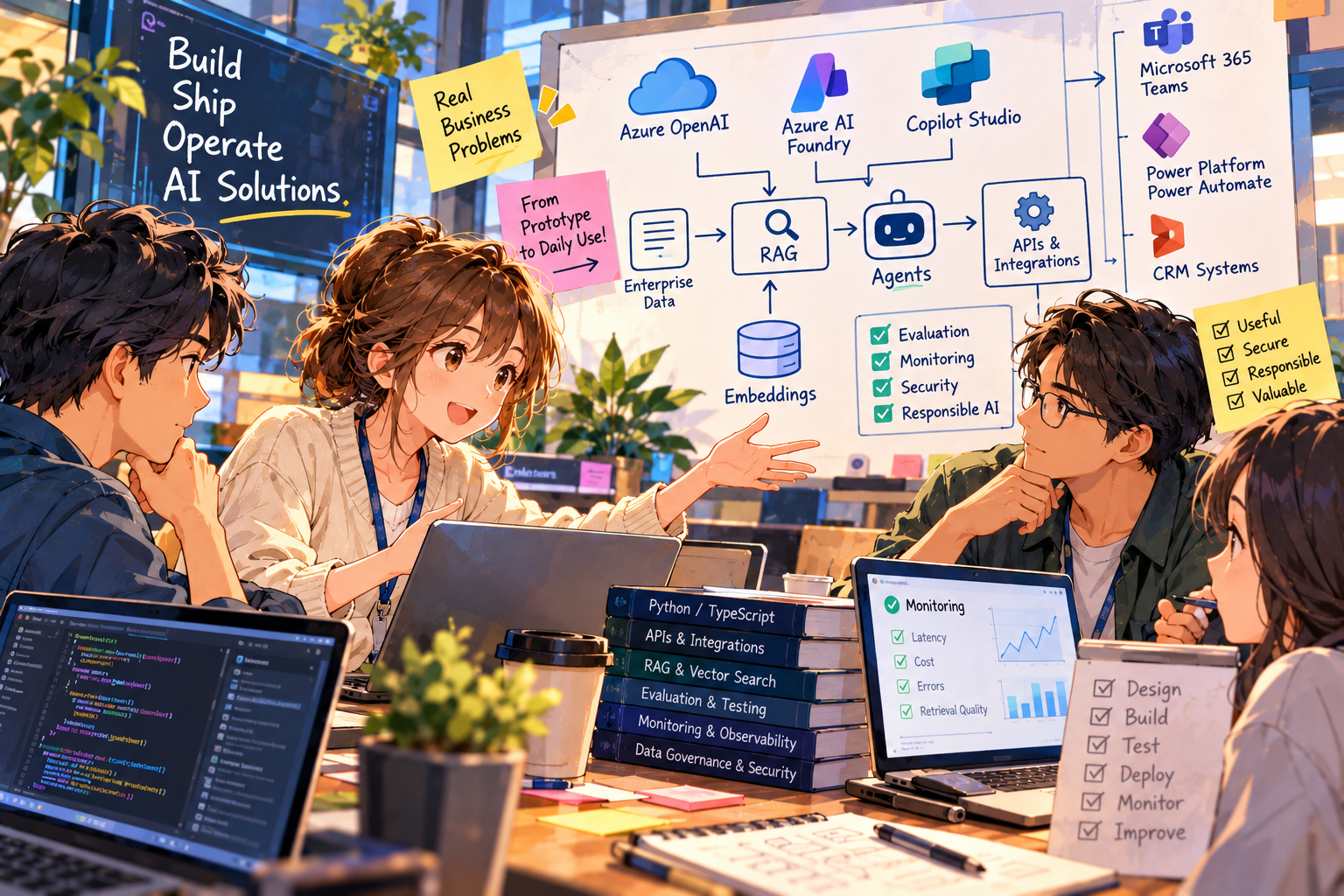
An AI application becomes much more demanding when people depend on it in daily work. A prototype can demonstrate an idea, but a production system must continue working when documents change, integrations fail, permissions differ between users, costs increase, or unexpected questions appear. This scenario uses that engineering environment as the basis for German language practice.
The Engineering Situation
A development team is creating an internal AI assistant for employees. The assistant must search approved business material, provide grounded answers, connect to controlled services, and involve a person when an automated decision would carry meaningful consequences. The organization is still developing its AI engineering standards, so the project must produce both a useful application and reusable technical patterns.
Retrieval and Grounding
Enterprise answers should be based on appropriate business sources rather than unsupported model memory. Documents are prepared for retrieval, divided into useful segments, represented for semantic search, and ranked against a user’s request. Engineers then need to determine whether poor answers originate in generation or whether the correct evidence was never retrieved.
This distinction is important because prompt changes cannot repair every retrieval failure. A robust system needs evidence that retrieval itself is performing well, along with checks for whether generated answers remain faithful to the retrieved material.
Agents, Tools and Human Control
An AI agent may call APIs, collect permitted information, prepare summaries, or initiate workflow steps. Its authority should be deliberately limited. Sensitive or difficult-to-reverse actions can require human approval, and important actions should leave enough evidence for later review.
The goal is controlled automation rather than unrestricted autonomy. A useful workflow makes clear which information was used, which tool was called, which rule applied, and where a human decision entered the process.
Evaluation and Regression Testing
The team maintains evaluation examples that represent ordinary requests as well as difficult cases. These examples can test answer quality, grounding, retrieval behavior, refusal behavior, permissions, and tool use. When prompts, models, retrieval settings, or application logic change, regression checks help reveal whether previously acceptable behavior has deteriorated.
Production Operations
Deployment is not the end of engineering ownership. The team monitors latency, cost, errors, retrieval quality, integration failures, and patterns in user feedback. Engineers investigate degradation and decide whether the cause lies in the model, data, retrieval pipeline, application code, an external dependency, or changing user behavior.
Security and Reuse
Access control should apply to the information retrieved for each user. Secrets belong in appropriate secure services rather than application source code, and agents should receive only the capabilities necessary for their tasks. At the same time, reusable components, evaluation harnesses, integration patterns, logging conventions, and architecture documentation can make later projects faster and safer.
Conclusion
This topic allows German learners to move from concrete technical nouns and simple workplace actions toward advanced language about evidence, causality, governance, operational responsibility, and architectural trade-offs. The technical situation stays consistent while the linguistic demands increase from basic statements to precise professional reasoning.


Leave a Reply