
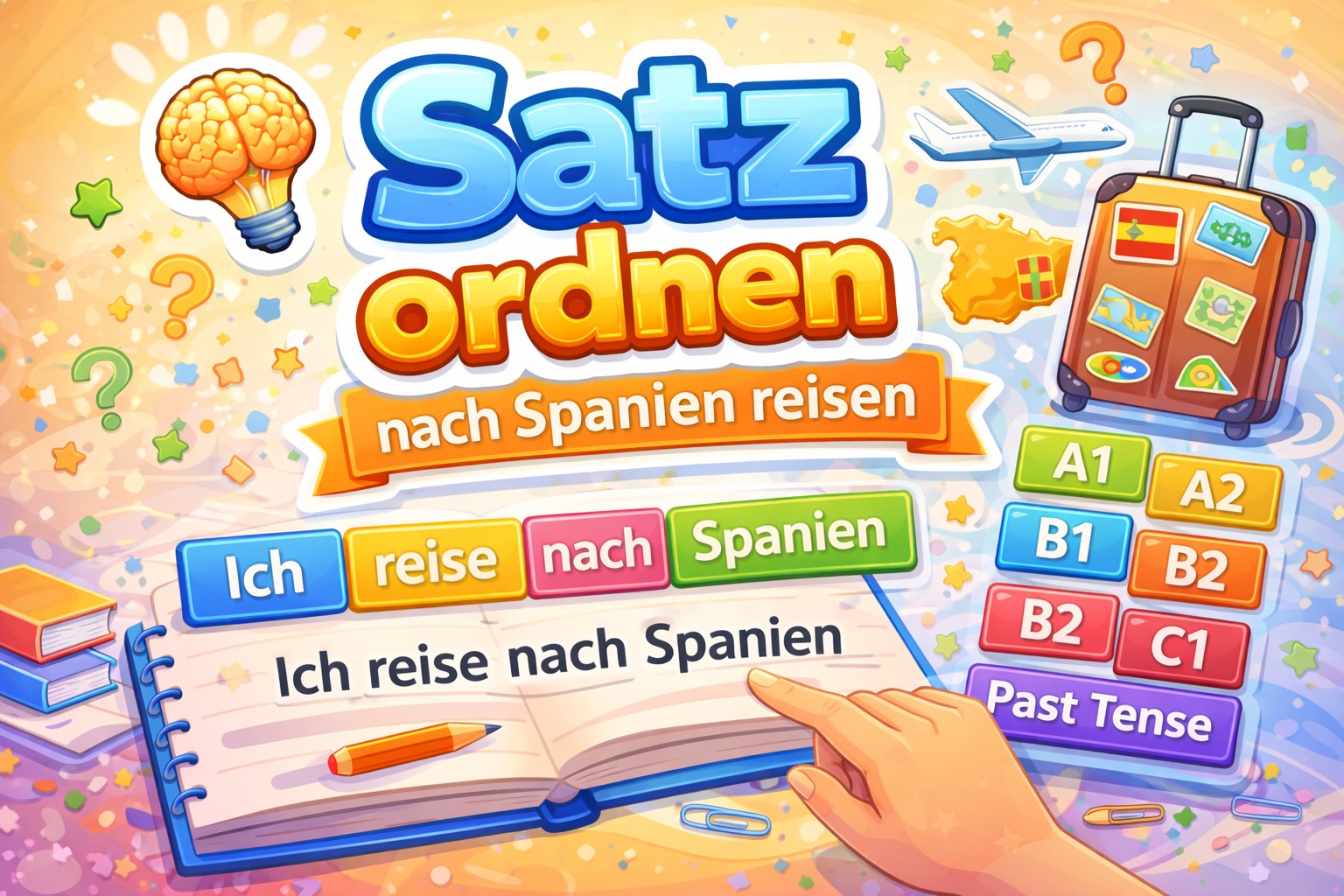
Learning German can sometimes feel difficult—especially when it comes to
grammar and sentence structure. But there’s a simple and effective way to
improve: “Satz ordnen” (arranging sentences).
This method helps learners put words in the correct order to form a proper
sentence. It’s interactive, easy to understand, and works for all
levels—from beginners to advanced learners.
——————————
✈️ Learn with a real-life context
In our example, everything is based on a simple theme: traveling to Spain.
Instead of random sentences, learners follow a clear story:
–
A1: Ich reise nach Spanien
–
A2: Wir reisen morgen nach Spanien
–
B1: Wir besuchen viele Städte in Spanien
The topic stays the same, but the sentences become more complex step by
step. This makes learning more natural and easier to remember.
——————————
📈 Step-by-step progression
Each level builds on the previous one:
–
A1: Basic sentence structure
–
A2: Adding time expressions
–
B1: Expanding with more details
–
B2: Using clauses (e.g. “wenn”)
–
C1: More advanced structures (e.g. “obwohl”)
This helps learners improve without feeling overwhelmed.
——————————
⏳ Learning the past tense (Präteritum)
At higher levels, learners are introduced to the past tense:
Letztes Jahr reisten wir nach Spanien und erkundeten viele Städte
This form is often used in storytelling and written German, making it an
important step for advanced learners.
——————————
🎯 Why this method works
–
Active learning instead of passive reading
–
Better understanding of German word order
–
Improves logical thinking and language skills
–
Suitable for all ages
——————————
🚀 Final thoughts
“Satz ordnen” is a simple but powerful way to learn German. With a clear
structure, real-life context, and gradual difficulty, it turns grammar
practice into an engaging experience.

Leave a Reply