
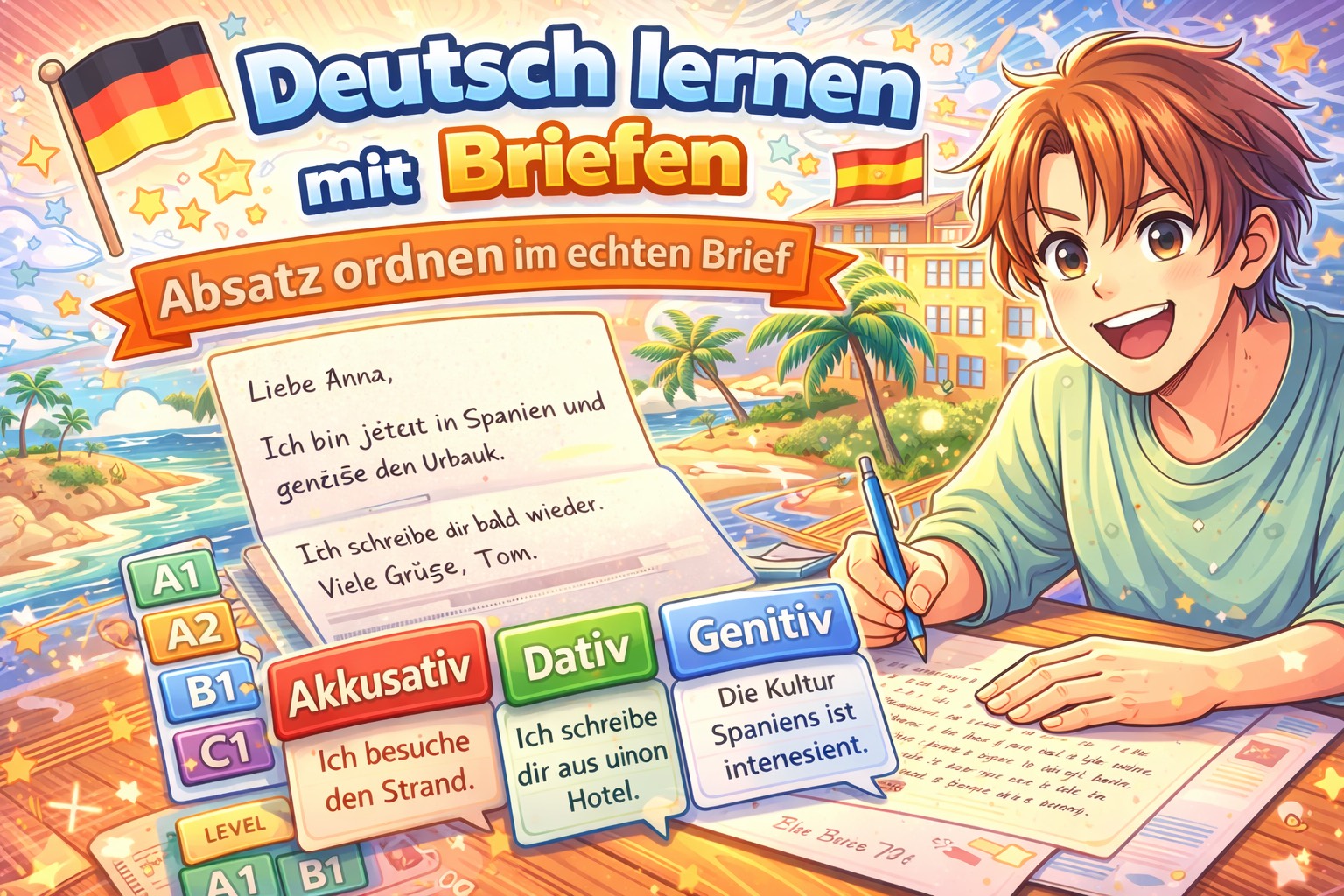
Learning German grammar can be challenging, especially when trying to build
correct sentences and understand structures like Akkusativ, Dativ, and
Genitiv. One method that helped me a lot is practicing with real letter
writing (“Brief schreiben”) combined with paragraph ordering exercises.
This approach is simple, practical, and very effective.
——————————
✉️ Learning through a real letter
Instead of working with random sentences, I practiced using a complete
letter with a clear story.
For example, the letter follows a person writing from Spain:
–
Greeting: Liebe Anna,
–
Main message: talking about travel, hotel, and experiences
–
Closing: Viele Grüße, Tom
Because everything is connected, it feels natural—just like real
communication.
——————————
📚 Understanding structure step by step
A letter always has a clear structure:
1.
Greeting
2.
Introduction
3.
Main content
4.
Closing sentence
5.
Signature
By arranging paragraphs in the correct order, I started to understand how
German texts are built.
——————————
🧩 Learning grammar in context
This method also helped me understand grammar more easily:
–
Akkusativ:
Ich besuche den Strand
–
Dativ:
Ich schreibe dir aus einem Hotel
–
Genitiv:
Die Kultur Spaniens ist interessant
Instead of memorizing rules, I saw how they are used in real sentences.
——————————
📈 Progressing from simple to advanced
The exercises become more complex step by step:
–
A1–A2: Short and simple letters
–
B1: More detailed descriptions
–
B2: Logical connections (wenn)
–
C1: Complex expressions (obwohl, dennoch)
–
Advanced: Reflection and deeper meaning
This gradual progression makes learning easier and more structured.
——————————
🎯 Why this method works
–
Uses real-life communication
–
Combines grammar and vocabulary
–
Improves writing skills
–
Helps understand text flow
It’s also suitable for all ages and learning levels.
——————————
🚀 Final thoughts
Practicing German through real letters and paragraph ordering made a big
difference for me. It turned grammar into something practical and easy to
understand.

Leave a Reply