
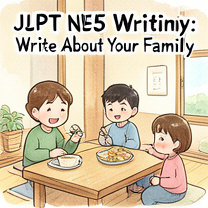
Learning Japanese Through JLPT N5 Writing: Write About Your Family
The JLPT (Japanese Language Proficiency Test) N5 is a great first step towards learning Japanese! While listening and reading are important, writing plays a surprisingly significant role in the exam. This article will focus on a common N5 writing task – “Write about your family” – providing practical advice and examples to help you prepare.
Understanding the Task
The prompt “書いてください、あなたの家族について (Kite kudasai, anata no kazoku ni tsuite)” – “Please write about your family” – is straightforward. However, it’s not just about listing names. It’s about expressing simple information and sharing a little bit about your family members and their relationships.
Key Vocabulary & Phrases
Here are some essential Japanese phrases you’ll need:
- 私の家族は (Watashi no kazoku wa) – My family is…
- お父さんです (Otousan desu) – He is a father.
- お母さんです (Haha san desu) – She is a mother.
- 妹です (Imouto desu) – She is a younger sister.
- 弟です (Otouto desu) – He is a younger brother.
- 一緒にいます (Issho ni imasu) – They live together.
- 好きです (Suki desu) – I like…
- 元気です (Genki desu) – I’m fine/well.
Example Sentences & Common Mistakes
Let’s look at some example sentences and common mistakes beginners make:
- Correct: 私の父は、医者です。 (Watashi no chichi wa, isha desu.) – My father is a doctor.
- Incorrect: 私のパパは、医者です。(Watashi no papa wa, isha desu.) – Explanation: “Papa” is an informal term for father and generally inappropriate for formal writing or the JLPT N5.
- Correct: 妹は音楽が好きです。 (Imouto wa ongaku ga suki desu.) – My younger sister likes music.
- Incorrect: 妹は、音楽は好きです。(Imouto wa, ongaku wa suki desu.) – Explanation: This is grammatically awkward in Japanese. The ‘wa’ particle connects the subject (妹) to the object of the liking (音楽).
Structuring Your Response
Here’s a suggested structure for your response:
- Introduction: Briefly introduce your family. (例: 私の家族は4人です。(Watashi no kazoku wa yon nin desu.) – My family has four people.)
- Describe each member: (例:お父さんは、会社で働いています。お母さんは、看護師です。) – My father works in a company. My mother is a nurse.
- Mention relationships and hobbies: (例: 妹は学校に行っています。音楽が大好きです。) – My younger sister goes to school and loves music.
- Concluding sentence: A simple statement about your family’s well-being or happiness. (例:家族といつも一緒にいます。(Kazoku to itsumo issho ni imasu.) – I am always with my family.)
Real-World Situations & Tips
Scenario 1: A Simple Introduction Email – Imagine you’re introducing your family to a new friend. You could write an email like this:
Subject: Introducing My Family

Dear [Friend’s Name],

私の名前は[Your Name]です。私の家族は4人です。お父さんは会社で働いています。お母さんは先生です。妹は高校生です。 いつも元気です!

Best regards,
[Your Name]
Tip: Keep your sentences short and simple. Focus on conveying the essential information. Don’t worry about perfect grammar initially; focus on communicating clearly.
Resources for Practice
- JLPT N5 Vocabulary Lists: Search online for “JLPT N5 vocabulary lists” to build your knowledge.
- Japanese Writing Practice Websites: Several websites offer writing prompts and feedback (look for beginner-friendly options).
Writing about your family is a fantastic way to practice basic Japanese conversation and build confidence. Good luck with your JLPT N5 preparation!


Leave a Reply