
Giving presentations on social topics – Grammar: Presentation language
My First Real German Collaboration: Preparing for a Presentation

It’s been six months since I moved to Berlin, and honestly, some days I still feel like I’m fumbling through conversations. I’m working as a freelance translator, which is amazing, but it also means I’m constantly surrounded by the language. And let’s be honest, sometimes I feel completely overwhelmed. But lately, things are starting to feel… smoother.

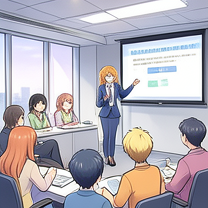
That’s partly because of Martin and Alice. Martin’s a student studying media, and Alice is a graphic designer. They’ve been incredibly patient and helpful, and they’ve actually invited me to help them with a presentation for one of their courses. It’s a little nerve-wracking, but also a fantastic opportunity to really practice my German and get comfortable with talking about something more complex than just ordering coffee – although, let’s be real, I still need to work on my coffee orders!

It all started with this conversation: “Hallo Martin! Hallo Alice, wie geht’s dir? Mir geht’s gut, danke. Und dir? Auch gut, danke.” (Hello Martin! Hello Alice, how are you? I’m doing well, thank you. And you? Also good, thank you.) We were just getting started, discussing whether we should prepare for the presentation next week. “Wir müssen uns ja nächste Woche für die Präsentation vorbereiten, oder?” (We have to prepare for the presentation next week, right?).

I had some ideas, thinking about social media and how it affects young people. “Ich dachte an etwas über soziale Medien und ihre Auswirkungen auf junge Leute.” (I was thinking about something about social media and its impact on young people.) Martin immediately said, “Das ist eine gute Idee!” (That’s a good idea!). But he was right – it was a bit too broad. “Aber vielleicht sollten wir uns auf einen bestimmten Aspekt konzentrieren, damit es nicht zu allgemein wird.” (But maybe we should focus on a specific aspect so it doesn’t become too general.)

I have to admit, I felt a little nervous about the presentation itself. “Ich bin auch für die Präsentation sprachlich etwas nervös.” (I’m also a little nervous about the presentation linguistically.) Martin reassured me, “Keine Sorge, ich bin auch etwas nervös.” (No worries, I’m also a little nervous.) It’s funny, because even though I speak German every day, the thought of presenting in front of people still makes me want to hide under a table! “Wir können uns gegenseitig unterstützen.” (We can support each other.)

We quickly realised we needed a plan. “Wichtig ist, dass wir uns gut vorbereiten.” (It’s important that we prepare well.) We started talking about making an outline. “Vielleicht sollten wir eine Gliederung erstellen, damit wir wissen, was wir sagen müssen.” (Maybe we should create an outline so we know what we need to say.)

“Und dann üben wir? Genau!” (And then we practice? Exactly!) We decided to set aside some time for rehearsal. “Okay, dann machen wir uns einen Plan.” (Okay, then let’s make a plan). I offered to write the outline, and Martin suggested he could come up with some examples. “Ich kann die Gliederung schreiben und du überlegst dir Beispiele?” (I can write the outline and you think about examples?).

We also talked about adding statistics. “Wir könnten auch einige Statistiken einbauen, um die Präsentation interessanter zu machen.” (We could also include some statistics to make the presentation more interesting.) “Gute Idee!” (Good idea!). I said I’d look for some. I realized even small things like numbers can make a difference. It’s about showing we’ve done our research.

The biggest hurdle seemed to be the time limit – “Wieviel Zeit haben wir denn? 15 Minuten.” (How much time do we have?). “Das ist nicht viel, deshalb müssen wir es kurz und präzise halten.” (That’s not much, so we need to keep it short and precise.)

We agreed to make a detailed plan. “Ja, klar! Das ist super.” (Yes, of course! That’s great!). We even talked about scheduling another meeting. “Wollen wir morgen Abend nochmal zusammensetzen?” (Do we want to meet again tomorrow evening?).

This whole experience is fantastic. It’s forcing me to think about my German in a different way – not just as a tool for work, but as a way to connect with people and participate in my new life here in Berlin. And even though I’m still making mistakes (I accidentally said “Ich bin” instead of “Ich bin”), I know that with people like Martin and Alice, I’m going to get there. Maybe I’ll even nail that coffee order next time!

Leave a Reply

Your email address will not be published. Required fields are marked *

We use cookies and similar technologies to enhance your experience on wobizdu.com, analyze site traffic, personalize content, and deliver relevant ads. Some cookies are essential for the site to function, while others help us improve performance and user experience. You may accept all cookies, decline optional ones, or customize your settings. Review our Privacy Policy to learn more.

