
My First German Grocery Trip: Lessons Learned in Berlin
Okay, so moving to Berlin has been… a lot. The sheer scale of everything is overwhelming at first, but I’m slowly getting my bearings. One of the biggest things I’ve realized is that even small everyday things, like going to the supermarket, can be a mini-adventure when you’re learning a new language. It’s amazing how much you can learn just by listening to people talk!
The Aldi Encounter
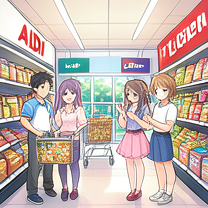
Last week, I met Klaus and Alice at the local Kaufhaus (shop), which was Aldi. It was actually really helpful – they were practicing their German and it gave me a chance to put some of the phrases I’d been learning into practice. We were talking about groceries, and it started like this:
“Hallo Klaus! Hallo Alice! Wie geht’s dir? Mir geht’s gut, danke. Und dir? Auch gut.” (Hello Klaus! Hello Alice! How are you? I’m fine, thanks. And you? Also good.)
I replied, “Mir geht’s gut, danke.” (I’m fine, thanks.) It felt a little awkward saying it, but they seemed genuinely pleased I was making an effort.
Lidl vs. Aldi: The Great Debate
They were talking about their shopping habits, and it sparked a really interesting conversation. Apparently, they were planning to visit Aldi next week.
“Wir planen, nächsten Wochen Aldi zu besuchen.” (We’re planning to visit Aldi next week.)
I said, “Wirklich?” (Really?) I’d been shopping at Lidl mostly, and they explained why:
“Ich kaufe meistens bei Lidl. Ich finde die Auswahl oft größer.” (I usually buy at Lidl. I often find the selection larger.)
It’s true! Lidl definitely has a wider range of products. But then I said, “Aber Aldi ist günstiger, finde ich.” (But Aldi is cheaper, I think.) And they agreed. “Stimmt, Lidl hat oft mehr Auswahl. Aber Aldi ist günstiger, finde ich.” (That’s right, Lidl often has more selection. But Aldi is cheaper, I think.)
Eggs, Potatoes, and the Art of Small Purchases
The conversation then shifted to specific items. They were talking about needing 10 eggs – “Ja, ich brauche auch meistens 10 Eier.” (Yes, I need 10 eggs usually too). And suddenly, I realized I had a completely different approach to buying things.
“Manchmal kaufe ich auch 2 Kartoffeln, wenn ich Kartoffelsalat kochen möchte. Ich kaufe meistens nur 1 Kartoffel für mich.” (Sometimes I buy 2 potatoes when I want to make potato salad. I usually buy only 1 potato for myself.)
I explained that I tended to buy smaller amounts – “Ich kaufe oft nur kleine Mengen, vielleicht 1 Packung Joghurt oder 1 Flasche Milch.” (I often buy only small quantities, perhaps 1 yogurt container or 1 bottle of milk). It felt a bit strange admitting that, like, I didn’t always buy in bulk!
They were surprised. “Wir kaufen oft 6 Joghurtbecher, wenn die Kinder es wollen.” (We often buy 6 yogurt cups when the children want them). And they mentioned “Und wir nehmen oft 2 Packungen Brot, wenn wir viele Leute haben.” (And we often take 2 loaves of bread when we have many people).
A Little Confusion (and a Helpful Correction)
It got a little confusing when they started talking about making a Kartoffelstampf (mashed potatoes) – “Wir nehmen oft 3 Kartoffeln, dann können wir auch einen großen Kartoffelstampf machen.” (We often take 3 potatoes, then we can also make a large mashed potato dish!). I just nodded along, unsure if I should offer to help, but I managed to say, “Das ist eine gute Idee!” (That’s a good idea!)
I realized I was mostly buying things for myself, and my purchases were usually very small, like “Ich kaufe meistens nur 1 Brot, weil ich selten alleine esse.” (I usually only buy 1 loaf of bread because I rarely eat alone). It struck me as funny how different our shopping habits were.
“Das ist schön! Ja, so ist es oft. Es ist interessant, wie unterschiedlich wir einkaufen!” (That’s nice! Yes, it’s often like that. It’s interesting how different we shop!).
More Than Just Shopping
The whole experience wasn’t just about groceries. It was about hearing real German, understanding the local culture, and realizing that even something as simple as a trip to the supermarket could be a valuable learning experience. I’m still stumbling over my words, and I definitely need to work on my pronunciation, but every conversation, every shopping trip, gets me a little bit closer to feeling more comfortable and confident in Berlin. Next time, I’m going to try to remember to ask for die Rechnung (the bill!) – I completely forgot last time!

Leave a Reply