
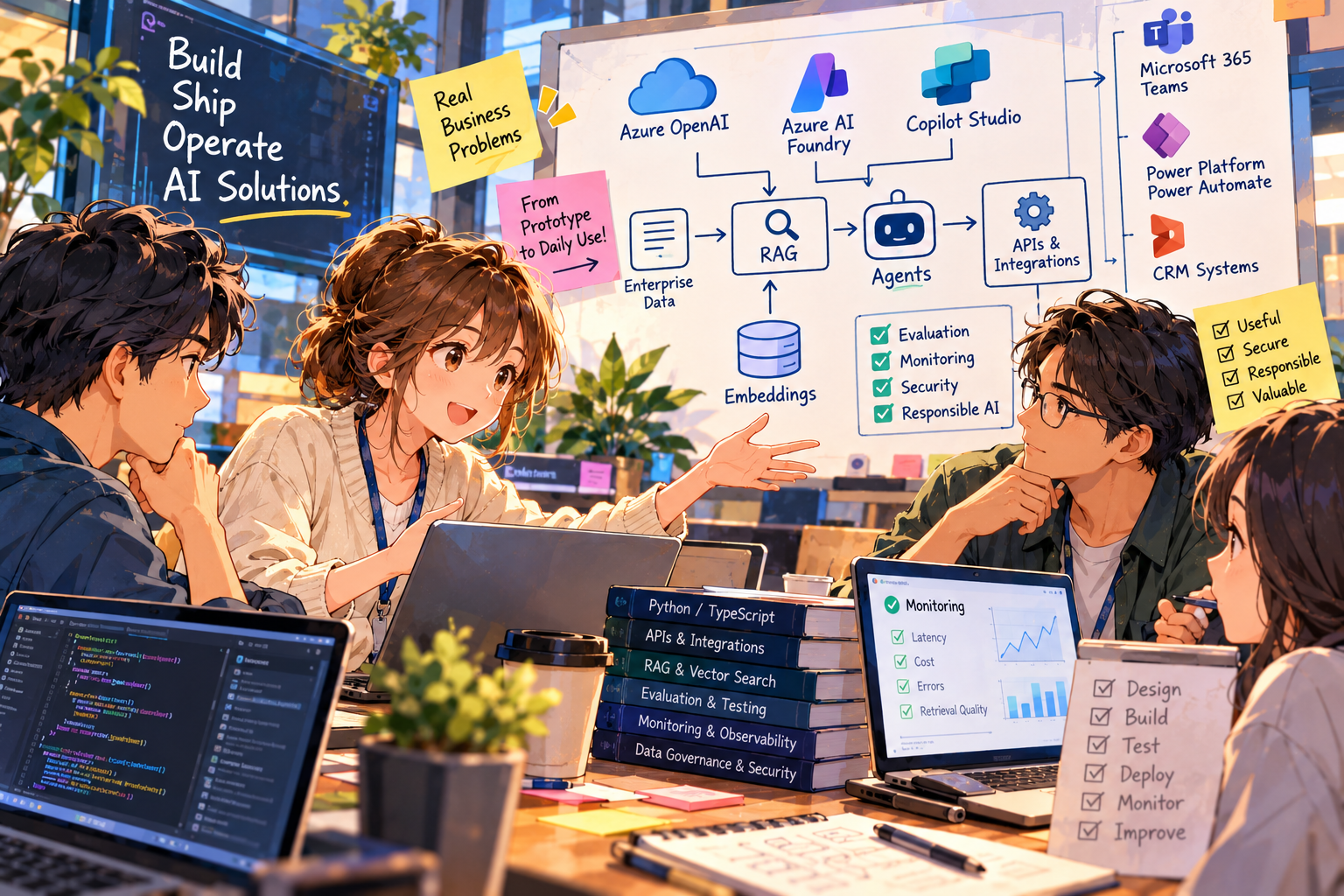
Creating a convincing AI demonstration is very different from operating an AI application that employees depend on every day. A prototype may succeed with carefully selected examples, while a production system must cope with changing documents, permissions, unreliable integrations, ambiguous questions, cost limits, latency targets, and users who expect consistent results.
The Project Situation
Imagine joining a company that already automates business processes but is only beginning to establish its AI engineering practices. A service department wants an internal assistant that can answer questions from approved operational material, retrieve permitted account context through controlled services, and return sensitive decisions to a person.
There is no mature internal AI platform waiting for the engineer. The first solution therefore has two jobs: solve the immediate business problem and establish patterns future projects can reuse. Retrieval, evaluation, security, monitoring, integration, and documentation become part of the product rather than optional work after the prototype.
Grounding Answers in Business Content
The assistant should not answer enterprise questions from model memory alone. Approved documents are divided into useful segments, represented for semantic search, retrieved according to the user’s question, and supplied as context for generation. Engineers must choose useful chunk boundaries, retrieval depth, metadata filters, ranking behavior, and ways to expose supporting sources.
A system can sound confident while retrieving the wrong material. Retrieval quality and answer quality therefore need separate checks. If relevant evidence never reaches the model, changing the prompt may not solve the underlying problem.
Controlled Actions and Human Decisions
The assistant may eventually call an internal API, prepare a case summary, look up permitted customer information, or draft the next workflow step. Actions with meaningful consequences should be constrained by explicit rules. Human approval is appropriate when an action is sensitive, difficult to reverse, or requires business judgment.
An auditable workflow should make it possible to understand which information was retrieved, which tool was called, what decision was made, and where a person intervened. This matters when AI is connected to operational systems rather than remaining a standalone chat interface.
Evaluation Before Release
Before deployment, the team creates a representative evaluation set containing routine requests, difficult wording, missing information, misleading context, permission-sensitive cases, and questions that should be declined or escalated. The same checks run again when retrieval settings, prompts, models, tools, or application logic change.
This turns evaluation into an engineering discipline rather than a one-time demonstration. A new version is not better merely because one example looks impressive. It should improve relevant measures without introducing unacceptable regressions elsewhere.
Operating the Application
After launch, production evidence becomes essential. Engineers watch latency, failures, model cost, tool errors, retrieval behavior, and user feedback. A deployment can still fail if responses are too slow, costs become unpredictable, or retrieval quality deteriorates as the knowledge base changes.
Security and access control belong in application design. Retrieval should respect the requesting user’s permissions, secrets should not be embedded in source code, and integrations should expose only the capabilities the application actually needs.
Reusable Engineering
The most valuable result is not only one working assistant. A project can leave reusable evaluation harnesses, retrieval components, integration patterns, logging conventions, deployment checks, and architecture documentation. These assets reduce uncertainty for later AI applications.
Conclusion
Production AI engineering combines software construction with retrieval design, controlled automation, evaluation, observability, security, and communication. The difficult part is often not making a model produce an impressive response. It is building a system whose behavior can be tested, explained, monitored, repaired, and trusted as the surrounding business environment changes.


Leave a Reply