
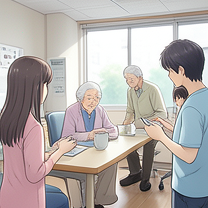
Navigating German Healthcare: A Newcomer’s Perspective
My First “Guten Morgen!” and a Growing Concern
Okay, so moving to Berlin has been… intense. The city is amazing, the culture is fascinating, and the food! But getting settled, especially when it comes to things like healthcare, is proving to be a bit of a head-scratcher. I’m currently working as a freelance translator – which is brilliant, but means I have to deal with everything myself, at least initially. It all started with a conversation I had with Herr Müller at the Bäckerei (bakery) near my apartment.
“Guten Morgen, Herr Müller! Wie geht es Ihnen heute?” (Good morning, Mr. Müller! How are you today?)
“Guten Morgen, Frau Schmidt! Mir geht es gut, danke. Aber ich bin etwas besorgt, ehrlich gesagt.” (Good morning, Ms. Schmidt! I’m fine, thank you. But I’m a little worried, honestly.)
It was a pretty typical morning greeting, but it sparked a whole chain of thoughts about the healthcare system, particularly for older people. It’s something I’ve been reading about and hearing more and more about – the issues around the aging population in Germany.
The Queue for Physiotherapy: A Real Problem
The thing is, I’ve noticed a huge problem. My sister, who lives back in England, told me she’s been waiting for a physiotherapist for ages. She’s got some back problems, and the waiting lists are apparently insane. “Es scheint, als ob die Wartezeiten unverhältnismäßig lang sind und das viele ältere Menschen frustriert.” (It seems like the waiting times are disproportionately long and it frustrates a lot of older people.) That’s exactly what I’m hearing here too. I was talking to a neighbour, Frau Schmidt, who lives in the building across the street, and she told me a similar story. She’s on a list for a physiotherapist and it’s completely unbearable. She said, “Die Situation ist wirklich unerträglich.” (The situation is really unbearable.)
Honestly, it’s made me think about the whole system. It’s not just about waiting; it’s about access and whether people are being cared for efficiently.
Systematic Changes – It’s More Than Just Numbers
I read an article about how the ambulante Versorgung (outpatient care) is particularly struggling with the demand. It’s like the healthcare system is completely overwhelmed. Someone pointed out that a “systematic Überprüfung” (systematic review) of the processes is desperately needed. They think we need to find ways to be more efficient, distribute resources better, and really consider the individual needs of each patient. “Eine flexiblere Anpassung an die unterschiedlichen Bedürfnisse der älteren Generation wäre sicherlich ein wichtiger Schritt.” (A more flexible adaptation to the different needs of the older generation would certainly be an important step.) It’s not just about numbers; it’s about understanding that older people have different requirements.
Prevention and Funding – A Complex Equation
And it’s not just about the current process. It’s also about prevention. Someone mentioned “die Prävention stärker in den Fokus rücken” (focusing on prevention) to reduce the overall burden on the system. They said a proactive approach to health, like encouraging people to exercise and eat well, could ultimately reduce the need for expensive treatments in the long run. But then the question of “die finanzielle Tragfähigkeit” (financial viability) came up. The current models just don’t seem to be working – they aren’t covering the rising demands.
Maybe new funding models or a bigger contribution from private health insurance are needed to bridge the gap. I know it’s a complicated issue, with ethical questions involved. “Es ist ein komplexes Problem, das auf vielen Ebenen angegangen werden muss.” (It’s a complex problem that needs to be addressed at many levels.)
Putting People First – My Thoughts on the Future
Ultimately, it comes down to making sure the voices of older people are heard. I really believe it’s essential to “die älteren Menschen nicht in irgendeiner Weise ausser Acht lassen und ihre Stimme in den Entscheidungsprozessen ernst nehmen.” (not to disregard older people in any way and to take their voice seriously in decision-making). It’s about giving them a dignified life and maintaining their quality of life, even when things are tough. “Denn letztendlich geht es darum, ihnen ein würdevolles Leben zu ermöglichen und ihre Lebensqualität zu erhalten.” (Ultimately, it’s about enabling them to live a dignified life and maintaining their quality of life.) I completely agree – a “inklusive und menschenzentrierte Gesundheitsversorgung” (inclusive and people-centered healthcare) has to be the top priority. It needs a “ganzheitliche Betrachtung” (holistic perspective), considering medical, social, and psychological aspects to create a really sustainable solution.
Learning Some German Phrases – Useful for Talking About Health
Here are a few useful phrases I’ve learned that have been really helpful:
- Wie geht es Ihnen? (How are you?) – A standard greeting.
- Ich bin etwas besorgt. (I’m a little worried.) – Useful when expressing concerns.
- Die Wartezeiten sind zu lang. (The waiting times are too long.) – A common complaint.
- Ich brauche einen Arzt. (I need a doctor.) – A basic need.
- Die Gesundheitsversorgung ist wichtig. (Healthcare is important.) – A key topic.
It’s definitely a learning process, and I’m still navigating the German healthcare system. But having these conversations and understanding the issues is a really important first step! I’m planning to keep learning and, hopefully, contribute to finding some solutions.


Leave a Reply