
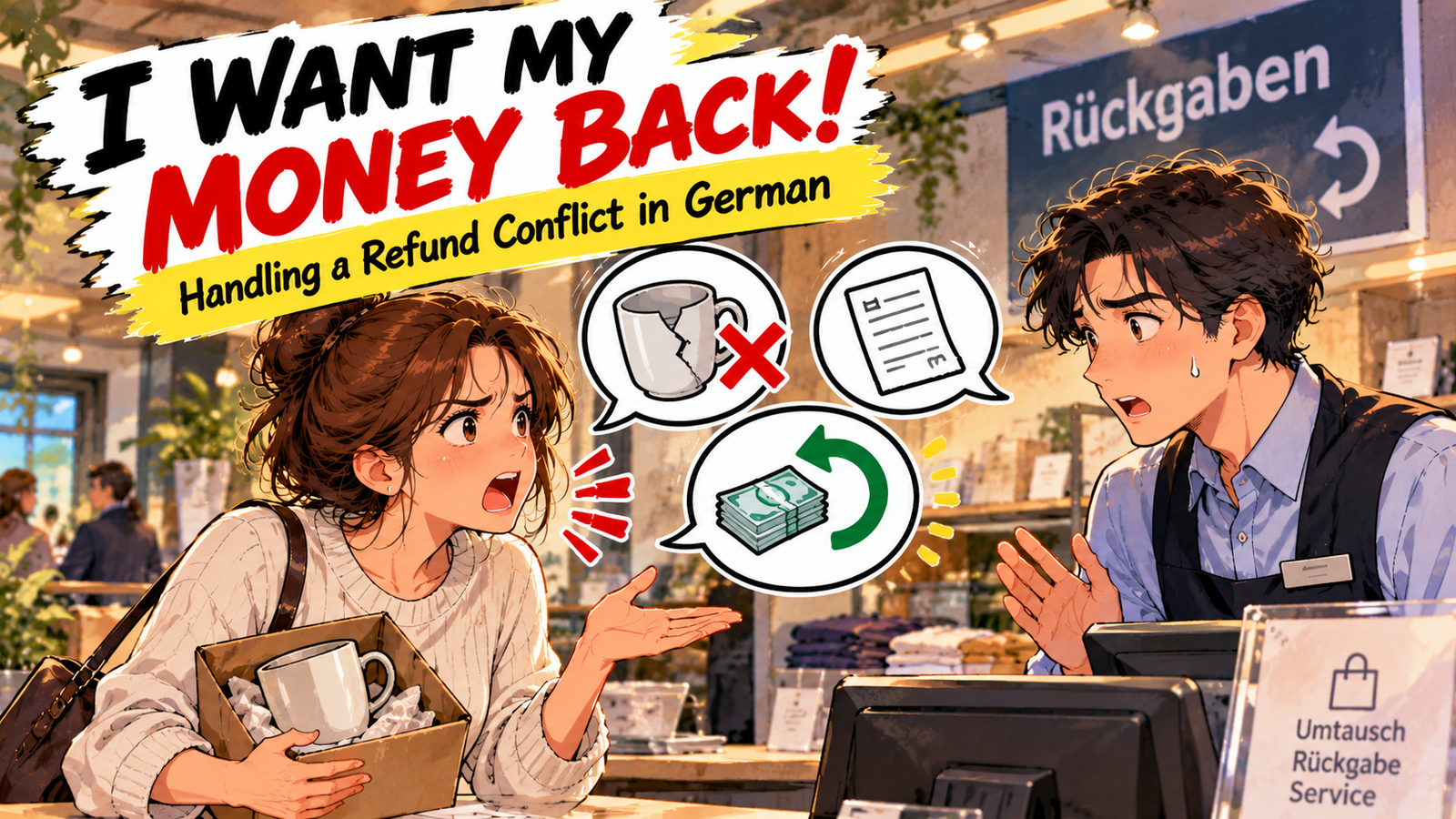
A refund conversation can become uncomfortable very quickly. A customer
walks into a shop with a damaged product, places it on the counter, and
expects an immediate solution. Then comes the complication: there is no
receipt. The customer remembers buying the item in the store, but the
employee cannot immediately verify the purchase. What begins as a simple
return suddenly becomes a conflict about proof, responsibility, store
policy, and what counts as a fair solution.
I like this situation for German practice because it forces me to do
more than memorize shopping vocabulary. I need to ask questions without
sounding suspicious, explain rules without hiding behind them, acknowledge
frustration without promising something I cannot authorize, and offer
alternatives when the customer’s preferred solution is not immediately
available.
From simple return language to professional conflict management
At A1, the goal is practical communication. I need sentences such as
„Was ist kaputt?“, „Haben Sie den
Kassenbon?“, „Einen Moment, bitte.“, and
„Ich kann das prüfen.“ These phrases are short enough to
use even when the customer is impatient.
At A2, I can explain a basic problem: „Ohne Kassenbon kann ich
die Rückgabe nicht sofort bearbeiten.“ I can ask whether the
customer paid by card, when the item was purchased, or whether another form
of proof is available. This turns the conversation from a confrontation
into a search for information.
At B1, the customer may interpret the rule personally: „Glauben
Sie mir nicht?“ Now I need to separate verification from
accusation. A useful response is: „Doch. Ich muss nur prüfen, ob
wir den Kauf in unserem System finden können.“ The purpose is not
to win the argument. It is to keep the conversation factual.
At B2, responsibility becomes more complicated. The customer may say the
product was already defective, while the store cannot immediately determine
when the damage occurred. I need language that avoids premature
conclusions: „Ich kann im Moment weder bestätigen noch
ausschließen, dass der Schaden bereits beim Kauf vorhanden
war.“
At C1 and C2, the conversation becomes a professional exercise in
evidence, policy, discretion, escalation, and service recovery. A strong
response distinguishes what is known, what still needs verification, what
the employee is authorized to do, and what requires a supervisor’s
decision.
Rules should explain the process, not end the conversation
One common communication mistake is to repeat a rule as though the rule
itself were a complete solution. „Ohne Bon keine
Rückgabe.“ may be concise, but it does not tell the customer
whether any other option exists. A more useful professional response
explains both the limitation and the next step: „Für eine direkte
Erstattung brauche ich normalerweise einen Kaufnachweis. Ich kann aber
prüfen, ob wir den Einkauf über Ihre Kartenzahlung finden.“
This structure is valuable in many professional conflicts: acknowledge
the request, explain the constraint, and identify the next available
action.
Do not turn uncertainty into an accusation
If I cannot verify a customer’s story immediately, that does not
automatically mean the story is false. Professional language leaves room
for uncertainty. Instead of saying, “You did not buy this here,” I can say:
„Ich kann den Kauf im Moment noch nicht zuordnen.“ Instead
of saying, “You damaged it,” I can say: „Wir müssen zunächst
klären, wie der Schaden entstanden ist.“
This distinction becomes increasingly important at higher CEFR levels.
Advanced German is not simply longer German. It allows me to express
uncertainty, qualify conclusions, distinguish evidence from assumptions,
and challenge claims without unnecessarily escalating the interaction.
Offer realistic alternatives
A customer asking for money back may still accept another solution if it
is explained clearly. Depending on the situation and store policy, possible
alternatives might include an exchange, repair, store credit, verification
through a card transaction, or review by a supervisor. The language should
make clear which options are confirmed and which still need
authorization.
For example: „Eine direkte Erstattung kann ich Ihnen ohne
Kaufnachweis nicht zusagen. Ich kann jedoch prüfen, ob ein Umtausch möglich
ist, oder meine Filialleitung um eine Einzelfallentscheidung
bitten.“
Escalation can be professional
Calling a supervisor does not necessarily mean that the employee has
failed. Sometimes escalation is exactly the correct professional action
because the requested exception exceeds the employee’s authority. The
important part is explaining the handover properly so the customer does not
have to restart the entire argument.
I can say: „Ich gebe meiner Filialleitung die Informationen
weiter, die wir bereits geklärt haben, damit Sie den Vorgang nicht noch
einmal vollständig erklären müssen.“ This protects continuity and
shows that the complaint is being taken seriously.
What the CEFR progression should teach me
In this lesson, every granular level is a complete scene rather than an
isolated response. At A1, I identify the problem and ask for the receipt.
At A2, I gather enough information to search for the purchase. At B1, I
handle frustration and explain alternatives. At B2, I respond to disputed
responsibility and avoid unsupported conclusions. At C1, I manage policy
and escalation diplomatically. At C2, I distinguish evidence, operational
policy, discretionary service recovery, and process improvement.
The objective is not to make every higher-level sentence unnecessarily
complicated. The objective is to make the communication more precise. If I
can calmly move from „Haben Sie den Kassenbon?“ to
„Lassen Sie uns zunächst trennen, was wir bereits belegen können
und welche Punkte noch geprüft werden müssen.“, then I am learning
how German changes as professional responsibility becomes more complex.


Leave a Reply