
🛡️
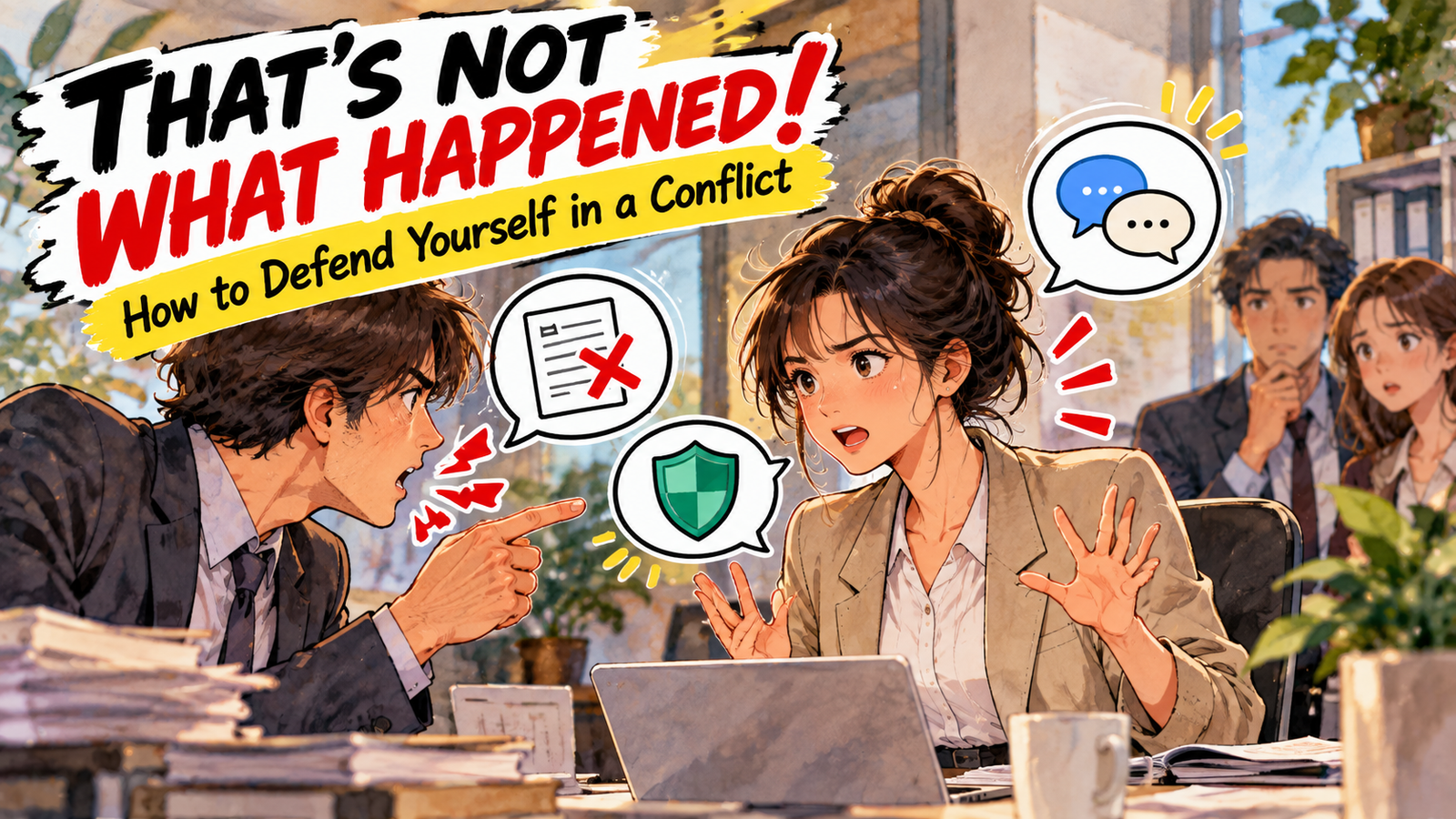
“That’s Not What Happened.” — Defending Yourself in a Workplace
Conflict
Defending myself in a conflict does not have to mean
becoming aggressive. In a professional environment, some of the strongest
responses are calm, specific, and surprisingly simple. If a colleague
blames me for something I did not do, interrupts me repeatedly, raises
their voice, or presents an incomplete version of events, my goal is not to
“win” the argument. My goal is to protect my position, communicate the
facts clearly, and prevent the conversation from becoming disrespectful or
unproductive.
This is especially challenging in another language.
When I feel accused or pressured, I may understand much more German than I
can actively produce. Stress makes long sentences harder. That is why I
find it useful to learn conflict language in layers. At A1, I need a few
short sentences that create immediate boundaries. At A2, I can explain a
simple reason. At B1, I can describe what happened and ask for a fair
discussion. At B2, I can distinguish facts from assumptions and respond to
specific allegations. At C1 and C2, I can defend my position diplomatically
while addressing process, evidence, responsibility, and future
cooperation.
A1: Stop the escalation with simple language
At A1, I do not need an elegant argument. I need functional sentences
that I can remember under pressure: „Bitte sprechen Sie
ruhig.“, „Das stimmt nicht.“, „Ich war
das nicht.“, and „Bitte lassen Sie mich
sprechen.“ These phrases are basic, but they already perform
important professional functions. They reject an incorrect statement,
request respectful behavior, and create space for me to respond.
The
important lesson is that simple German can still communicate a strong
boundary. I do not need advanced grammar to say that something is incorrect
or that I want to finish my sentence.
A2: Add a reason and a basic
factual correction
At A2, I can move beyond a simple denial.
Instead of only saying „Das stimmt nicht“, I can add a
short explanation: „Ich habe die Datei gestern geschickt.“
or „Ich war zu dieser Zeit nicht im Büro.“ I can also ask
the other person to check something: „Bitte prüfen Sie die
E-Mail.“
This is an important step because professional
self-defense becomes stronger when it is connected to something verifiable.
I am not merely contradicting the other person. I am pointing to a fact
that can be checked.
B1: Explain my perspective without attacking
the other person
At B1, I can describe a sequence of events and
explain why I disagree. For example: „Ich verstehe, dass es ein
Problem gab, aber ich habe meine Aufgabe rechtzeitig erledigt.“ I
can also redirect the conversation: „Lassen Sie uns bitte zuerst
klären, was genau passiert ist.“
This level introduces a
useful professional principle: I can disagree with an accusation without
attacking the person making it. Instead of saying “You are lying”,
I can say that my information is different, that a statement does not match
the documented process, or that I would like to review the facts
together.
B2: Separate facts, interpretations, and
responsibility
At B2, defending myself becomes more precise.
Workplace conflicts often contain several different claims at the same
time. Someone may say that a task was late, that I failed to communicate,
and that I caused a larger problem. Those claims should not automatically
be treated as one conclusion.
I can respond with language such as:
„Ich möchte zwischen dem tatsächlichen Ablauf und der
Interpretation unterscheiden.“ I can acknowledge the problem
without accepting inaccurate responsibility: „Dass die Übergabe
nicht funktioniert hat, sehe ich. Ich kann jedoch nicht bestätigen, dass
die Verzögerung durch mich verursacht wurde.“
This is not
avoidance. It is precision. Taking responsibility professionally means
accepting what I actually did or failed to do—not automatically accepting
every conclusion made during an emotional discussion.
C1: Defend my
professional position while preserving cooperation
At C1, the
challenge is often relational. I may need to correct a colleague,
supervisor, customer, or project partner while still preserving the
possibility of working together afterward. The language therefore becomes
more diplomatic: „Ich möchte der Darstellung in diesem Punkt
widersprechen, weil sie einen wesentlichen Teil des Ablaufs nicht
berücksichtigt.“
I can also address communication behavior
directly without escalating: „Ich bin bereit, die Kritik zu
besprechen. Ich möchte das Gespräch jedoch sachlich führen und ausreden
können.“ This combines openness with a boundary. I am not refusing
discussion; I am defining the conditions under which a productive
discussion can happen.
C2: Respond to complex accusations with
evidence and structure
At C2, effective self-defense is less about
producing complicated vocabulary and more about controlling the structure
of the conversation. If several accusations are being combined, I can
separate them. If assumptions are being presented as facts, I can identify
that distinction. If responsibility is unclear, I can refer to documented
decisions, timestamps, agreed procedures, or previous communication.
A useful formulation is: „Ich möchte die Verantwortung nicht
pauschal zurückweisen. Allerdings sollten wir die einzelnen Entscheidungen
anhand der dokumentierten Informationen bewerten, bevor wir daraus
persönliche Verantwortlichkeit ableiten.“ This response neither
accepts nor rejects everything. It asks for a fair evidentiary basis.
At this level, I can also protect myself against an unproductive
communication pattern: „Wenn wir die Situation aufarbeiten möchten,
sollten wir konkrete Handlungen und Entscheidungen besprechen, statt Motive
oder Absichten zu unterstellen.“ That distinction is extremely
useful. Actions can often be verified. Motives are much easier to speculate
about.
Boundaries are not the same as aggression
One of the
most important things I want to remember is that a boundary does not need
to sound threatening. „Bitte lassen Sie mich ausreden.“ is
a boundary. „Ich möchte nicht in diesem Ton angesprochen
werden.“ is a boundary. „Ich bespreche das gern, aber
nicht unter diesen Bedingungen.“ is also a boundary.
The
professional objective is to make the boundary clear enough that the
conversation can either improve or be paused and escalated through the
appropriate channel. If a discussion becomes insulting, threatening, or
impossible to conduct constructively, continuing the argument is not
automatically the most professional choice.
Documentation can be
part of professional self-protection
In more serious workplace
disagreements, memory alone may not be enough. Emails, task records,
meeting notes, timestamps, written approvals, and documented
responsibilities can clarify what actually happened. The language I use
should reflect that evidence carefully. Instead of saying „Ich
weiß, dass ich recht habe“, I can say: „Nach meiner
Dokumentation wurde die Datei am Dienstag um 14:10 Uhr
versendet.“
This makes the discussion less personal. The
focus moves away from who sounds more confident and toward information that
can be reviewed.
What I want to achieve in a conflict
My
goal is not to memorize increasingly sophisticated ways to say “No.” The
progression from A1 to C2 should teach me increasingly sophisticated ways
to protect my position while keeping the conversation grounded. At A1, I
establish a boundary. At A2, I give a reason. At B1, I explain my
perspective. At B2, I distinguish facts and responsibility. At C1, I defend
my position diplomatically. At C2, I structure a complex disagreement
around evidence, process, and fair attribution of responsibility.
That is the kind of German I want available when a meeting suddenly
becomes uncomfortable: not dramatic German, not aggressive German, but
language that helps me stay calm enough to say, clearly and professionally,
„Das ist nicht die vollständige Darstellung. Lassen Sie uns bitte
die Fakten gemeinsam prüfen.“


Leave a Reply