
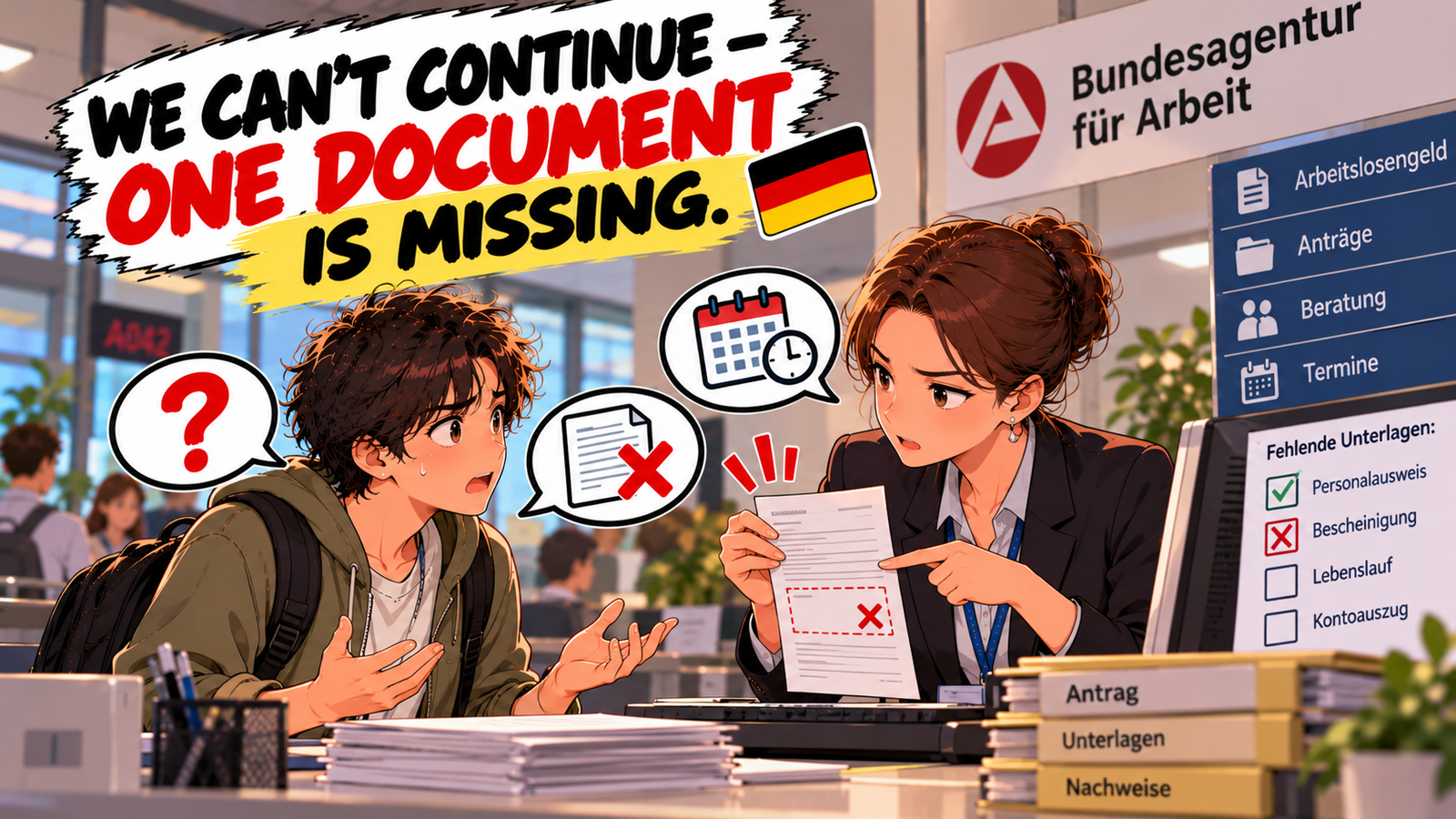
📑 “We
Can’t Continue — One Document Is Missing.” — Clarifying Missing Paperwork
at the Arbeitsamt in German
I arrive for an appointment at an
employment office expecting my case to move forward. Instead, the employee
looks at the file and tells me that one required document is missing. That
immediately creates a practical conflict. Which document? Was I previously
told to bring it? Can I submit it later? Is the document something I can
produce myself, or does it have to come from an employer? Most importantly,
what do I need to do now so that the missing paperwork does not become an
unclear, unresolved problem?
This lesson uses a fictional
employment-office scenario for German language practice. It does not claim
that one particular document, deadline, benefit procedure, or
administrative rule applies to every real case. Actual requirements can
differ by authority and individual situation. The communication skill is
learning how to turn the vague statement “something is missing” into a
specific, documented next step.
Start by identifying exactly what
is missing
At beginner level, the most useful question is also the
simplest: “Welches Dokument fehlt?” Once I know the name of the document, I
can ask where to obtain it, whether a copy is enough, whether the original
is needed, where I can submit it, and by what date. These questions reduce
uncertainty one piece at a time.
The word “Unterlage” appears
frequently in administrative German and can refer broadly to a document or
supporting paperwork. “Nachweis” emphasizes evidence or proof. “Formular”
is a form. Understanding the difference helps me recognize whether the
office wants a particular form, evidence of something, or a general
supporting document.
When somebody else controls the document
A more difficult situation occurs when the missing evidence must come
from an employer or another organization. I may have requested it on time
but still not possess it. In that situation, I need language that separates
what I can control from what I cannot. I can explain that I already
requested the document and ask how that effort should be documented while I
wait.
This is more precise than simply saying, “I don’t have it.”
The office now has useful information: the document is outstanding, I have
taken a step to obtain it, and there may be evidence of that request. At
intermediate levels, the conversation asks whether a temporary alternative
can be accepted or whether another submission path exists.
Make
submission traceable
Another common source of confusion is not the
document itself but whether the office can see that it was submitted. In
the lesson, I practice asking for an “Eingangsbestätigung” and referring to
an “Aktenzeichen.” If I upload something electronically, I ask how I can
confirm that the upload was received. If I submit it another way, I ask
what proof of receipt is available.
The purpose is straightforward:
I want the next conversation to begin with evidence rather than memory.
Instead of saying “I’m sure I sent it,” I can refer to a documented
submission, date, or case reference.
Handle contradictory
instructions calmly
At higher levels, the conflict becomes more
realistic. A checklist may say one thing while a message in my account says
another. An employee may tell me that a document is insufficient even
though I was previously told it would be accepted. The language challenge
is to point out the inconsistency without turning the conversation into an
accusation.
I can say: “Mir wurde vorher gesagt, dass dieses
Dokument ausreicht. Können wir die Anforderung klären?” This focuses on
reconciling the information. At advanced levels, I can ask which written
instruction is currently relevant to my specific case and request that the
clarified requirement be documented.
Deadlines need a concrete
action
A deadline becomes stressful when I do not know what counts
as compliance. If an employer has not produced a document or an upload
system has failed, I need to know what I personally must do before the
deadline. The lesson therefore progresses from “Bis wann?” to more precise
questions about what action must be completed, what evidence of that action
should be kept, and what happens when a delay is outside my direct
control.
The goal is not to assume that a deadline will
automatically change. It is to ask the responsible office what options or
documentation are available in the specific situation.
Escalate an
unresolved requirement, not the argument
If the first employee
cannot reconcile contradictory requirements, I can ask for the responsible
caseworker or supervisor. The advanced scenes make my intention explicit: I
still want to provide the required paperwork and continue the process, but
I need a clear statement of what is required before I can do that
correctly.
This is an important professional communication pattern
in German. I identify the unresolved point, show willingness to cooperate,
request the appropriate decision-maker, and ask for the outcome to be
documented.
The climax: a documented next step
The
strongest resolution is not simply hearing “Okay, bring it later.” I want
to leave knowing the exact missing item, the deadline, the accepted
submission method, who is responsible, what proof I should keep, and what
happens next. At the highest levels, I practice combining those elements
into one precise request.
By the end of the lesson, “one document is
missing” is no longer a dead end. I can turn it into a manageable sequence:
identify the requirement, determine who can provide it, document my
actions, clarify the deadline, submit the evidence in a traceable way, and
confirm the next processing step.


Leave a Reply