
👀 Why
an AI Agent Sometimes Needs a Better Way to Look Back
Imagine
trying to solve a complicated visual puzzle while being allowed to see only
the current screen.
At first, that might not sound too difficult.
You can inspect what is in front of you, choose an action, and see what
happens next. But after twenty or thirty steps, an awkward problem appears:
the earlier screens may contain exactly the clue you now need.
A
person can often handle this naturally. We glance back at a diagram,
compare two earlier states, remember where an object used to be, or
reorganize information on a desk until a pattern becomes obvious.
An
AI agent can face a similar challenge.
A capable multimodal model
may be good at interpreting images and reasoning about them, yet still
struggle when a task unfolds over a long sequence of visual states. The
limitation is not necessarily that the model cannot reason. Sometimes the
surrounding system simply gives it an inconvenient view of its own
experience.
This suggests an interesting design principle:
better reasoning can come from better access to
observations.
Consider an agent exploring a visual maze. It
sees a room, moves through a doorway, discovers a symbol, enters another
area, and later encounters a locked mechanism. The symbol from several
steps earlier may suddenly matter. If the original observation has
disappeared, the agent has to rely on a compressed description or an
imperfect recollection.
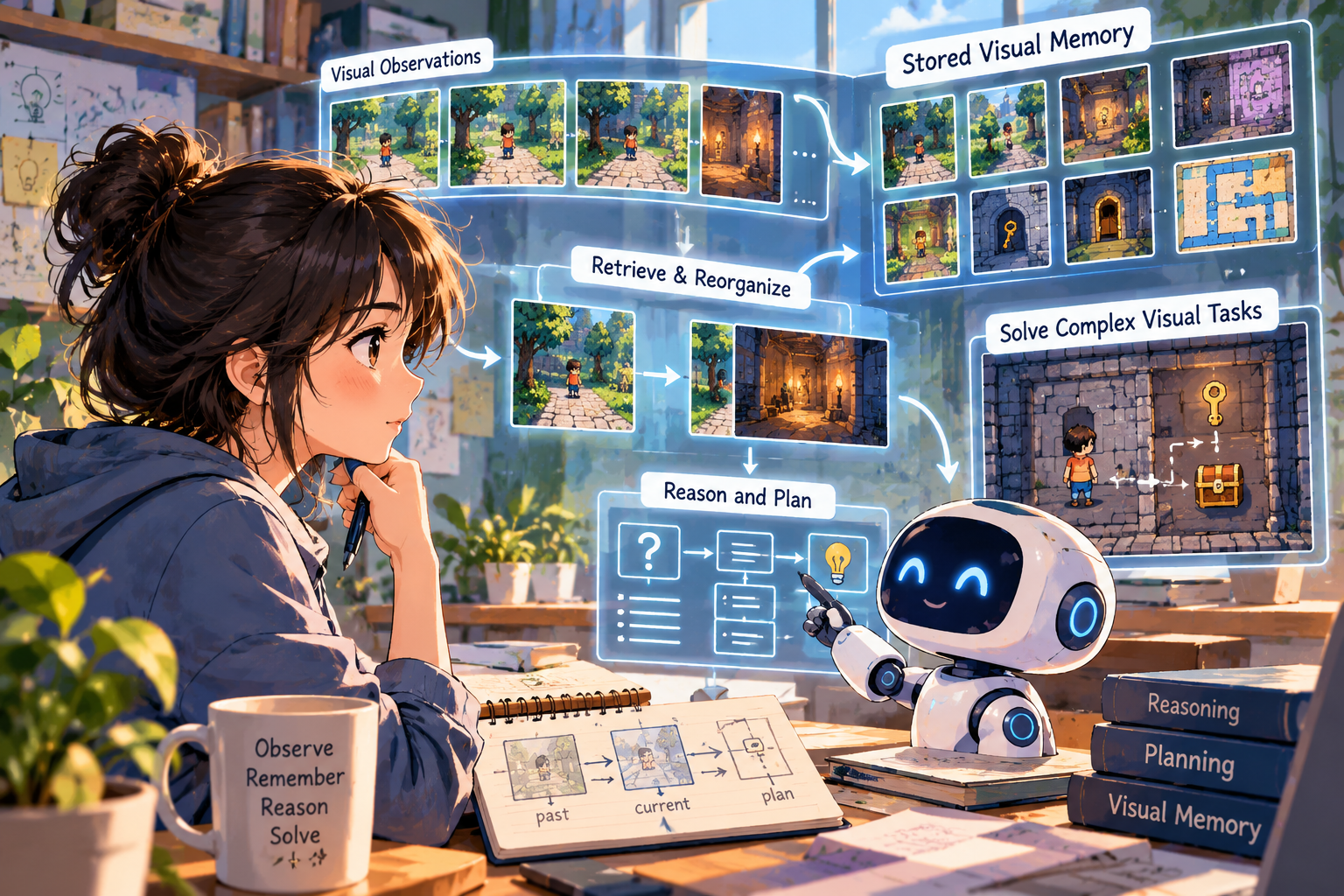
But what if the agent could retrieve the
original visual state?
That changes the problem.
Instead of
treating perception as a disposable stream, the system can preserve
previous observations and make them available again when needed. The agent
is no longer limited to whatever happens to be visible at the present
moment.
This creates something like a visual working
archive.
The word “archive” matters because storing an
observation is different from summarizing it. A summary decides in advance
which details seem important. That can be efficient, but it can also
discard information whose importance becomes clear only later.
Suppose an early screen contains six colored shapes. At the time, the
agent notices only the large triangle because it appears relevant. Much
later, the puzzle reveals that the order of the small circles was actually
the critical clue.
A textual summary such as “a triangle and several
shapes appeared” would not be enough.
The original image might
be.
Preserving observations in their original visual form therefore
protects information from premature compression. It gives the reasoning
process another chance to decide what matters.
Storage alone,
however, is not the interesting part.
A giant folder of screenshots
is useful only if the agent can find the right one.
The more
powerful idea is active retrieval. During reasoning, the
model can decide that an earlier state is relevant, bring it back into
view, and compare it with the current situation.
That makes memory
part of the reasoning loop rather than a passive record of the past.
The agent might ask, in effect: “Where did I see this pattern before?”
or “What changed between the first room and this one?” It can then retrieve
the relevant observations instead of attempting to reconstruct them from a
vague internal trace.
There is another useful step: reorganizing
what the model sees.
Visual reasoning does not always benefit from
chronological order. Sometimes the most useful view places two distant
observations next to each other. Sometimes several related states should be
grouped together. Sometimes an old clue should be displayed beside the
current puzzle.
In other words, the agent can transform a long
history into a task-specific visual workspace.
This
resembles something people do constantly.
When solving a difficult
problem, we rarely keep every piece of information in the order we
encountered it. We put related notes together. We reopen a reference image.
We compare versions. We move useful material closer and ignore irrelevant
material for the moment.
The underlying intelligence has not
changed.
The information arrangement has.
That distinction is
important when evaluating intelligent systems. A model can appear
dramatically weaker or stronger depending on the interface through which it
perceives, remembers, and acts.
If an agent repeatedly forgets
earlier visual evidence, adding more reasoning instructions may not solve
the real problem. The bottleneck may be observational access rather than
inference.
Likewise, if every past image is always displayed
simultaneously, the model may become overwhelmed by irrelevant material.
More context is not automatically better context.
A useful visual
memory system therefore needs two complementary properties:
preservation and selection.
Preservation keeps earlier evidence available.
Selection
determines what should return to the active workspace.
Together,
they support longer chains of interaction without forcing the model to
carry every visual detail in its immediate context at every moment.
This also helps explain why relatively simple surrounding systems can
sometimes produce surprisingly large improvements. The core model may
already possess much of the required reasoning ability. A better
interaction structure can make that ability easier to use consistently.
The broader lesson extends beyond games and puzzles.
Any visual
task with delayed consequences can benefit from remembering exact earlier
states: navigating software, inspecting changing diagrams, following
spatial procedures, comparing interfaces, or tracking objects across a
sequence of actions.
The key question becomes less “Can the model
understand this image?” and more “Can the agent preserve, retrieve, and
arrange the right visual evidence across time?”
That is a different
kind of intelligence problem.
It is partly about perception, partly
about memory, and partly about controlling attention.
And sometimes
the biggest improvement does not come from teaching the model a new
trick.
It comes from giving the model a better desk.


Leave a Reply