
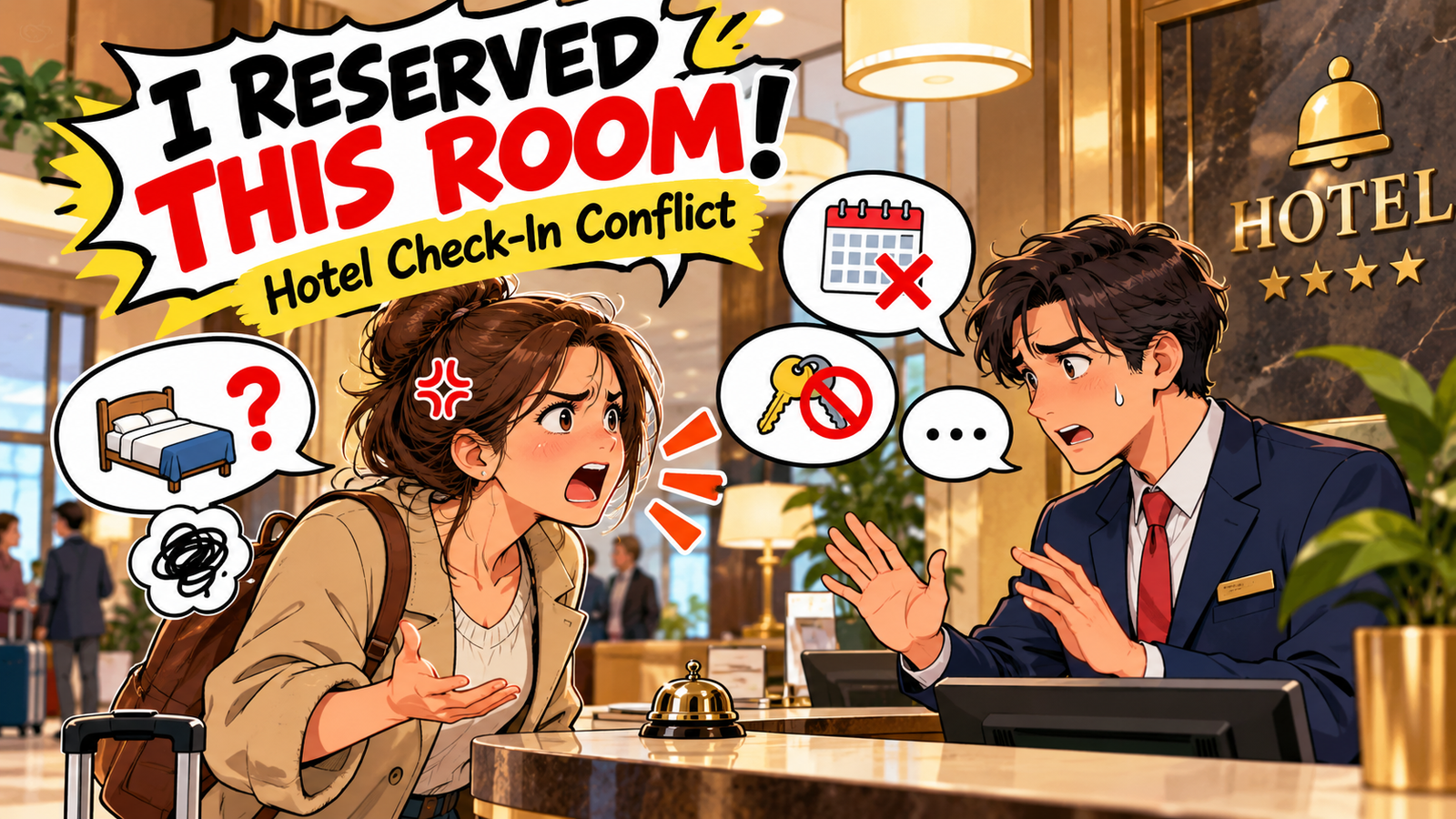
🏨 “I
Reserved This Room!” — A Hotel Check-In Conflict
One of the most
useful things I have learned about professional German is that difficult
conversations rarely begin with difficult vocabulary. They usually begin
with a simple expectation that has not been met. A guest has a reservation.
The confirmation says the room should be available. The guest arrives tired
after a long journey, walks to reception, and hears the sentence nobody
wants to hear: „Ihr Zimmer ist leider noch nicht
fertig.“
That is the moment when an ordinary check-in can
become a conflict. For me, this makes a hotel reception an excellent place
to practice German. The language has to do several jobs at once. I need to
understand the complaint, acknowledge the guest’s frustration, explain what
has happened without sounding defensive, communicate what I can and cannot
promise, and offer a realistic solution. All of that has to happen while I
remain polite and professional.
Why this situation is
linguistically useful
At beginner level, the situation starts with
concrete language: „Ich habe eine Reservierung.“,
„Das Zimmer ist noch nicht fertig.“, „Wie lange
muss ich warten?“, and „Es tut mir leid.“ These
sentences are short, but they already introduce an important distinction
between describing a problem and responding to it professionally.
As
my German improves, the challenge changes. I no longer need only the
vocabulary for Zimmer, Reservierung, Schlüssel,
and Rezeption. I need language for expectation management:
„Ich verstehe, dass Sie mit einem bezugsfertigen Zimmer gerechnet
haben.“ I also need language for responsibility without making
promises I cannot keep: „Ich prüfe sofort, welche Alternative wir
Ihnen anbieten können.“
A complaint is not automatically a
personal attack
In a stressful service situation, it is easy to
react to the guest’s tone instead of the underlying problem. If somebody
says, „Das ist nicht akzeptabel!“, my first instinct might
be to defend the hotel. Professionally, however, it is more useful to
identify the concrete issue. The guest expected a room at the agreed
check-in time, and that expectation has not been met.
Acknowledging
that fact does not mean agreeing with every accusation. It means showing
that I have understood the reason for the complaint. A sentence such as
„Ich verstehe, warum Sie verärgert sind.“ can lower the
emotional temperature of the conversation without admitting something that
I cannot verify.
Explaining the problem without hiding behind
excuses
Another useful skill is learning the difference between an
explanation and an excuse. If housekeeping has been delayed, I can explain
that the room is still being prepared. But repeating internal operational
details will not necessarily help the guest. The guest usually wants to
know what happens next.
That is why solution-oriented language
matters. Instead of stopping at „Das Zimmer ist noch nicht
fertig.“, I can continue with something concrete: „Ich
kann Ihr Gepäck aufbewahren und prüfen, ob ein anderes Zimmer bereits
verfügbar ist.“ The second version gives the conversation
direction.
Being precise about time
Conflict often becomes
worse when vague promises are used to make somebody feel better
temporarily. Saying „Es dauert nur fünf Minuten“ is risky
if I do not actually know that. A more professional formulation is:
„Nach aktuellem Stand rechnen wir mit ungefähr zwanzig Minuten. Ich
informiere Sie sofort, falls sich daran etwas ändert.“
This
kind of language is useful far beyond hotels. It teaches me how to
communicate uncertainty honestly while still sounding competent. I am not
avoiding responsibility; I am separating what I know from what I am still
checking.
Offering alternatives without losing control of the
conversation
When the expected solution is unavailable,
alternatives become important. Depending on the situation, the hotel might
be able to store luggage, provide access to a lounge, offer another
available room, or involve a supervisor. The important language skill is
not simply listing options. I need to present them clearly enough that the
guest can make an informed choice.
For example: „Sie können
entweder hier warten, während wir das Zimmer fertigstellen, oder ich prüfe,
ob wir Ihnen sofort ein anderes Zimmer anbieten können.“ This
gives the guest agency without promising an option that has not yet been
confirmed.
De-escalation at an advanced level
At B2, C1,
and C2, the conflict becomes less about individual vocabulary and more
about professional judgment. I practice distinguishing between the guest’s
legitimate complaint, the operational cause of the delay, and the response
that the hotel can realistically provide. I also practice language that
protects both the customer relationship and professional boundaries.
A useful advanced sentence is: „Ich möchte Ihnen nichts
versprechen, was wir anschließend nicht einhalten können. Lassen Sie mich
deshalb zuerst prüfen, welche Lösung tatsächlich verfügbar ist.“ I
like this formulation because it combines empathy, transparency, and
action.
At the highest levels, the conversation also becomes a
question of process improvement. If rooms repeatedly remain unavailable
after the communicated check-in time, the problem should not be treated as
a series of isolated complaints. The team may need to review communication
between reception and housekeeping, the accuracy of availability
information, escalation procedures, and the way expected delays are
communicated before guests arrive.
What I want to learn from this
scenario
My goal is not to memorize one perfect sentence for every
angry guest. Real conflicts are too unpredictable for that. I want to build
a flexible set of professional patterns: acknowledge the concern, clarify
the facts, explain the current situation, avoid unsupported promises, offer
realistic alternatives, and confirm the next step.
That progression
is reflected in the exercise below. The early levels focus on basic hotel
vocabulary and simple check-in problems. Intermediate levels introduce
complaints, apologies, waiting times, and alternatives. Advanced levels
focus on expectation management, de-escalation, operational responsibility,
and systematic improvement.
If I can handle the sentence „I
reserved this room!“ without panicking, becoming defensive, or
accidentally promising the presidential suite, I am not just learning
German vocabulary. I am learning how German works in a real professional
conflict.


Leave a Reply