
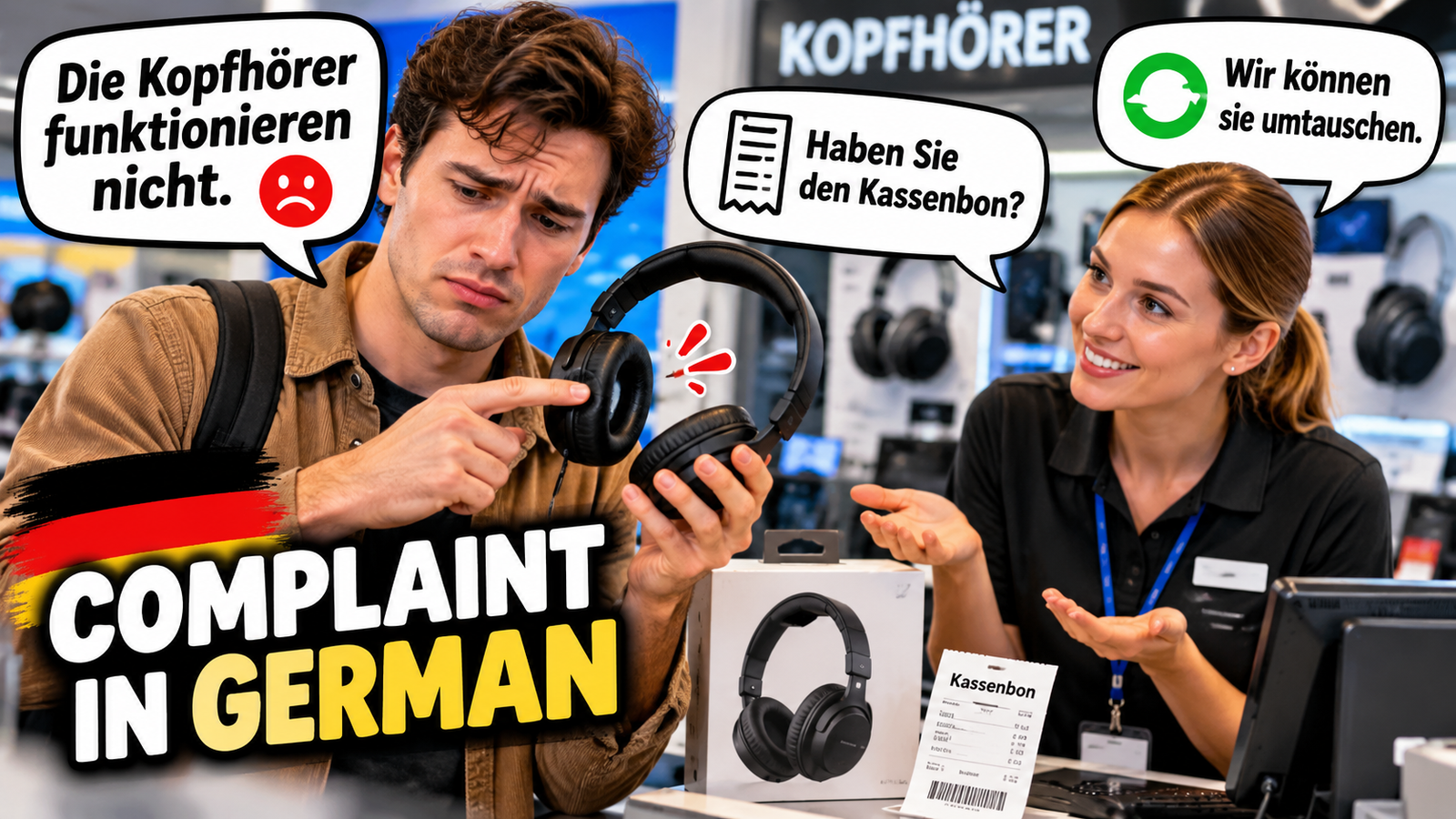
🎧 My New Headphones Lasted Three Days Before I Had to Complain in
German
I thought buying a pair of headphones in Germany would be one of those
pleasantly simple transactions. I would walk into an electronics store,
compare a few models, choose one, pay, and leave feeling unusually
competent. There would be no complicated German conversation, no confusing
paperwork, and absolutely no reason to learn vocabulary for customer
complaints.
Three days later, the right headphone stopped working.
Not gradually, either. One moment I was listening to music normally, and
the next moment half of the song had apparently decided to move somewhere
else. The left headphone worked perfectly. The right headphone had entered
a state of complete technological silence.
I disconnected Bluetooth and connected it again. Nothing. I restarted my
phone. Nothing. I charged the headphones. Still nothing. I connected them
to my laptop because apparently I needed a second electronic device to
confirm that the first electronic device was not responsible for
disappointing me.
The right side remained silent.
That was when I realized I had a new German-learning opportunity that I
had not requested: returning to the electronics store and explaining a
defective product.
At first, I tried to prepare the simplest possible sentence. I did not
need to give the employee a detailed technical diagnosis. I just needed to
communicate the problem. So I practiced „Die Kopfhörer
funktionieren nicht.“
That was my A1 survival sentence. The headphones did not work. Simple,
direct, and almost impossible to misunderstand.
I also made sure that I had the receipt because I knew there was a
reasonable chance the next question would be „Haben Sie den
Kassenbon?“ Fortunately, I had kept it instead of performing my
usual receipt-management system, which consists of putting receipts
somewhere extremely safe and then immediately forgetting where that safe
place is.
When I arrived at the store, I explained the problem. The employee asked
what exactly was wrong, and suddenly „Die Kopfhörer funktionieren
nicht.“ felt slightly incomplete. Technically, the headphones did
work. Half of them worked extremely well.
So I upgraded my explanation: „Der linke Kopfhörer funktioniert,
aber der rechte ist kaputt.“
That was much better. Now I could identify the specific problem instead
of accusing the entire product of failure.
The employee then asked whether I had already tried connecting the
headphones to another device. Fortunately, I had. My unnecessary-looking
experiment with the laptop had suddenly become useful evidence.
I explained, „Ich habe sie sowohl mit meinem Smartphone als auch
mit meinem Laptop getestet.“ That sentence felt surprisingly
satisfying. I was no longer simply arriving with a broken product. I could
explain what I had already done to investigate the problem.
This was where the conversation started becoming more interesting from a
language-learning perspective. At a basic level, I only needed to say what
was wrong. At a more intermediate level, I needed to describe what had
happened, what I had tested, and what result I had observed.
I could say, „Seit gestern funktioniert die rechte Seite nicht
mehr.“ I could explain that „Das Problem bleibt leider
bestehen.“ And when the employee discussed possible solutions, I
could express what I actually wanted instead of simply accepting whatever I
happened to understand.
My preference was straightforward: I liked the headphones. I did not
want a completely different product. I wanted the same headphones, except
preferably with the revolutionary feature of producing sound on both
sides.
So I said, „Ich würde die Kopfhörer am liebsten direkt
umtauschen.“
That sentence was useful because it expressed a preference without
turning it into a demand. I was not saying that the employee had exactly
one acceptable option. I was explaining which solution I preferred.
As my German became more advanced, I realized that customer complaints
involve much more than knowing words such as kaputt,
Kassenbon, and umtauschen. A professional complaint is
really an exercise in separating observations from conclusions.
I knew that the right headphone did not produce sound. That was an
observation. I suspected that there was a technical defect. That was a
conclusion.
Instead of presenting my conclusion as unquestionable fact, I could say,
„Daher gehe ich davon aus, dass tatsächlich ein technischer Defekt
vorliegt.“
That sounded much more precise. I had tested the headphones with
different devices, reset them, and repeated the connection process. Based
on those observations, a defect seemed likely. But I was not pretending
that I had secretly become an electronics engineer during the bus ride to
the store.
The employee also became more precise. Instead of promising an immediate
replacement without checking anything, she explained that she first needed
to see whether the same model was available.
This introduced another useful part of German: conditions.
„Das sollte möglich sein, sofern wir das gleiche Modell auf
Lager haben.“
I particularly liked „sofern“ because it made the
condition explicit. The exchange might be possible, but it depended on
availability. Suddenly, the conversation was not simply about yes or no. It
was about what could happen under different circumstances.
That meant I also needed a second option.
I asked, „Falls es nicht verfügbar ist, könnte ich auch ein
vergleichbares Modell nehmen?“
Now the conversation had developed from “broken headphones” into an
actual negotiation. My preferred solution was an identical replacement. If
that was impossible, I was willing to consider an alternative.
Of course, “alternative” can be a dangerous word when electronics are
involved. Two products can both be described as wireless headphones while
having completely different battery life, sound quality, controls, comfort,
and features. I did not want to exchange the product simply because another
box happened to contain approximately the same shape of object.
At a more advanced level, I could express that condition clearly:
„Das wäre für mich ebenfalls denkbar, vorausgesetzt, die
technischen Eigenschaften sind ähnlich.“
This was a significant improvement over my original plan of pointing at
the headphones and saying „kaputt“ with a disappointed
expression.
By C1, the language became useful for handling the complaint without
making the conversation unnecessarily confrontational. I could say that the
headphones had failed „trotz sachgemäßer Nutzung“. I could
explain the troubleshooting steps in sequence. I could describe my
conclusion as a reasonable assumption rather than an established fact.
For example, „Da der Fehler unabhängig vom verwendeten Gerät
auftritt, vermute ich einen Defekt am Kopfhörer selbst.“
That sentence does several things at once. It explains the evidence,
connects the evidence to a conclusion, and still leaves room for the
possibility that the conclusion could be wrong.
I began to understand that this kind of precision is extremely useful in
professional communication. Being confident does not require pretending to
know more than you actually know.
The employee could respond in the same way. She could say that my
explanation sounded plausible without claiming that the technical diagnosis
had already been confirmed. She could explain the next step, check
availability, and offer alternatives if necessary.
At C2, the complaint became less about vocabulary and more about
controlling nuance.
I could distinguish the defect itself from the solution I wanted. I
could say, „Mir geht es weniger um den Defekt an sich als um eine
möglichst unkomplizierte Lösung.“ That sentence communicates
something much more specific than simply saying that I am unhappy.
I could also describe my troubleshooting more systematically:
„Ich habe das Gerät auf Werkseinstellungen zurückgesetzt, die
Kopplung auf mehreren Endgeräten wiederholt und sowohl die Firmware als
auch die Audioeinstellungen überprüft.“
At that point, my complaint sounded considerably more technical than the
original moment in my apartment when I repeatedly tapped the right
headphone and wondered whether disappointment counted as a troubleshooting
method.
The most useful C2 distinction was between what the evidence suggested
and what had actually been confirmed. I could say, „Da der Fehler
reproduzierbar und unabhängig vom jeweiligen Endgerät auftritt, halte ich
einen Hardwaredefekt für die wahrscheinlichste Erklärung.“
The employee, meanwhile, could acknowledge that reasoning while
maintaining an appropriate degree of uncertainty: „Eine endgültige
technische Beurteilung kann ich zwar nicht vorwegnehmen, aber aufgrund
Ihrer Beschreibung spricht einiges dafür, dass das Gerät überprüft
beziehungsweise ersetzt werden sollte.“
That is the kind of sentence that would have terrified me when I first
started learning German. Now I could see its internal logic. There was a
limitation, an assessment based on available information, and a proposed
next step.
The final negotiation concerned the replacement. If the exact model was
unavailable, I was willing to consider something comparable, but not
without conditions. I wanted similar sound quality, battery life, and
functionality.
So instead of simply saying „Das ist okay.“, I could
say, „Eine Alternative käme grundsätzlich infrage, sofern ich
dadurch hinsichtlich Klangqualität, Akkulaufzeit und Funktionsumfang keine
wesentlichen Abstriche machen müsste.“
That sentence is obviously far beyond what an A1 learner needs in an
electronics store. But that is exactly what makes the progression
interesting.
The situation never really changed.
I bought headphones. One side stopped working. I returned to the store.
I explained the problem. The employee investigated it. We discussed a
replacement.
What changed was how much control I had over the conversation.
At A1, I could report the problem. At A2, I could describe exactly what
was broken. At B1, I could explain what I had already tested. At B2, I
could connect evidence with conclusions and discuss alternatives. At C1, I
could communicate professionally while distinguishing assumptions from
facts. At C2, I could negotiate conditions, preferences, uncertainty, and
technical equivalence with considerable precision.
That is one of the things I like most about learning German through real
situations. Advanced German does not necessarily mean finding a completely
different situation to talk about. Sometimes it means returning to the same
ordinary problem and discovering that you can suddenly express much more of
what you actually think.
And yes, eventually I got working headphones.
I tested both sides before leaving the store.
Some vocabulary lessons only need to happen once.


Leave a Reply