
🎟️
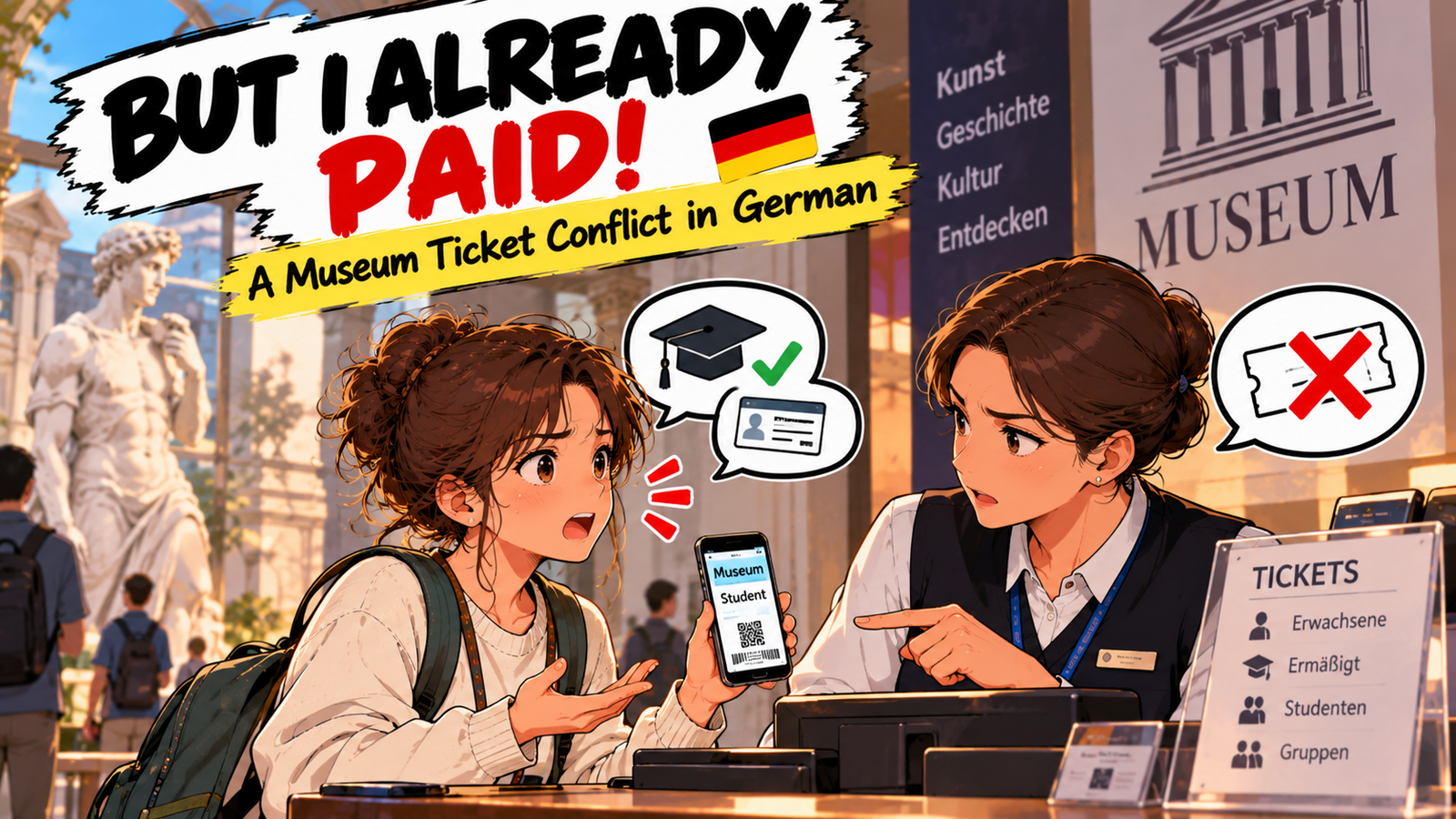
“But I Already Paid!” — A Museum Ticket Conflict in German
I am
visiting a museum when a very ordinary problem suddenly becomes a German
conversation challenge. I have already bought a reduced student ticket, but
at the entrance an employee asks me to stop. The ticket is visible on my
phone, yet something is missing: the employee also wants proof that I am
currently a student.
This is not a dramatic emergency. Nobody needs
to shout or win an argument. It is exactly the kind of small conflict that
makes everyday language useful. I need to explain what I bought, understand
what the employee needs, ask a question when a rule is unclear, and find a
practical solution without making the situation unnecessarily hostile.
The easiest conflict language is often enough
At the beginning,
I do not need complicated grammar. I can say that I have a ticket. I can
say that I am a student. I can show my identification and ask a short
question such as “Why?” or “Is this okay?” These small sentences already
give me a way to participate in the situation instead of freezing when
something unexpected happens.
This matters for beginners because
real conversations are rarely perfect textbook exchanges. A person may not
understand my first sentence. I may not understand a rule. An employee may
ask for something I did not expect. Simple language becomes powerful when I
can use it calmly and repeatedly.
Clarifying is better than
guessing
As my German improves, I can ask more precise questions.
Is the ticket itself invalid, or is only the student proof missing? Can I
show a digital student card? Do I need an original document? Can the
employee check the booking number? Is there another desk where the issue
can be corrected?
These questions turn a vague disagreement into a
specific problem. Instead of saying, “This is unfair,” I can ask, “Which
document do you need?” Instead of assuming that I must buy another ticket,
I can ask whether my existing booking can be verified.
Being polite
does not mean giving up your position
A useful conflict skill is
staying polite while explaining my position clearly. I can acknowledge the
employee’s rule and still say that the information was not obvious when I
bought the ticket. I can ask the employee to check again. I can explain
that I have already paid and would prefer not to purchase a second ticket
before we understand what happened.
This language is useful far
beyond museums. Students, tourists, visitors, and hobby enthusiasts
encounter similar misunderstandings at exhibitions, attractions, events,
libraries, transport counters, and public venues.
Rules can be
correct and communication can still fail
At higher levels, the
conversation becomes more nuanced. The employee may be following a
legitimate discount policy, while I may also have a reasonable complaint
about how the requirement was presented during online booking. Both things
can be true at the same time.
I can distinguish between the rule
itself and the way it was communicated. I might say that I understand why
student status needs verification, but that the requirement for a
particular form of identification was not sufficiently clear during
purchase. This creates room for a solution without accusing the employee
personally.
From a ticket problem to service recovery
An
advanced conversation can also discuss what should happen after the
immediate problem is solved. Perhaps the museum accepts my digital proof
this time. Perhaps I need to pay the difference to a regular ticket.
Perhaps the employee asks a supervisor for an exception. Whatever the
result, the organization can still learn from the misunderstanding.
If several visitors regularly arrive without the required document, the
problem may not be individual carelessness. The booking page, confirmation
email, signage, or discount description may need to communicate the
requirement more clearly.
The goal of this lesson
The
German conversations below begin at the easiest possible point for a
student or visitor: short statements about having a ticket, being a
student, showing an ID, and asking what is wrong. Each later scene
introduces more independence. The learner begins to clarify rules, explain
a booking, negotiate a practical solution, distinguish policy from
communication, and finally discuss how the organization could prevent the
same conflict for future visitors.
The central skill remains the
same throughout: I want to protect my position without turning a small
misunderstanding into a bigger confrontation. Clear questions, calm
explanations, and practical solutions are often more effective than
aggressive language.


Leave a Reply