
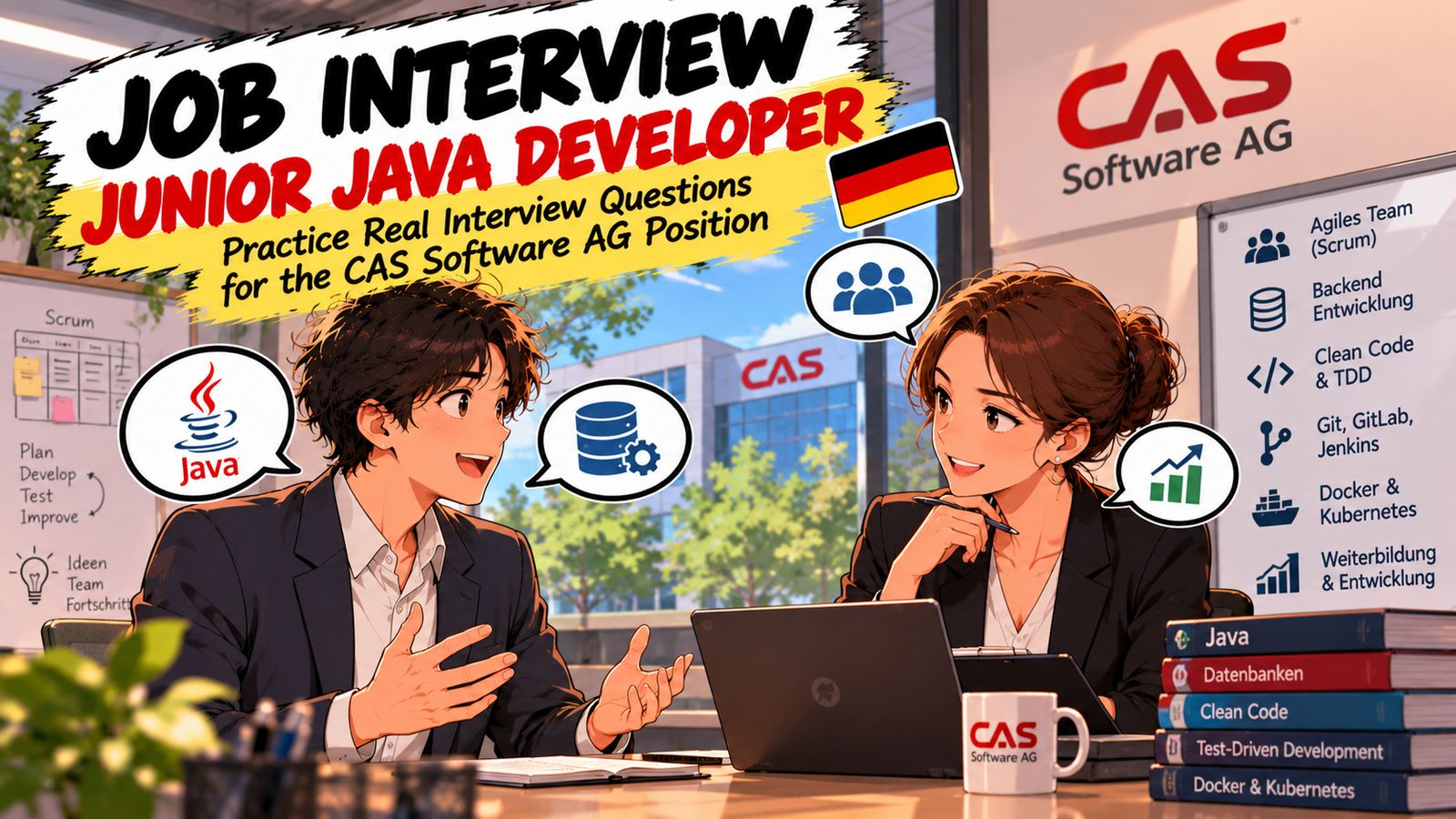
☕ “Why
Should We Hire You as a Junior Java Developer?” — Practicing a German
Backend Job Interview
I am preparing for a Junior Java Developer
interview based on a role that focuses on server-side applications and
databases. The position describes work across the development process, from
understanding needs and contributing to a concept through development and
implementation. It also places the developer in a multidisciplinary Scrum
team where responsibility, improvement and knowledge sharing matter.
That means my preparation should go beyond Java syntax. I need to
explain what I have actually built, how I approach backend problems, what I
know about relational databases, how I collaborate, and how I learn
practices or technologies in which my experience is still limited.
Present junior experience credibly
The role asks for a
computing-oriented degree or vocational background, or someone close to
completing one, together with first experience developing professional
applications in object-oriented languages such as Java or C#. That
experience may come from internships, working-student work or an initial
role after studying. In an interview, I should therefore describe concrete
work rather than inflate my seniority.
Connect Java to backend
engineering
The posting emphasizes backend development. A useful
answer explains not only that I know Java, but what I did with it: classes,
business logic, data access, interfaces, error handling or tests when those
are genuinely part of my experience. A small project explained precisely is
more credible than a broad list of technologies.
Be ready to
discuss relational databases
Relational database knowledge is
explicitly relevant. I practice describing tables, relationships, keys, SQL
and data consistency through examples. The interview becomes stronger when
I can explain why data was structured a certain way and what queries or
application behavior the structure supported.
Clean Code and
TDD
The posting treats first contact with Test-driven Development
and Clean Code as a plus rather than a strict prerequisite. That gives me
room to distinguish knowledge from experience. I can explain what I have
already practiced, state honestly where my experience is limited, and
describe how I would learn through a small task, team conventions, reviews
and feedback.
Scrum, ownership and knowledge sharing
The
role expects work in a multidisciplinary Scrum team and encourages taking
responsibility, looking beyond one’s immediate task and driving
improvements. I therefore practice questions about unclear requirements,
code review, technical disagreement, ownership and knowledge sharing. Good
answers make assumptions visible, keep disagreements technical rather than
personal and show that I can ask for help without abandoning
responsibility.
The development environment
The posting
names Git, GitLab, Jenkins, SonarLint, Docker, Kubernetes, Confluence and
Jira among the tools supporting the work. I should not claim expertise in
every tool merely because it appears in the advertisement. Instead, I can
say which tools I have actually used, which I have only encountered and how
I would become productive with unfamiliar parts of the environment.
From need to implementation
A central theme is accompanying
software from needs analysis through conception to development and
implementation. At higher levels, I practice explaining an engineering
process: clarify the need and constraints, agree on acceptance criteria,
consider data and interfaces, identify error cases, implement in manageable
steps, test important behavior, seek review and verify the integrated
result.
Why this role?
The posting describes individual
onboarding with a mentor and emphasizes development through the CAS
Akademie. For a junior candidate, that makes growth part of the interview
story. I can connect my current foundation—object-oriented development,
computing knowledge and first database experience—to the skills I want to
deepen in a professional Java backend environment.
By the final
levels, the goal is not to sound like a memorized “perfect candidate.” It
is to sound like a credible junior developer: technically grounded, honest
about experience, willing to learn, comfortable collaborating and able to
explain how an unclear requirement becomes a maintainable
implementation.


Leave a Reply