
⚡
“Architecture Has to Survive Production.” — A Java Software Architecture
Interview in German
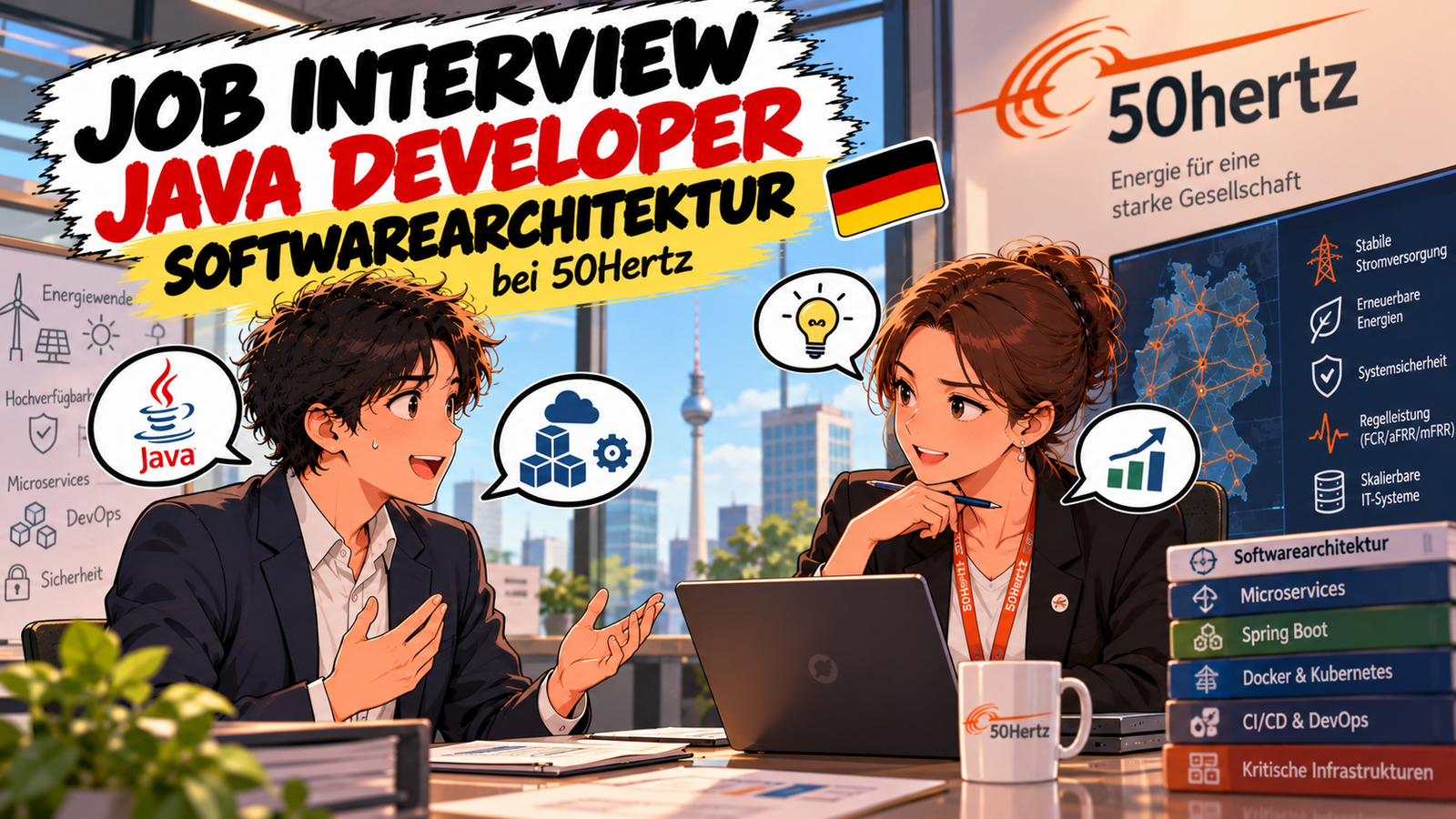
I am preparing for a Java Developer interview
with a strong software-architecture focus at 50Hertz. The role described in
the posting connects Java development, architecture and operation. It
includes technical guidance of development teams, responsibility for target
architecture, highly available and scalable systems, production stability,
service structures, code quality, IT security, documentation, tests,
releases and collaboration with operations, Product Owners, business units
and other stakeholders.
This is therefore not an interview where
memorizing Java definitions is enough. The strongest questions test what
happens after my first answer. If I recommend microservices, I should be
ready to justify their operational cost. If I claim high availability
experience, I should be able to discuss failure modes and recovery. If I
describe myself as a technical leader, I should explain what happens when
experienced engineers disagree with me.
Expressions make the
interview realistic
Each dialogue contains an expression such as
interested, skeptical, analytical, calm or challenging. The interviewer
reacts to my answer instead of simply moving to an unrelated question. I
also practice controlling my own tone. A production incident may require a
focused answer; an architecture disagreement may require a diplomatic one;
a security challenge may require a firm answer.
Architecture is
more than diagrams
The posting emphasizes architecture principles,
target architectures and technology stacks. I therefore practice
architecture as a set of decisions about boundaries, interfaces,
availability, scalability, security, maintainability, deployment and
operation. A target architecture also has to acknowledge the current
system, constraints, risks and technical debt.
Production is part
of the design
The role covers the complete service lifecycle:
design, build or DevOps, and run. Several interview scenes therefore begin
with unstable production services, incidents, observability or release
risk. I practice separating confirmed facts from hypotheses, stabilizing
service before making risky changes and continuing the work after recovery
through root-cause analysis and prevention.
Microservices, APIs and
scalability
The posting requests strong knowledge of microservice
architectures and API-centered system designs. The quiz deliberately
challenges simplistic enthusiasm. Microservices can improve independent
evolution or scaling, but they also create network, deployment and
observability complexity. APIs need clear contracts, error behavior,
security and versioning. Scalability needs evidence about real bottlenecks
rather than assumptions.
Quality, security and critical
infrastructure
Code quality, IT security, documentation and best
practices are explicit responsibilities. Because the company operates
electricity-transmission infrastructure, the interview also explores what
changes when failures or security problems can have more serious
consequences. I practice treating security as an architectural concern and
regulatory requirements as something to translate with the appropriate
domain experts rather than interpret casually on my own.
Technical
leadership
The role includes technical steering and architectural
responsibility. Technical leadership does not mean that my preferred
solution must always win. I need to make criteria explicit, invite
challenge, support engineers and accept better alternatives. At the same
time, unresolved security or stability risks cannot simply disappear
because consensus is difficult. The interview therefore includes
disagreement, escalation and decision-making under uncertainty.
Stakeholders and domain learning
The posting calls for close
collaboration with operations, Product Owners, business units and other
stakeholders. I practice translating architecture into consequences they
can use: reliability, delivery risk, future change or operating effort.
Knowledge of control-reserve processes such as FCR, aFRR and mFRR is listed
as advantageous, so the interview also tests whether I can admit a domain
gap and explain a disciplined way to close it.
The final
challenge
The strongest closing answer connects Java, architecture,
production, quality, security and collaboration. I should also be able to
identify where I still need to learn. Across all 36 scenes, the central
skill is not delivering a polished first sentence. It is remaining
technically credible when the interviewer reacts, challenges an assumption
and asks the second question.


Leave a Reply