
🌀 I
Tried to Explain a Picture That Contains Its Own World in German
I
thought describing an image in German would be easy. I had described
photographs before. There is a person. There is a building. Something is in
the foreground. Something else is in the background. If necessary, I can
become extremely adventurous and mention that an object is „links
im Bild“.
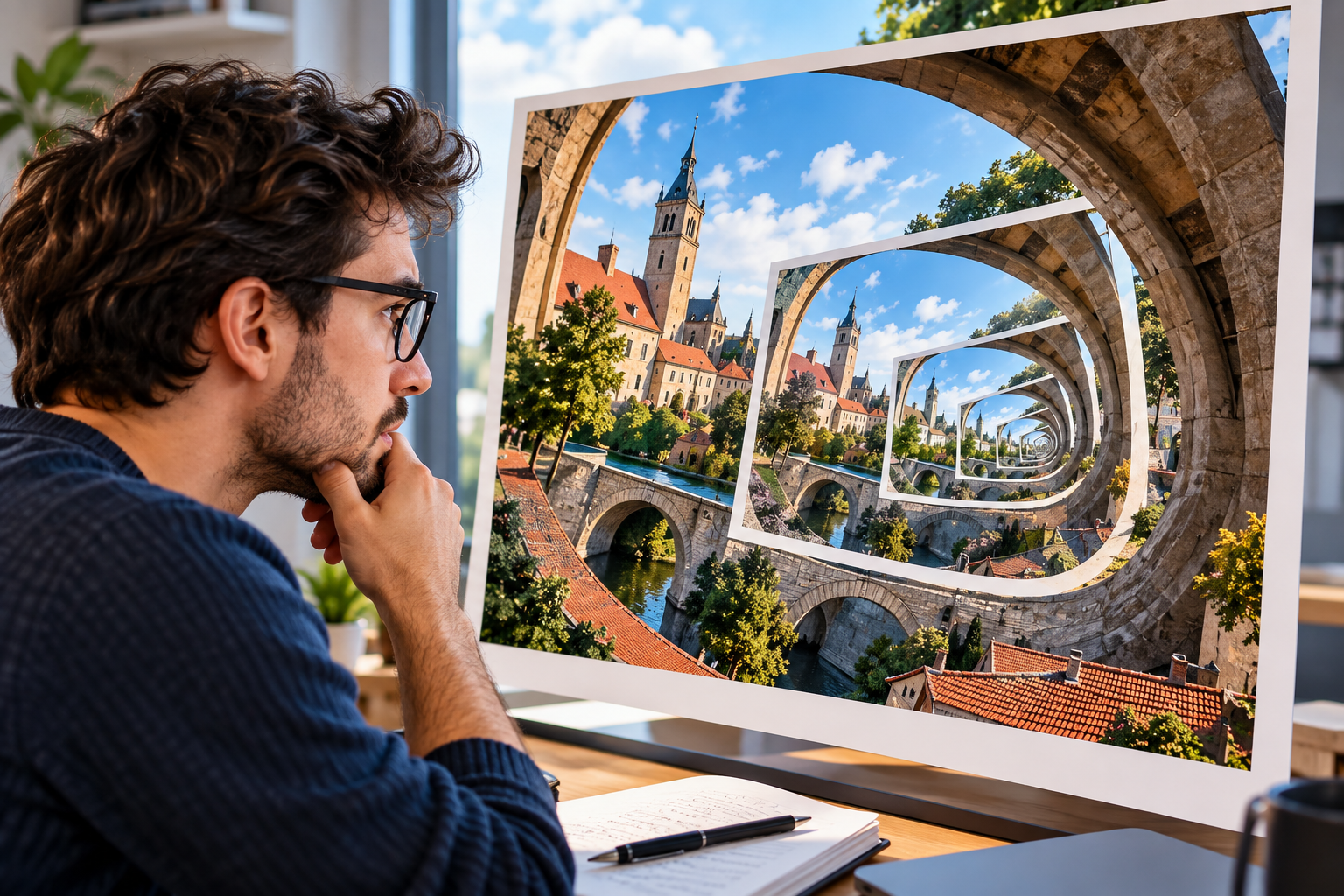
Then a colleague showed me an image that seemed
to contain another version of its own scene.
That immediately
destroyed my comfortable little vocabulary plan.
The picture was not
simply showing an object. Its geometry appeared to bend into itself. A
region of the scene seemed connected to another representation of the same
visual world, creating the impression that the image was somehow referring
back to itself.
I stared at it for a while and produced my first
highly technical German analysis: „Das Bild ist sehr
seltsam.“
It was not wrong.
It was also not going to
carry me very far through a conversation about recursive geometry and
generative models.
I started with a more useful expression:
„Das Bild verweist auf sich selbst.“ The image refers to
itself.
That gave me a simple way to describe self-reference without
immediately trying to explain the mathematics behind it. At an early
language level, that was enough. I could say that the image looked unusual,
that one part appeared inside another part, and that the scene seemed to
repeat itself.
But the more closely I looked, the less accurate the
word “repeat” became.
This was not ordinary repetition like copying
the same photograph three times. The structure had been transformed.
Positions changed. Scale changed. Straight relationships could become
curved ones. The scene was recognizable, but its geometry followed a
different arrangement.
I learned to say, „Die Geometrie des
Bildes wurde transformiert.“
That sentence was already much
better than “very strange.” It told my colleague that I was thinking about
the spatial structure of the image rather than merely its appearance.
Then the mathematics arrived.
The discussion involved a mapping
between an ordinary source representation and a distorted representation.
In a simpler picture-editing workflow, I might create an image first and
transform it afterward. But that can produce a problem: structures that
should meet naturally in the transformed geometry may no longer connect
convincingly.
I needed a German sentence for that too: „Eine
nachträgliche Transformation kann die Verbindungen im Bild
beschädigen.“
That idea became surprisingly important.
If I distort a finished scene only after generation, I am asking a
geometric operation to reorganize content that was never created with that
final geometry in mind. Lines can stop meeting properly. Objects can
stretch in awkward ways. Boundaries can become visually inconsistent.
My first instinct was obvious: why not apply the transformation while
the image is being generated?
Unfortunately, generative models have
their own opinions.
A denoising model is trained to turn noisy
intermediate representations into increasingly plausible images. If I
impose an unusual geometric distortion during that process, the denoiser
may interpret the distortion as something that needs to be corrected.
I found the German phrase „Das Modell versucht, die Verzerrung
zu korrigieren.“ extremely useful.
The funny part was that
the model could be doing exactly what it had learned to do well while
simultaneously destroying the structure I wanted.
I was not asking
it to repair the geometry.
I was asking it to respect the
geometry.
That distinction moved my vocabulary into much more
precise territory. Instead of talking only about a transformation, I needed
to talk about a „geometrische Nebenbedingung“—a geometric
constraint.
The generated image should not merely look attractive.
It should remain compatible with a prescribed spatial structure.
I
could explain the problem more precisely like this: „Das Modell
soll ein plausibles Bild erzeugen, ohne die vorgeschriebene Geometrie zu
verlassen.“
That sentence captured the tension surprisingly
well. There were really two objectives. The image needed to look visually
coherent, but it also needed to remain geometrically admissible.
Then my colleague introduced another complication: the transformation
was not necessarily invertible.
I knew the word
„umkehrbar“, but suddenly I needed its more technical
counterpart: „invertierbar“.
If a transformation is
invertible, I can conceptually move from one representation to another and
then recover the original. A non-invertible transformation is more
difficult because some information can be merged, constrained, or lost.
So simply saying “apply the inverse” was no longer enough.
We
needed something more general.
That was how
„verallgemeinerte Inverse“ entered my German
vocabulary.
I practiced the sentence „Für die nicht
invertierbare Transformation benötigen wir eine verallgemeinerte
Inverse.“
This was the moment when I realized my German
study session had moved a considerable distance from ordering coffee.
The generalized inverse was useful because it provided a way to move
information back toward the source representation even when an ordinary
inverse was unavailable. More importantly, it could be designed around the
recursive constraint of the transformation rather than treated as a generic
image-editing trick.
I wanted to explain why that mattered rather
than merely name the operation.
I could say, „Die
verallgemeinerte Inverse rekonstruiert eine geeignete Darstellung im
Quellraum.“
The word „Quellraum“ became
central to the entire discussion.
I began thinking of the process as
movement between two related spaces. In the source space, the scene could
develop in a comparatively ordinary, untwisted representation. In the
transformed space, the image could be evaluated and refined according to
the unusual final geometry.
This was much easier for me to
understand than imagining one model desperately trying to generate a
perfect recursive image in a single representation.
The process
could alternate.
A few steps could improve the source
representation. Then the transformation could carry the current result into
the target geometry. Additional denoising could improve appearance and
local connections there. A generalized inverse could then return useful
information toward the source representation.
I learned the sentence
„Die Verarbeitung wechselt zwischen Quellraum und transformiertem
Raum.“
That one sentence contained the central intuition I
had been missing.
The source and transformed representations were
not competing versions of the image. They had different
responsibilities.
The source space made it easier to develop
recognizable content. The transformed space made it possible to refine the
image where the recursive geometry actually mattered.
Eventually, I
could describe this as an interleaved process rather than a simple
sequence.
„Die Entrauschungsschritte werden mit der
Transformation und ihrer verallgemeinerten Inversen
verschränkt.“
I liked the word
„verschränkt“ here because it communicated that the
operations were deliberately interwoven. We were not finishing one entire
process and then beginning another. Scene formation and geometric
enforcement developed together.
That distinction also changed how I
thought about image generation.
A conventional post-processing
workflow says: first create the picture, then distort it.
The more
interesting approach says: allow the picture and the distortion to
influence one another while the picture is still forming.
That
sounds like a small procedural difference until you consider what happens
to structures crossing transformed regions. If two parts of the image are
supposed to meet under a recursive mapping, waiting until the end may be
too late. Their visual relationship needs to develop under the
constraint.
I could now explain this in German: „Die Szene
und ihre geometrische Verzerrung entwickeln sich gemeinsam.“
Then came the word „Projektion“.
In ordinary
conversation, projection might make me think of a presentation screen. Here
it meant something much more mathematical: an operation that maps a
candidate representation back toward the set of images satisfying the
geometric constraint.
An especially useful property was
idempotence.
I had definitely not expected
„idempotent“ to become part of my German vocabulary that
day.
An idempotent projection has the useful property that applying
the projection again does not continue changing an image that is already in
the projected set. Informally, once the representation satisfies the
relevant constraint, projecting it again should leave it there.
I
practiced: „Die Projektion ist idempotent.“
Short
sentence. Considerably less short explanation.
But even projection
did not solve everything.
A geometrically admissible image is not
automatically a natural image from the perspective of a diffusion model. If
I force the denoiser to operate only on heavily transformed
representations, I may be asking it to process inputs that differ
substantially from the distribution it encountered during training.
That introduced another wonderfully compact technical expression:
„außerhalb der Trainingsverteilung“.
I could say,
„Die transformierte Darstellung kann außerhalb der
Trainingsverteilung des Modells liegen.“
This helped
explain why enforcing the geometry and obtaining good denoising were not
the same problem.
A projection could enforce a mathematical
constraint while the denoiser still struggled with an unfamiliar
representation.
That was why alternating between spaces was so
appealing. The model could spend part of the process working in a
representation closer to ordinary images, while other steps maintained and
refined the unusual target geometry.
As the conversation became more
technical, it was less about translating individual words and more about
expressing the relationships between them precisely.
I wanted to
distinguish an inverse from a generalized inverse, plausibility from
admissibility, transformation from projection, and ordinary denoising from
denoising under a recursive constraint.
I could say, „Die
geometrische Zulässigkeit allein gewährleistet noch keine verteilungsnahe
Eingabe für den Entrauscher.“
That sentence would have been
completely inaccessible to me when I started. But the underlying idea was
not mysterious anymore.
Something can satisfy the geometry and still
look statistically unfamiliar to the model.
I could also explain the
role of alternating representations more precisely:
„Quellraum-Schritte stabilisieren die untransformierte
Szenenstruktur, während Schritte im Zielraum die Kohärenz innerhalb der
vorgeschriebenen Geometrie verfeinern.“
At that point, I
was no longer merely describing a strange picture. I was describing a
computational strategy.
That was the most interesting part of the
entire language exercise.
I had started with simple words for
picture, shape, strange, inside, and repeat. From there, I learned to
describe transformations, explain why a model might unintentionally correct
an intended distortion, and discuss non-invertibility, generalized
inverses, and movement between representations.
Eventually, I could
explain projection, denoising, constraints, and interleaved processing,
then distinguish mathematical admissibility from statistical familiarity
and explain why the source scene and transformed geometry might need to
evolve together.
The image had not become less peculiar.
I
had simply acquired more precise ways to explain why it was peculiar.
And somewhere between „Das Bild ist seltsam“ and
„geometrisch zulässige Projektion“, my German vocabulary
apparently wandered into a machine-learning laboratory and decided to stay
there.


Leave a Reply