
🍽️
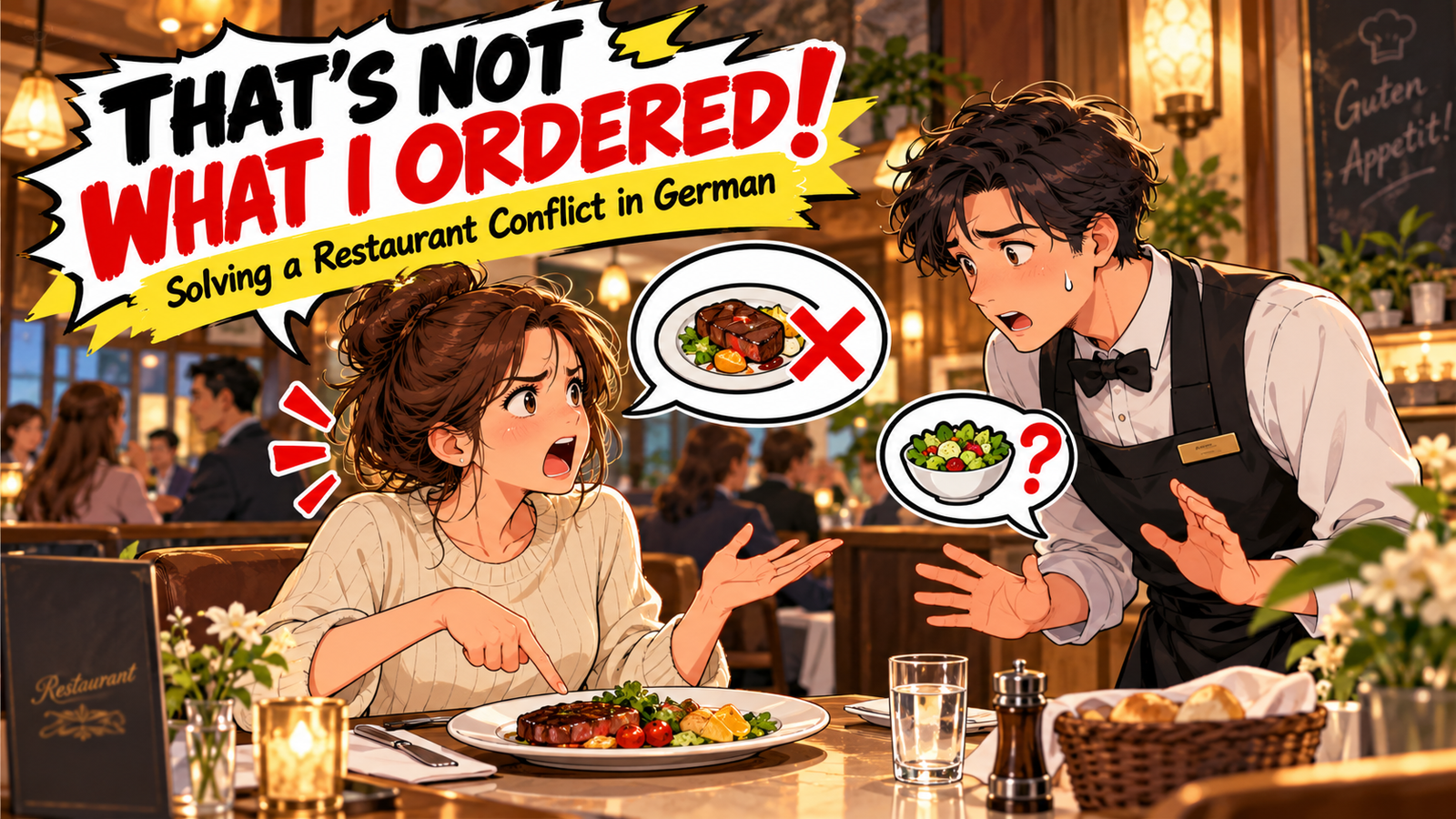
“That’s Not What I Ordered!” — Solving a Restaurant Conflict in German
A restaurant complaint is a useful test of professional German because
the problem is concrete, but the conversation can become emotional very
quickly. A guest orders one dish and receives another. Perhaps a side dish
is missing, an allergy request was misunderstood, or the replacement takes
longer than expected. The waiter has to understand the complaint, avoid
arguing, clarify what was ordered, offer a realistic solution, and close
the interaction professionally.
In this lesson I practice the same
professional skill across the full CEFR range, but I do not simply make one
dialogue longer. Every level is a complete scene with its own beginning,
conflict, response, resolution, and closing. The communicative task
develops with the learner’s German.
A1 — Identify the problem and
respond simply
At A1, I need short sentences I can retrieve
immediately: „Das ist nicht meine Suppe.“,
„Entschuldigung.“, „Ich bringe die richtige
Bestellung.“ The goal is not negotiation. It is to recognize a
simple mismatch and respond politely.
A2 — Clarify what happened
and offer a basic solution
At A2, I can ask what the guest ordered,
explain a simple mistake, give an approximate waiting time, and offer a
straightforward alternative. I begin connecting sentences with reasons:
„Es tut mir leid. Die Küche hat die Beilage
verwechselt.“
B1 — Manage a complaint as a
conversation
At B1, the guest can explain why the mistake is
inconvenient, and I can acknowledge that perspective without becoming
defensive. I can summarize the issue, propose options, and confirm what
will happen next. This is where service German starts to sound less
scripted and more genuinely conversational.
B2 — Separate the
complaint from blame
At B2, I need precision. I can acknowledge a
service failure without making unsupported claims about who caused it. I
can distinguish the confirmed facts from what still needs to be checked and
explain realistic options without promising something the kitchen cannot
deliver.
C1 — Protect trust while handling competing
constraints
At C1, the challenge is not only correcting the order.
I may need to address lost time, dietary requirements, a dissatisfied
table, or a guest who no longer trusts the service. I practice transparent
language that recognizes the impact of the mistake while keeping the
conversation solution-oriented.
C2 — Turn a difficult complaint
into structured resolution
At C2, the language becomes
strategically precise. I can distinguish an isolated service error from a
process problem, respond to a broader criticism without dismissing it, and
explain how the restaurant can resolve the immediate complaint while also
learning from the incident.
Across all levels, the principle stays
the same: professional conflict management is not about defeating the guest
in an argument. It is about understanding the concrete issue, communicating
accurately, offering what is realistically possible, and making the next
step unmistakably clear.


Leave a Reply