
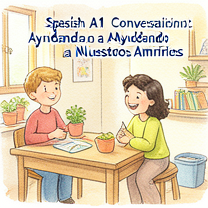
Spanish A1 Conversational: Ayudando a Nuestros Amigos
Starting Your Spanish Journey – Simple Conversations
Learning any new language can seem daunting, but with a focus on practical conversation, achieving fluency in Spanish at the A1 level is entirely possible. The program “Ayudando a Nuestros Amigos” (Helping Our Friends) uses realistic scenarios to teach beginners how to communicate effectively. This article explores key areas and provides useful phrases for building confidence.
Understanding Greetings & Introductions
The first step in any conversation is knowing how to greet someone. Spanish offers several options, depending on the time of day.
- Buenos días – Good morning (until noon)
- Buenas tardes – Good afternoon/Good evening (noon until sunset)
- Buenas noches – Good night/Good evening (after sunset)
A learner might nervously say: “Hola, ¿cómo estás?” (Hello, how are you?). A native speaker would likely respond with “Bien, gracias. ¿Y tú?” (Fine, thank you. And you?) . It’s important to observe and mimic natural responses.
Asking for Basic Information
Simple questions form the backbone of many conversations. Let’s look at some useful phrases:
- ¿Cómo te llamas? – What is your name? (Informal)
- ¿Cómo se llama usted? – What is your name? (Formal – use with elders or strangers)
- De dónde eres? – Where are you from?
- ¿Cuántos años tienes? – How old are you?
A visitor, arriving in a new town might ask: “Perdón, ¿de dónde son ustedes?” (Excuse me, where are you from?). The locals might reply, “Somos de Madrid.” (We’re from Madrid) and then follow up with “¿Y tú?” (And you?)
Useful Phrases for Everyday Situations
Here are some essential phrases a learner can quickly master:
- Por favor – Please
- Gracias – Thank you
- De nada – You’re welcome
- Sí – Yes
- No – No
A shopper might say: “¿Cuánto cuesta esto?” (How much does this cost?). The shopkeeper would respond: “Cuesta cinco euros.” (It costs five euros.)
Common Mistakes & Corrections
Many learners make mistakes when starting. One common error is forgetting the accent mark on words like “está” (is) – it should be “está” not “esta”. Another frequent issue is using the wrong verb conjugations, particularly with ser and estar.
A learner struggling might say: “Yo soy aquí.” (I am here). The correct phrasing would be “Estoy aquí.” The difference stems from knowing when to use ser (for permanent characteristics) and estar (for temporary states or location).
Resources for Continued Learning
“Ayudando a Nuestros Amigos” offers interactive exercises and audio support. Supplementing this with language learning apps like Duolingo, Memrise or Babbel can significantly boost progress. Consistent practice, even just 15-20 minutes a day, will lead to noticeable improvement in conversational Spanish.


Leave a Reply