
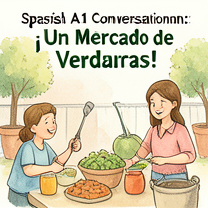
Spanish A1 Conversational: ¡Un Mercado de Verduras!
Getting Started with Market Spanish
Learning a new language can seem daunting, but it doesn’t have to be. A great way for beginners is to focus on practical conversations related to everyday situations. This article focuses on “¡Un Mercado de Verduras!” – A Vegetable Market – offering an excellent opportunity to learn basic Spanish conversation and build confidence.
The Scenario: Entering the Market
Imagine a shopper, Ana, visiting a local vegetable market for the first time. She wants to buy some tomatoes and peppers. The stallholder, Ricardo, is friendly and helpful. Let’s see how a simple exchange might unfold:
Greeting and Asking for Help
Ricardo: “¡Buenos días! ¿Puedo ayudarle?” (Good morning! Can I help you?)
Ana: “Buenos días. Sí, por favor.” (Good morning. Yes, please.)
Explanation: “Buenos días” means “good morning.” “Sí, por favor” translates to “Yes, please,” a crucial phrase for politeness.
Identifying the Products
Ricardo: “¿Qué le interesa?” (What are you interested in?)
Ana: “Quiero tomates y pimientos, por favor.” (I want tomatoes and peppers, please.)
Common Vocabulary:
- tomates – tomatoes
- pimientos – peppers
Asking About the Price
Ana: “¿Cuánto cuesta un tomate?” (How much do a tomato cost?)
Ricardo: “Un kilo de tomates es dos euros.” (A kilo of tomatoes is two euros.)
Important Note: Spanish speakers often use ‘un kilo’ (a kilo) for approximate prices. Don’t worry about exact amounts at this stage.
Dealing with a Minor Mistake
Ana: “¿Un kilo?” (A kilo?) – This is a common mistake! A learner might initially misinterpret the quantity being offered.
Ricardo: “Sí, un kilo. ¿Quiere más?” (Yes, a kilo. Do you want more?)
Correction: It’s better to ask for clarification, like “¿Cuánto cuesta un tomate?” (How much does one tomato cost?).
More Useful Phrases at the Market
- “Gracias” – Thank you
- “De nada” – You’re welcome
- “Perdón” – Excuse me (when asking a question)
- “¿Tiene…?” (Do you have…?) – Example: “¿Tiene cebollas?” (Do you have onions?)
Practicing the Dialogue
A fan of Spanish language learning can practice this dialogue repeatedly. Encourage a learner to say the phrases aloud, first slowly and then with increasing speed. It’s perfectly normal to make mistakes – they are part of the learning process!
Resources for Further Learning
There are many free resources available online, including Duolingo, Memrise, and YouTube channels dedicated to Spanish conversation.
Conclusion
“¡Un Mercado de Verduras!” offers a simple yet effective way to start learning conversational Spanish. Focusing on basic greetings, asking for prices, and expressing needs builds confidence and creates a positive foundation for further language acquisition. ¡Buena suerte! (Good luck!)


Leave a Reply