
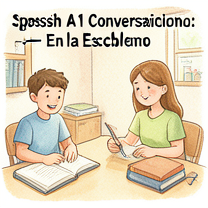
Spanish A1 Conversational: En la Escuela – Un Problema
Starting Your Spanish Journey with a Classroom Challenge
Learning any new language can feel overwhelming at first. A learner starting with basic conversational Spanish, specifically focusing on scenarios like school life, often encounters frustrating moments. One common issue for a student, let’s call him Miguel, is asking for help with his homework – and doing it effectively.
The Situation: Miguel’s Homework Struggle
Miguel is in his first year of Spanish at the local community center. He finds understanding the instructions difficult, particularly when given by his teacher, Señora Rodriguez. He often approaches her after class wanting clarification, but the interactions are awkward and unproductive. This article explores how a learner can approach these situations positively using basic Spanish phrases.
Key Phrases for Asking for Help
Here’s some essential vocabulary and phrases that Miguel (and any new learner) could use:
- Perdón, Señora Rodriguez: (Excuse me, Ms. Rodriguez) – Used to get someone’s attention politely.
- No entiendo. (I don’t understand.) – A simple and essential phrase.
- ¿Puede repetir, por favor? (Can you repeat, please?) – A polite request for clarification.
- ¿Me lo puede explicar de nuevo? (Can you explain it to me again?) – More direct, but still respectful.
- No sé cómo hacer esto. (I don’t know how to do this.) – Useful when facing a specific task.
A Typical Dialogue: A Problem Arises
Let’s imagine a scene after class:
Miguel: Perdón, Señora Rodriguez. No entiendo el ejercicio número tres.
(Excuse me, Ms. Rodriguez. I don’t understand exercise number three.)
Señora Rodriguez: ¿Qué es lo que no entiende? Dime. (What is it that you don’t understand? Tell me.)
Miguel: No sé cómo sumar estos números. ¿Me lo puede explicar de nuevo?
(I don’t know how to add these numbers. Can you explain it to me again?)
Señora Rodriguez: Vale, Miguel. Mira… (Okay, Miguel. Look…) – She then explains the problem step-by-step.
Common Mistakes and Corrections
A learner often makes mistakes with pronunciation or overusing overly complex sentences. Here are a few common issues:
- Overcomplicating requests: A student might say “¿Podría, por favor, me explicarlo de forma más sencilla?” (Could you, please, explain it to me in a simpler way?) – This is perfectly acceptable, but for an A1 learner, “No entiendo. ¿Puede repetir, por favor?” is much more effective and natural.
- Hesitation: Sometimes, a learner avoids asking questions because they are afraid of looking foolish. It’s crucial to realize that Señora Rodriguez wants to help!
- Incorrect verb conjugation: Miguel initially says “¿Cómo hacer esto?” (How to do this?). The correct form is “No sé cómo hacer esto.” (I don’t know how to do this.) – This small detail significantly improves clarity.
Tips for Effective Communication
Here are some helpful tips for any learner in a similar situation:
- Be specific: Instead of saying “I don’t understand anything,” be clear about which part you find difficult.
- Ask follow-up questions: If Señora Rodriguez explains something, ask further questions to ensure understanding. “¿Qué significa…?” (What does… mean?).
- Listen carefully: Pay close attention to Señora Rodriguez’s responses and repeat key phrases if necessary.
By using these simple Spanish phrases and following these tips, Miguel – and anyone starting their Spanish journey – can navigate classroom challenges with confidence and improve their communication skills.


Leave a Reply