
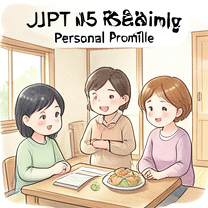
Learning Japanese Through the JLPT N5: Understanding a Simple Personal Profile
The JLPT (Japanese Language Proficiency Test) has five levels – N5 being the most basic. Passing the N5 demonstrates you can understand and use very simple Japanese in everyday situations. This article focuses on practicing your reading skills by analyzing a realistic personal profile, something you might encounter when starting to meet people or do simple transactions.
The Profile: Let’s Meet Hana!
Below is a short dialogue and some accompanying text. We’ll break down each part to help you understand it. This example reflects common introductory exchanges and phrasing seen at the N5 level.
Dialogue:
山田さん、こんにちは! (Yamada-san, konnichiwa!)
どうぞよろしくお願いいたします。 (Douzo yoroshiku onegaishimasu.)
あなたはどちらのご出身ですか? (Anata wa dochira no go shusshin desu ka?)
私はハナです。京都から来ました。 (Watashi wa Hana desu. Kyoto kara kimashita.)
趣味は読書です。(Shumi wa dokushou desu.)
Translation:
- 山田さん、こんにちは! (Yamada-san, konnichiwa!) – Mr./Ms. Yamada, hello!
- どうぞよろしくお願いいたします。 (Douzo yoroshiku onegaishimasu.) – Pleased to meet you. (A very polite and common phrase)
- あなたはどちらのご出身ですか? (Anata wa dochira no go shusshin desu ka?) – Where are you from?
- 私はハナです。 (Watashi wa Hana desu.) – I am Hana.
- 京都から来ました。(Kyoto kara kimashita.) – I came from Kyoto.
- 趣味は読書です。(Shumi wa dokushou desu.) – My hobby is reading.
Key Vocabulary & Phrases
Let’s break down the vocabulary and phrases you’ll encounter:
- さん (san): A polite suffix added to names. (Yamada-san)
- こんにちは (konnichiwa): Hello (used during the day).
- どうぞよろしくお願いいたします。 (Douzo yoroshiku onegaishimasu.): A standard greeting when meeting someone for the first time; a complex phrase meaning something like “Please treat me well.” Don’t worry about perfectly understanding it immediately – just learning to recognize and say it is a great start.
- どちら (dochira): Which, where.
- ご出身 (go shusshin): Origin; birthplace (formal way of saying “where are you from”). The ‘ご’ is another polite prefix.
- 来ました (kimashita): Came. Past tense of the verb “to come.”
- 趣味 (shumi): Hobby.
- 読書 (dokushou): Reading (as a hobby).
Common Mistakes & Corrections
Many beginners make mistakes with sentence structure and polite phrases. Here’s a common one:
- Incorrect: 私はハナです。京都で来ました。(Watashi wa Hana desu. Kyoto de kimashita.) – This sounds slightly unnatural.
- Correct: 私はハナです。京都から来ました。(Watashi wa Hana desu. Kyoto kara kimashita.) – Using ‘kara’ (from) is more natural for indicating origin.
Putting It All Together
This simple dialogue illustrates the kind of communication you’ll encounter at the N5 level. Focus on recognizing the phrases, understanding the basic sentence structure (subject-object-verb), and learning the common vocabulary. Practice reading similar short exchanges to build your confidence and fluency.
To continue your practice, look for more simple conversations online or in beginner Japanese textbooks. Good luck!


Leave a Reply