
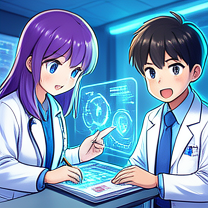
My Struggle with the TELC B1.2 Writing Exam – And Why I’m Obsessed with Doctors and Computers
Okay, so this is going to sound a bit…weird, but I’m writing about my attempt at the TELC B1.2 Writing exam. Honestly, it felt less like an exam and more like a deep dive into a slightly terrifying, yet fascinating, conversation with my Doktor in Munich. The prompt was: Discuss AI in Medical Diagnosis. I’d been struggling with the German writing for weeks, feeling constantly overwhelmed, and this particular task just seemed…important. It felt relevant to everything – my new job at the Sprachschule, seeing patients in the clinic where my wife works, even arguing with my Oma about whether technology is replacing real human connection.
First Contact: The Initial Panic
The first hurdle was just writing anything! I spent a whole evening staring at the blank page and muttering “Ich weiß nicht!” (I don’t know!) to myself. My German teacher, Herr Schmidt, kept saying “Versuch es einfach!” (Just try!), but that felt incredibly useless when my brain was full of fragmented thoughts about algorithms and medical scans. I started drafting a ridiculously long sentence about the potential of AI in identifying early signs of illness – completely overthinking it, as always. It ended up sounding like something out of a science fiction film!
I remembered our conversation last week with Frau Müller at the clinic. She was explaining how they use software to analyse X-rays for fractures, and I realised that’s exactly what I needed to talk about – in German! “Das ist ein guter Ansatz,” (That’s a good approach) she’d said when I explained my initial idea.
Talking About It – The First Conversation
I decided to try talking through it with a friend, Thomas, who works as a technician in a hospital near his flat. “Thomas, ich schreibe jetzt für die Prüfung über KI und die Diagnose von Krankheiten,” (I’m writing for the exam about AI and disease diagnosis). “Es ist so schwierig! Wie erklärst du das?” (It’s so difficult! How do you explain it?)
He chuckled, “Na klar, natürlich! Denk an die Röntgentechnik. Die KI kann viel schneller und genauer Probleme erkennen als ein Mensch. Aber…,” he paused, “es ersetzt den Arzt nicht! Der Arzt muss immer noch entscheiden.” (Of course, of course! Think about the X-ray technology. The AI can recognize problems much faster and more accurately than a human. But… it doesn’t replace the doctor! The doctor still needs to make the decision.)
We debated for almost an hour, using phrases like “Es könnte helfen” (It could help), “Aber was ist mit den Fehlern?” (But what about the mistakes?), and “Ich bin mir nicht sicher” (I’m not sure). He helped me formulate some more natural sentences. Learning how to use “aber” (but) properly feels so crucial – I kept forgetting to connect my thoughts smoothly!
My Attempted Essay – And The Mistakes
Okay, here’s a slightly embarrassing snippet of what I actually wrote (after Thomas’s help):
“Die künstliche Intelligenz kann in der medizinischen Diagnose eine wichtige Rolle spielen. Sie kann Bilder analysieren und schneller Fehler erkennen als ein Mensch. Es ist gut für die Effizienz, aber ich finde es auch ein bisschen beängstigend. Was passiert, wenn die KI einen Fehler macht? Wer ist dann verantwortlich? Ich denke, die KI sollte nur helfen, aber der Arzt muss immer noch das letzte Wort haben. Es ist wichtig, dass wir vertrauen können und dass die KI sicher ist.” (Artificial intelligence can play an important role in medical diagnosis. It can analyze images and recognize errors faster than a human. It’s good for efficiency, but I also find it a bit frightening. What happens if the AI makes a mistake? Who is then responsible? I think the AI should only help, but the doctor still has to have the final word. It’s important that we can trust it and that the AI is safe.)
Looking back, it’s clunky! I used too many formal phrases like “Es ist wichtig” (It’s important). Thomas pointed out I wasn’t using enough conversational German – things people actually say when discussing this. He suggested adding a personal touch: “Wie sehen Sie das? Finden Sie es auch beängstigend?” (What do you think about that? Do you find it frightening too?).
Vocabulary and Useful Phrases – What I Learned
Here are some key phrases I picked up that really helped, specifically for this topic:
- “Das ist doch logisch!” (That makes sense!) – Perfect for agreeing with someone’s point.
- “Ich verstehe nicht ganz.” (I don’t quite understand.) – Useful when you need clarification.
- “Was meinst du damit?” (What do you mean by that?) – Great for probing deeper into a conversation.
- “Das ist eine gute Frage!” (That’s a good question!) – For acknowledging the importance of a question.
- “Es kommt darauf an…”(It depends on…) – useful when discussing different scenarios.
Moving Forward – My Plan
I realized this wasn’t just about passing an exam; it was about really understanding how to discuss complex topics in German, like healthcare and technology. I need to focus on listening more actively to native speakers (which is easier said than done!). I’m planning to read more articles about medicine and AI – even if I have to look up every single word at first! And I’m going to keep talking to Thomas – he’s a lifesaver.
The next time I encounter the prompt “discuss…”, I know I’ll be ready, not just with my textbook, but with a little bit of real-world experience and a whole lot more confidence. “Ich glaube, ich schaffe das!” (I think I can do it!).

Leave a Reply