
My German Journey: Tackling the B1.2 Presentation
Okay, deep breaths. Moving to Germany has been… intense. The language, the culture, everything is different. I’m still very much a newcomer, trying to navigate daily life, and honestly, I feel a bit overwhelmed sometimes. But I’m determined to improve my German, and right now, my focus is on reaching the TELC B1.2 level – specifically, the Bildbeschreibung (image description) section. It feels like a really practical step, and I’m starting to see how it’s actually helping me communicate better.
The Scenario: The Project Presentation
Yesterday, my team at the marketing agency (where I’m working as a copywriter – Kopitch) asked me to present a new campaign idea. It was terrifying! I spent ages preparing, and when I started talking, I realized I was stumbling over my words, struggling to get my points across clearly. It was a real wake-up call. The image description exam is, in a way, practicing this kind of scenario.
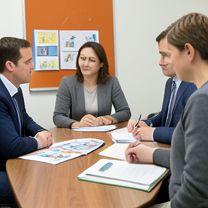
The image was a young woman, probably around 28 or 30, standing confidently in front of a group of colleagues. She was holding a digital tablet, pointing to a chart on the wall, and her expression was one of conviction. She looked professional, but also approachable. It immediately made me think: “This is what I need to learn to do!”
Understanding the Details – German Phrases for Observation
The Bildbeschreibung part of the exam asks you to describe what you see in an image. I’ve started to learn specific phrases that are incredibly useful. For example, instead of just saying “a woman,” I can say:
- “Es ist eine junge Frau.” (It’s a young woman.) – This is a basic, but crucial, sentence.
- “Sie steht vor einer Gruppe von Kollegen.” (She is standing in front of a group of colleagues.) – I actually needed this one a lot when describing the presentation!
- “Sie hält ein Tablet in der Hand.” (She is holding a tablet in her hand.) – Very helpful for describing technology.
- “Sie zeigt auf einen Bildschirm.” (She is pointing at a screen.) – Essential for anything visual.
- “Ihr Gesichtsausdruck ist selbstbewusst.” (Her facial expression is confident.) – This is important for conveying nuance.
I’ve been practicing saying these out loud, and even writing them down. It makes them feel more natural, less like a foreign language rattling around in my head.
A Realistic Dialogue (with Mistakes!)
After the presentation (which, let’s be honest, wasn’t perfect!), my colleague, Steven, came over. He’s really good at German, and I asked him for some feedback.
“Wie war deine Präsentation?” (How was your presentation?) he asked.
I mumbled, “Es war… schwierig. Ich habe mich etwas verloren gefühlt. Ich konnte mich nicht gut ausdrücken.” (It was… difficult. I felt a bit lost. I couldn’t express myself well.)
Steven gently corrected me: “Nein, nein! Du hast es sehr gut gemacht! Aber vielleicht solltest du mehr Pausen machen und deine Sätze kürzer halten. Und versuche, ‘sich ausdrücken’ nicht so oft zu sagen.” (No, no! You did very well! But maybe you should take more pauses and keep your sentences shorter. And try not to say ‘sich ausdrücken’ so often.)
I felt my face turn red. It’s so embarrassing when you make mistakes, especially in front of native speakers! But Steven was really kind, and I appreciated the advice. It highlighted that I need to focus on clarity and simplicity.
Vocabulary Boost: Key Words for Presentations
Beyond the basic phrases, I’ve been building my vocabulary related to presentations and business. Here are a few words and phrases I’m actively using:
- die Präsentation: (the presentation) – Obviously!
- die Zielgruppe: (the target audience) – I need to think about who I’m talking to.
- die Kernaussage: (the main message) – What’s the core of my idea?
- die Argumentation: (the argument) – How do I support my idea?
- die Zusammenfassung: (the summary) – Always good to have a quick recap.
- “Ich möchte….” (I would like to…) – A polite way to introduce your proposal.
My Next Steps
I’m planning to practice describing images a few times a week. I’ve found some online resources that show images and ask you to describe them. I’m also going to focus on recording myself speaking German and listening back – it’s a really uncomfortable but valuable exercise! And I’m determined to keep having conversations with Steven and other native speakers, even if I stumble over my words. The Bildbeschreibung exam feels like a crucial step, not just for my TELC certification, but for building my confidence and fluency in German. I think I’m finally starting to understand that learning a language isn’t just about grammar rules; it’s about being able to communicate effectively, and that’s a goal worth striving for. Ich glaube, ich mache Fortschritte! (I think I’m making progress!)


Leave a Reply